
Mint Mark, Vitruvian Farms, Ramp Sausage
Season 16 Episode 8 | 26m 56sVideo has Closed Captions
Chef Sean Pharr cooks seasonal, modern Midwest flavors at Madison’s Mint Mark.
At Mint Mark in Madison, Chef Sean Pharr demonstrates how seasonally-driven cooking comes together. He showcases foraging-level relationships with Vitruvian Farms, crafts next-level ramp sausage and cooks with insanely gorgeous oyster mushrooms. Watch how Pharr uses peak Midwest ingredients to craft simple, expressive plates.
Problems playing video? | Closed Captioning Feedback
Problems playing video? | Closed Captioning Feedback
Wisconsin Foodie is a local public television program presented by PBS Wisconsin
Mint Mark, Vitruvian Farms, Ramp Sausage
Season 16 Episode 8 | 26m 56sVideo has Closed Captions
At Mint Mark in Madison, Chef Sean Pharr demonstrates how seasonally-driven cooking comes together. He showcases foraging-level relationships with Vitruvian Farms, crafts next-level ramp sausage and cooks with insanely gorgeous oyster mushrooms. Watch how Pharr uses peak Midwest ingredients to craft simple, expressive plates.
Problems playing video? | Closed Captioning Feedback
How to Watch Wisconsin Foodie
Wisconsin Foodie is available to stream on pbs.org and the free PBS App, available on iPhone, Apple TV, Android TV, Android smartphones, Amazon Fire TV, Amazon Fire Tablet, Roku, Samsung Smart TV, and Vizio.
Providing Support for PBS.org
Learn Moreabout PBS online sponsorship- Luke Zahm: This week on Wisconsin Foodie: - Sean Pharr: Mint Mark is a small plates restaurant focusing on locally-grown produce and product.
Having strong relationships with farmers is really important to me.
One that we've really started partnering up with a lot is Vitruvian Farms.
Tommy and the rest of the team at Vitruvian have been growing certain things for us and, like, giving me calls when he's like, "Hey, "you know, the oyster mushrooms right now "are looking incredible.
Can you do something with them?"
- Tommy Stauffer: All right, Sean, we are entering our mushroom fruiting chamber.
This is for our oyster mushrooms, which I believe you said you needed for your recipe.
So, we are gonna harvest some today.
- Sean: Holy smokes!
- Luke: Sean Pharr!
- Sean: I think one of the best things about living in this area is the fact that there is this abundance of fresh produce and great dairy and really great proteins all around.
- Luke: The mushrooms, the ramps, the black garlic, and it's got, like, this really strong body of those grits behind it.
This is amazing.
Wisconsin Foodie would like to thank the following underwriters.
[upbeat music] - Did you know Organic Valley protects over 400,000 acres of organic farmland?
So, are we an organic food cooperative that protects land, or land conservationists who make delicious food?
Yes; yes, we are.
Organic Valley.
- Wisconsin is known for some pretty great things, like football, food, and family.
At Jones Dairy Farm, we're proud to be a Wisconsin company, one that's been family-owned and operated in Fort Atkinson.
Jones: Making mealtime better since 1889.
- The Wisconsin potato and vegetable growers are proud underwriters of Wisconsin Foodie.
It takes love of the land and generations of farming know-how to nurture a quality potato crop.
Ask any potato farmer and they'll tell you, there's a lot of satisfaction in healthy-grown crops.
- Employee-owned New Glarus Brewing Company has been brewing and bottling beer for their friends, only in Wisconsin, since 1993.
Just a short drive from Madison, come visit Swissconsin and see where your beer's made.
- With additional support coming from The Conscious Carnivore.
From local animal sourcing to on-site, high-quality butchering and packaging, The Conscious Carnivore can ensure organically raised, grass-fed, and healthy meats through its small group of local farmers.
The Conscious Carnivore: Know your farmer, love your butcher.
Also with the support of the Friends of PBS Wisconsin.
[upbeat music] - Luke: We are a collection of the finest farmers, food producers, and chefs on the planet.
We are a merging of cultures and ideas, shaped by this land.
[brats sizzle] We are a gathering of the waters, and together, we shape a new identity to carry us into the future.
[glasses clink] We are storytellers.
We are Wisconsin Foodie.
[groovy music] You might be asking yourself why we're starting today in a parking garage.
Well, this is the entrance to the new Mint Mark.
Chef and owner Sean Pharr and I have a lot in common.
We both grew up in rural communities in Wisconsin, left the state briefly, and then came back to work on our craft and really embody what it means to cook Wisconsin food.
I'm so excited to see his take on springtime ingredients, and hopefully, we get a chance to peek behind the curtain and see where he sources some of his delicious food.
- All right, looking for one pork roast, one fig, one mortadella.
Sausage and an asparagus, oui?
Hi, there, my name is Sean Pharr.
I am the owner of Mint Mark in Madison, Wisconsin.
Mint Mark is a small plates restaurant focusing on locally-grown produce and product that operates in a seasonal format with a constantly changing menu.
Fire rigatoni, marinara pizza.
Well, a long time ago, when I was living in New London, Wisconsin, I worked at a pizzeria called Jolly Roger's.
At the time, I wasn't really aware that cooking was something that I was doing and loving, and I went on to pursue music.
And it was through music that I discovered that I needed something in my life that resulted in faster results, more tangible results, which led me back into the kitchen, to which I discovered that this is where I need to be.
I ended up doing an internship at Harvest, which led me to cook in Madison for three years, then eventually moved to Chicago for ten years to cut my teeth and become the chef that I am today.
Today, we are working with the elite team of sous-chef Lane.
We got Nick back there on large plates.
On pizzas, we got Diego, and on hot apps, we got Sean Fox.
And we got Daphne on garde manger down there.
My philosophy in cooking is really the "keep it simple, stupid" method.
Over the years, I just kind of felt, like, more of an Italian intent in cooking is where my heart lies.
Taking something local and seasonal and really trying not to mess it up.
Like, don't screw up with the farmers did for you.
Just treat it with respect.
Handle it lightly and it should work for you on the plate.
Having strong relationships with farmers is really important to me.
One that we've really started partnering up with a lot is Vitruvian Farms.
Tommy and the rest of the team at Vitruvian have been growing certain things for us and, like, giving me calls when he's like, "Hey, "you know, the oyster mushrooms right now "are looking incredible.
Can you do something with them?"
And it's moments like that where I get a call from a farmer saying, like, "Hey, "this is at its top.
What can you do with it?"
And their trust in Mint Mark to take their product and move it forward in a delicious agenda has become a really, really great relationship.
Right here on this plate, we have some of the most beautiful mushrooms from Vitruvian.
This is what Mint Mark represents: fresh, simple, fantastic.
I think one of the best things about living in this area is the fact that there is this abundance of fresh produce and great dairy and really great proteins all around.
You know, Madison is lucky to have such a diverse food scene for being, you know, just locked in the Midwest.
We're surrounded by some of the greatest farms in the country.
And now that more chefs are utilizing that, unlike 15, you know, years ago, where it really wasn't something people were focusing on, the food scene in Madison is as good as anywhere I can really think.
Having cut my teeth cooking in Madison and being introduced to many of the farmers at an early point led me to some incredible moments and incredible people that I now absolutely cherish working with.
Right now, I'm gonna drive out to Vitruvian and pick up some mushrooms for the restaurant.
Just everything that they're doing, you can tell that they care so much about.
And, again, it's just, it's something that makes my job easier, by getting a product that is already, like, something that could just be put on a plate.
- Tommy: My name is Tommy.
I am one of the owners here at Vitruvian Farms.
I co-own the farm with Sean Kuhn.
We are entering our 15th year here in McFarland.
We are a certified organic vegetable and mushroom farm.
We are a really diverse farm in not only what we grow, but how we get our produce to people.
Really, what we're trying to do is grow the highest-quality product, taking techniques that have been long practiced and in many ways reintroduced on this small-medium farm concept.
And when we get to interact and work with the chefs in our area, you know, what I always think of is creating a friendship, a partnership, and not just a buyer-seller relationship.
So, you know, for me, someone like Sean at Mint Mark, I like to see him more as a friend than just someone who buys produce from us.
And I think that builds community and that builds stability for the relationship.
And, you know, in the end, what we're trying to do here is all based off of having those relationships and building those for the long term.
- Tommy?
- Sean, how are you?
- Good, how are you?
- Good to see you.
- Good to see you.
- Thanks for coming out.
I hear you need mushrooms.
- Yeah, I do.
- All right.
- I need quite a few of them.
- Well, I think you should help me harvest them.
- Yes, let's do this.
- All right, come on.
- All right.
[gentle music] - Tommy: All right, Sean, we are entering our mushroom fruiting chamber.
This is for our oyster mushrooms, which I believe you said you needed for your recipe.
So, we are gonna harvest some today.
- Holy smokes!
- Come on in.
What you're seeing in here is just oyster mushrooms at different stages of fruiting.
So, everything in here is gonna be harvested within the next week.
So, they grow incredibly fast.
And believe it or not, this room alone produces well over 300 pounds of mushrooms per week.
- Whew, that's incredible, that's incredible.
Well, we'll take 'em all.
- Well, I am happy to make that happen.
[Sean laughs] So, let's get to harvesting.
So, what's cool about oyster is, they are incredibly easy to harvest.
You don't have to cut 'em.
You literally just pop them off.
I'm just gonna jiggle it around a little bit.
And like that, you feel a release, and the entire cluster pops off in one go.
- Sean: Holy smokes.
- Tommy: Yeah, you wanna try?
Get your hands in there and just kind of feel it around, and pop it off.
- Sean: All right, let's get in there.
- Tommy: Yeah, just kind of feel that pop.
Keep going, there we go.
Pretty beautiful, huh?
- It's amazing.
I mean, it's one of the most beautiful products you can see.
Just look how velvety.
- Tommy: It feels like an art piece.
And you almost wanna frame this and put it on your wall.
- Sean: I do.
- Tommy: But, instead, you're gonna cook with it.
- Sean: Yeah.
- Mushrooms for me is where-- kind of where science meets art.
You know, it's the science of knowing how these things need to grow, the food it needs, the conditions it needs.
But the art of knowing, like, how to get that perfectly beautiful mushroom.
- Sure.
- And when it's ready, you know, you look in here and you're like, "Man, this is just-- These are art pieces."
And I think it's something we've spent a lot of time getting to, but, you know, when I come in here, I've been doing this for years, and I still walk in here and I'm still like, "Whoa," every time.
- It's incredible.
- Tommy: And as you can see, the misters just came on.
- Yeah, this is what it's like to be in a produce section, being lettuce, right?
- In essence, imagine we've basically created artificial caves.
You know, it's 55 to 60 degrees in here.
It's 80% to 90% humidity.
And that's what mushrooms need to grow.
And then the light is here.
Mushrooms are phototropic, which just means that they need light to know which way to grow.
They don't need it for any sort of fuel.
But then, we provide the light, so then they know to grow upward.
- Amazing.
- Yeah.
- You really are a fun-gi to know.
- Dude, likewise.
The feeling is mutual.
Well, while we're here, I might as well show you another grow room, the shiitake room.
- Sean: Let's check it out.
- Come on in.
Very similar space, but obviously you can smell the difference.
Kind of smells almost like lightly cooked sawdust.
- Sean: [exhales] It's incredible.
- Tommy: Part of that is because all of these bags are open.
Where we try to focus the production of oyster to one specific location to develop that big cluster, shiitake don't do that.
They produce-- Each cap has its own stem.
And once again, what you're seeing in here is about almost 300 pounds of production per week.
- Sean: Okay.
- Tommy: And yeah, these, these we actually cut one mushroom at a time.
- Sean: Absolutely fantastic.
- Tommy: Yeah.
[Sean sniffs] Tommy: Yeah.
- Holy smokes.
- And the demand and the excitement around mushrooms is just skyrocketing.
And that's, honestly, thanks to people like you and restaurants saying, "I'm not gonna have that singular mushroom dish, "but mushrooms are gonna be incorporated throughout the menu."
- Yeah, absolutely.
- "This meat dish will have mushrooms.
This vegetable dish will have..." It's not the mushroom vegetarian dish.
It's now, mushrooms are a staple ingredient.
- Sean: Yeah, they are.
- Tommy: That, all of a sudden, changes shoppers here.
They start saying, "Oh, I've had that mushroom, I love it."
And, you know, it's been really great for us.
And I also think it's just really good for humanity to eat more mushrooms.
- Absolutely, I agree.
- Yeah.
- Tommy: I love it in here, but let's get back to the store.
- Sean: All right.
Tommy, thank you so much for these mushrooms.
Thank you so much for showing me how they're all grown.
This is crazy.
They're beautiful.
I mean, they are a standout item on Mint Mark's menu.
I've got an idea for a ramp sausage dish with these bad boys that I'm gonna make today.
- Awesome.
Well, thank you for coming out.
Thanks for supporting our farm and all the farms in Wisconsin.
It means a lot.
I'm excited to try the dish, and good luck tonight, so... - Thanks, brother.
- I'll walk you out.
- All right, sounds good, my man, thank you.
[gentle music] - Sean Pharr!
- Luke Zahm!
- What's up?
- There's my man.
Good to see you.
- Good to see you too.
Looking good, brother.
- What are we working on today?
- Well, Luke, you're right on time.
It's ramp season, baby.
- Yeah!
- Right, right?
So today, what I wanna do with you is, one of the things I put on the menu every spring is a version of ramp sausage.
Sausage, to me, is one of the more nobler meats you can put on a menu.
There's a ton of technique and tradition that goes with it.
And there's a lot of ways in which people fail at it.
And I wanna show you how not to fail.
- That's great.
I'm always looking for life hacks into not failing.
- Sean: Should we make some sausage?
- Luke: Let's make some sausage.
- Sean: Let's grind.
- Oh, you got it all set up, look at you.
- Yeah, we're all set.
Everything's at a proper temperature, super icy-cold.
That's one of the most important things about a sausage.
- Why?
- Rendering fat.
This is metal on metal.
- Mm-hmm.
- It's gonna create heat right off the bat.
- Sure.
- What's gonna happen is, this fat is going to start rendering if everything's too hot.
So, I've already had these iced down, ready to roll for us.
The pork has been super cold and ready to go.
I've got ice water for helping the emulsification.
So, this is a sausage, again, I make every year.
I love, I love ramp sausage.
It's simple to me.
- Luke: Mm-hmm.
- Sean: It's pork, it's mace, a little bit of black pepper, and some salt, and that's it.
And we're gonna pound a bunch of raw ramp leaves in there.
- Luke: Oh, that's great.
[gentle music] [laughs] Yeah, exactly.
All right.
- Sean: All right, so, some things that I've learned is that the milk crate is your friend.
- Sure.
- I'm gonna invite you to join me on this one.
- Okay.
- When you're whipping sausage, you leg up.
- Luke: Right leg or left leg, is there a preference?
- Sean: Well, it's typically right so we're facing the camera.
- Luke: Yeah, hips open.
- But often, when I don't feel like talking to people, a left leg up there.
- Is this a good look for you, Art?
[Arthur laughs] - Okay, so what we're looking for right now is, you see how we've got the grind of the meat moving around.
But what we're looking for is the myosin to start.
- Sure.
- Sean: And it's gonna look like little, like, shreds being stuck to the side of the bowl.
- We're looking for, like, little wispies, almost, like, that protein structure kind of coming together.
- And you can see it starting to form now.
There's, like, little white flecks sticking to the side of the bowl.
- Sure.
- Sean: So you can see how it's all kind of starting to stick to the side.
- Luke: Mm-hmm.
- Sean: We're gonna kick it to one again.
And we're gonna drizzle in a little water.
And watch as it, like, pulls away from the bowl, that it almost cleans itself off.
- Luke: Sure.
-Sean: You're trying to get water in between fat.
- Luke: Sure.
- How's the stance for you, good?
- I feel good, I feel great.
- Comfy, right?
Milk crates are one of the greatest things to happen to a kitchen.
- Seriously.
- Unless they don't pick 'em up.
- Unless they don't pick 'em up, yeah.
I also, early on in my career, way different era of cooking, I watched a chef kick out the milk crate from someone sitting on it doing prep.
- Yeah, nice.
- Dark moment.
[both laugh] - All right, and, see, it all came back together again.
- Yep.
- It's sticking on the sides.
And that's about it right there.
That's all we got to do.
- So, basically, what you're looking for in that adding the ice water is the emulsification to basically loosen in the beginning when it's cold and then whip itself back together.
That tells you that the myosin is really working with the fat in that sausage to give you that creamy, luxurious emulsification.
- Absolutely, and it sticks together when it's cooking.
- Sure.
- And you can actually, like, when you try to pull the raw farce apart, it almost does, like, you know, like, when you're looking at gluten strands in a dough?
It's harder to pull apart like that.
- Luke: Mm-hmm.
- Sean: If it's not emulsified, it'll come apart right away because it's already broken, it's already slicked up by rendered fat.
- Sure, okay, all right.
- So, from this point, we're gonna move over to stuffing.
- Luke: I love this part.
- I do too.
So, I really enjoy this part of it.
Again, it's like, one of those things where I've known if I've done a good job or if I screwed up.
All right, so now we're just gonna load up the tube.
- Luke: I tip your tube for you.
- Tip my tube.
Fire in the hole.
- Luke: Fire in the hole.
- I tipped tubes with Sean Pharr.
That's a T-shirt.
All right, so we're all loaded in.
- We packed the farce into the tube.
We use the quick crank to get it down there.
So, first, you get some air bubbles, a little juice.
Now, this is an important part right here.
- Luke: Okay.
- So, it started coming out.
And this is when you get to start having the power to restrict how it goes.
- Luke: Sure.
- I often tell cooks to keep one finger on the tube and the other three on the farce and the casing coming out.
And you should be able to feel how full the casing is getting.
If you overstuff it, it's gonna pop.
If you understuff it, it's gonna look pretty gnar.
- Luke: Yeah.
- Sean: So, here we are.
And if you wanna give it a squeeze, you can feel that there's room to move, right?
'Cause inevitably, we're gonna-- Eventually, we're gonna twist these into links.
And if they're too tight, it's gonna pop.
[crank squeaks] Hopefully we can edit that squeak out.
- Fix it in post.
[both laugh] [Luke imitates squeaking] - Oh, there we are.
- Done.
- We did it, we really did it.
- Cool.
We did it.
- Sean: We did it.
- Luke: Look at this.
- Sean: Here we are.
So, here's where we start it.
You can see it's in there kind of loose.
I'm just gonna back it in there.
One mistake people make often is tying off the casing before they start stuffing.
What that does is pocket air, and it doesn't allow you to, like, work with it after it's off the machine.
- Luke: Sure.
- Sean: Start by twisting a knot.
Just a simple once-through.
- Luke: Nice.
- Sean: Yep.
And then you got your size of a brat, you know?
-Luke: Yeah, the brat.
- Sean: You line it up with the next one to know where you're at.
So, there's a couple different ways you can go about this.
You can spin this way, link the next one, and spin the opposite way so it doesn't go.
- Luke: Right.
- Sean: Or you can do what I like to do.
Match it up, and go to the next one, and always spin the same way.
- Luke: Okay.
- Sean: 'Cause then you're not having to remember which way you're going.
- Luke: It's a necklace made out of meat.
[chuckles] - Okay, so we've got all these kind of rabbit-eared out.
What I'm gonna do now, I'm gonna slide through and start linking up like this.
And boom!
- Luke: Man, you're making meat magic over here.
- Sean: Meat magic.
And then, by the end of it, what you're left with... - Look at that.
- It's a great little tri-link.
Except for that part I-- There we go.
That's the smiley face.
I'm available for most birthday parties.
[Luke laughs] - "Hey, kids!
Who wants to make a sausage?"
- [high-pitched voice] "I do!"
Now, we're gonna grab the sausage pricking tool.
You don't have to do a ton of it to each sausage, but enough where while it rests, these little air pockets will go away.
If you're gonna smoke the sausage, I recommend doing it pretty heavily.
It allows that-- I mean, the smoke's gonna collect on the casing 'cause it's formed a pellicle from drying overnight.
But also, the holes allow the smoke to penetrate into the farce a little further.
So, we're gonna rack these up.
We're gonna let 'em cool in the cooler overnight, open, so the air can get to 'em.
And then the next day, there's a couple ways we can go about it.
We can cold smoke them, like Chef Casey is doing on the menu right now, and then steam them for a little bit.
For these, I just steamed a few for us to do.
We're gonna put together a little dish.
- Luke: Great!
- Sean: A little bit of, some grits, some ramp greens, turnip greens, and mushrooms.
And yeah, I've got this cool black garlic emulsification that I worked on today.
I was inspired by my friend Tatum's marble pavlova she does in Chicago.
- Luke: Sure.
- So, I was like, "Why can't a good old boy like me do that to grits?"
[Luke laughs] - And look at you now.
- And look at me now.
[Luke laughs] [bright music] - Luke: Oh, man.
- Sean: All right, my dude.
- Sean.
- The "fru-ettes" of our labor.
- Luke: This is gorgeous.
- Sean: Thanks, man.
The ramp sausage we made, the marbled polenta, some mushrooms, some more ramps, and turnip greens.
Pretty fantastic, I'm pretty excited about it.
[bright music] - Luke: One of the first flavors that grabs me is the acid from the greens, the turnip greens.
Like, it's pronounced.
And it makes-- It almost clears a path for all the richness that kind of comes afterwards-- the mushrooms, the ramps, the black garlic.
And it's got, like, this really strong body of those grits behind it to just hold up this wall.
It's a fantastic bite.
And as I keep breathing air over my palate, the complexity changes.
The dark fruit notes of the black garlic and the brown butter.
Mmm, they sing so well with that fat in that sausage that is truly emulsified in a masterful way.
- Your Michigan Stars.
- Here we go.
- Ladies and gentlemen, Chad Vogel.
Wow, you even got your own bobblehead?
- Absolutely.
So, as you can see here, a little while ago, we were blessed with our fifth Michigan Star.
[Luke laughs] You know, some say we're lucky.
I think we worked for it.
- Sure, yeah, well, that's great.
You know, and to have five Michigan Stars and not sell out your values, you know?
- Absolutely.
Speaking of which, would you like to try my new flavor of Doritos?
- Luke: [laughs] Yeah.
Exactly.
Man, you've done New London proud.
I can say that as a kid coming out of rural Wisconsin, who maybe had some similarities to you, outside of even just what we look like, that it's really hard to find those things that you gravitate towards.
And to go to Chicago to cut your teeth, to kind of get 'em kicked in a little bit, come back to Madison, take Mint Mark from a small space into what it is now, for the benefit of your staff, for the benefit of the diners, and to the benefit of the city, it's like the Triple Crown.
And Sean, I'm super proud of you, man.
- Thank you, thank you so much.
- Luke: This is amazing.
- Thanks, Luke.
- Luke: Thank you for being Sean Pharr.
- Thank you, brother.
- You bet.
[sings "This is How We Do It"] ♪ This is how we stuff it ♪ ♪ This is how we stuff the sausage ♪ ♪ We're at Mint Mark ♪ ♪ It's obviously not dark ♪ ♪ Me and Sean Pharr ♪ ♪ We're gonna make some sausage for the people ♪ ♪ I want you to know, it won't be cheap, though ♪ ♪ Because we're doing myosin ♪ [both laugh] ♪ In a freezing bowl ♪ - Oh, baby, I didn't mean to ruin your sausage.
- ♪ I didn't mean to ruin your sausage ♪ - Sean: You gotta get in there with the Boyz II Men-style stuff.
- ♪ BBD, BBD ♪ I'm really excited to go behind the curtain today and see... how Chef makes his springtime menu and sources his ingredients.
- Wisconsin cuisine is a study in beige.
[laughs] - Luke: Wisconsin Foodie would like to thank the following underwriters.
[upbeat music] - Did you know Organic Valley protects over 400,000 acres of organic farmland?
So, are we an organic food cooperative that protects land, or land conservationists who make delicious food?
Yes; yes, we are.
Organic Valley.
- Wisconsin is known for some pretty great things, like football, food, and family.
At Jones Dairy Farm, we're proud to be a Wisconsin company, one that's been family owned and operated in Fort Atkinson.
Jones: Making mealtime better since 1889.
- The Wisconsin potato and vegetable growers are proud underwriters of Wisconsin Foodie.
It takes love of the land and generations of farming know-how to nurture a quality potato crop.
Ask any potato farmer and they'll tell you, there's a lot of satisfaction in healthy-grown crops.
- Employee-owned New Glarus Brewing Company has been brewing and bottling beer for their friends, only in Wisconsin, since 1993.
Just a short drive from Madison, come visit Swissconsin and see where your beer's made.
- With additional support coming from The Conscious Carnivore.
From local animal sourcing to on-site, high-quality butchering and packaging, The Conscious Carnivore can ensure organically raised, grass-fed, and healthy meats through its small group of local farmers.
The Conscious Carnivore: Know your farmer, Love your butcher.
Also with the support of the Friends of PBS Wisconsin.
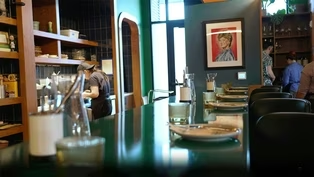
Preview - Mint Mark, Vitruvian Farms, Ramp Sausage
Preview: S16 Ep8 | 30s | Chef Sean Pharr cooks seasonal, modern Midwest flavors at Madison’s Mint Mark. (30s)
Providing Support for PBS.org
Learn Moreabout PBS online sponsorship
- Food
Christopher Kimball’s Milk Street Television
Transform home cooking with the editors of Christopher Kimball’s Milk Street Magazine.



Support for PBS provided by:
Wisconsin Foodie is a local public television program presented by PBS Wisconsin