
Restoring Native Grasses
6/22/2026 | 26m 30sVideo has Closed Captions
Montana rancher restores native grasslands. New wheat restores soil. Soy used in new baby wipes.
A Montana rancher who is part of the Blackfeet tribe honors his ancestors, and Mother Earth, by restoring native grasses to his land. A Minnesota farm family plants a new kind of wheat that restores the soil and saves water. Now his crop is being used by this company making all kinds of organic foods. And see how college students are turning soybeans into new products like baby wipes.
Problems playing video? | Closed Captioning Feedback
Problems playing video? | Closed Captioning Feedback
America's Heartland is presented by your local public television station.
Funding for America’s Heartland is provided by US Soy, Sustainable Agriculture Research and Education, Rural Development Partners, and a Specialty Crop Grant from the California Department of Food and Agriculture.
Restoring Native Grasses
6/22/2026 | 26m 30sVideo has Closed Captions
A Montana rancher who is part of the Blackfeet tribe honors his ancestors, and Mother Earth, by restoring native grasses to his land. A Minnesota farm family plants a new kind of wheat that restores the soil and saves water. Now his crop is being used by this company making all kinds of organic foods. And see how college students are turning soybeans into new products like baby wipes.
Problems playing video? | Closed Captioning Feedback
How to Watch America's Heartland
America's Heartland is available to stream on pbs.org and the free PBS App, available on iPhone, Apple TV, Android TV, Android smartphones, Amazon Fire TV, Amazon Fire Tablet, Roku, Samsung Smart TV, LG TV, and Vizio.
Providing Support for PBS.org
Learn Moreabout PBS online sponsorship- Coming up on "America's Heartland": Farmers and ranchers across America face increasingly extreme weather.
See how they're finding new ways to adapt, protect their land, and thrive despite the challenges.
Journey to the Blackfeet Reservation in Montana, where this tribal rancher is restoring the land by bringing back native prairie grasses and managing scarce water resources.
Meet a farm family in Minnesota focused on healthy soil, growing a new grain called kernza that better handles both too much or too little rainfall.
And see how soybeans are being turned into all kinds of new products, even including familiar items like baby wipes.
It's all next on "America's Heartland."
"America's Heartland" is made possible by: - [Announcer] Sustainable Agriculture Research & Education.
SARE is a USDA grants program for farmers, researchers, and educators.
Since 1988, SARE grantees have used their own innovative ideas to improve profitability, stewardship, and quality of life on farms and ranches across the US.
More information at sare.org.
U.S.
Soy, powered by the innovation of the American soybean industry and a commitment to the sustainability of the soybeans grown by our farming families who invest through checkoff dollars.
More information at unitedsoybean.org.
♪ You can see it in the eyes ♪ Of every woman and man ♪ In America's Heartland ♪ Living close to the land ♪ There's a love for the country ♪ ♪ And a pride in the brand ♪ In America's Heartland living close ♪ ♪ Close to the land - So the way I visualize myself as a steward of this land, and that's the proper word, not owner, not manager, but steward.
- The beautiful grasslands you see here didn't always look like this.
Since the 1990s, Joe Kipp, a rancher and member of the Blackfeet Nation, and his wife Kathy, have been working tirelessly to restore this land, not just for their livelihood, but for generations to come.
- [Joe] This is where my people have been since the beginning of creation.
This is our treaty lands, what was given to us by creator and by treaty.
This is who I am.
- This land was passed down to Joe by his late father-in-law.
When he stepped in, there were some major issues.
- It really was not the system you see today.
It would've been heavily overgrazed by trespass cattle, no water resources, no fencing.
The grass species were really non-palatable, non-nutritional types.
And we started doing our conservation efforts basically 35 years ago with the idea to get rough fescue reestablished in our fields.
It's one of the most wonderful, nutritious plants on Mother Earth for ruminants.
- To help return the more nutritional native prairie grasses to the landscape, Joe sought some help from the Natural Resources Conservation Service or NRCS.
- We went and explained our situation to 'em.
They were very gracious, very helpful.
They got the okay from the fed, the DC level.
And so they did help us.
We built this boundary fence right here.
We went around most of the acreage we owned, and then we said, "Okay, what can we do for cross-fencing?"
- Different from boundary fencing, which separates properties, cross-fencing helps divide up the land for management, creating smaller pastures and providing more control of when and where your cattle graze.
- We had fencing projects funded by the NRCS for about 18 years straight, and then we started the water developments.
And so we could start putting water in each unit, sustainable water, so that we could rotationally graze the cattle and move them.
Intensely graze for very short period of time, and then go to the next field, and then let that rest for the entire rest of the season up until next year.
- For Joe, it's important to be drought resistant to avoid having to sell and purchase new cattle, which could bring in outside diseases and pathogens.
He does so by ensuring that there's always some old growth in the field to get through the drier years.
- If you got 1,000 acres and 200 cows and you just put 'em all in there, they're gonna go to the very most nutritious, most palatable grass species.
They're gonna kill those off by overgrazing them and you're not forcing 'em to graze the rough forage.
But if you cut that field into four, four different pastures by two different fences, and, say, you got a four month-grazing season, move them one month in each unit, but you graze everything, even the undesirable plants they don't want to eat, but you graze it, and then you move.
So all the plants, they're all competing fairly against one another.
- Once the right fencing was put up, Joe had another challenge to tackle.
- There's no groundwater, or at least no drillable groundwater.
We have a few old springs, but in a dry part of the year, it'll only flow about a hundred yards down and then it soaks back into the ground.
There's enough water in there.
That flows about three gallons a minute.
200 cows is gonna need 4,000 gallons of water per day.
- Providing enough water is not the only challenge.
Having water in tanks ensures it's clean and free of parasites that might otherwise be passed along from cattle waste.
- It's coming outta Mother Earth nice and clean.
And when the calves drink it, they're not gonna get full of worms or germs.
And so that's what we wanted to do.
We started setting up isolated tanks.
- To raise cattle sustainably, Joe engages in another sustainable practice, the use of solar energy.
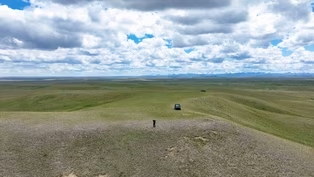
- If you look around the horizon here, you don't see one power line.
Basically, out here, to distribute the water, I probably rely 90% on solar power to pressurize that line that distribute the water to the cattle.
- After years of restoration, diverse wildlife has also returned to this sacred land.
- [Joe] There's lots of sharp-tails, there's lots of antelope.
- Like Joe, other ranchers in Northern Montana have learned restoration practices from the NRCS.
The return of more native prairie grasslands is helping to provide healthy feed to both cattle and domestic bison herds, both important sources of revenue.
- My message to my people and to the world would be, to really do these practices properly.
You're fencing, cross-fencing, water distribution, rotational grazing.
You're not gonna fix it in one year.
It may take decades to get where you wanna go, but you're never gonna get there if you don't start.
The land's gonna survive me.
It's gonna go... I'll be gone.
I'll be part of the land, and it'll still be producing.
- I am growing food for humans that's healthy.
To be able to grow a product that is nutrient dense, that people can feed their families with, brings me a lot of joy.
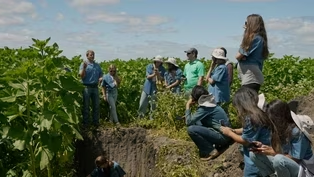
- Tucked away in West Central Minnesota, you can find the sprawling A-frame Farm stretching 500 acres, where the Peterson family grows various certified organic grains, as well as grass-fed beef.
- We work on mother nature's terms.
There is, you know, kind of a harsh reality that we live in a system that just wants as much as possible as fast as possible.
But mother nature can only give us so much at a time before it can replenish itself.
- Luke Peterson and his family are practicing regenerative farming.
It's a farming method that aims to improve soil health while adapting to challenges posed by extreme weather.
- We regenerate the soil, and not only sustain it, but to actually build it back up.
We're gonna mitigate climate change with deep-rooted plants like the kernza, the alfalfa, the sunflower, the perennial pasture.
- To keep their soil healthy, the Petersons grow cover crops and avoid tilling.
They rotate a diverse set of crops and the grass-fed cattle provide compost.
(cow mooing) - My wife was involved with healthcare and she had a lot of good questions about how that correlates with what she did as a nurse practitioner in human health, and then that got me kind of looking at soil health.
And being a farmer, it was pretty obvious that, in order to kind of maintain the health of people in the land, we'd have to start farming differently.
- Luke's way of farming not only yields healthier crops, but also protects them.
Healthy soil can help reduce the effects of drought and severe rain on crops.
That's because it can absorb and retain more water, keeping the soil in place during heavy rains.
- One thing I've noticed farming is how fragile growing food is.
You know, like, rain events at the wrong time, you know, too much rain or not enough rain, obviously, can just impact how much product there is.
- With increasingly severe and unpredictable weather patterns, Luke leans heavily on diverse crop rotation, as well as a unique grain crop called kernza.
Its roots reach deep into the earth, enriching and stabilizing the soil while capturing and storing carbon dioxide from the atmosphere.
- You know, if I have a catastrophic rain event at certain periods, I can always just move in another crop you know, into that spot.
So, by having options, it makes us more resilient.
And then having healthy soil that holds to itself, that doesn't wash away, um, you know, building up our own nutrients within our soil has resilience.
You know, the more diversity in a system, the better chance it has that survival.
- Luke's farming practices caught the eye of Simple Mills' CEO, Katlin Smith.
Her natural food company was looking for like-minded collaborators.
Before long, a partnership blossomed.
- We love partnering directly with the farmers who make our crops and our ingredients.
Um, Luke is one of those farmers.
So he makes sunflower seeds for us.
And one of the big things that we are passionate about is advancing regenerative agriculture and advancing this transition to regenerative agriculture.
- Simple Mills uses sunflower seeds to make crackers, along with several other products.
- Each year, they come out to the farm and see where the program is headed and can physically see the crop in the ground and learn more about regenerative ag.
- I think coming out here to, to farms like this, it's, it's soul filling.
To see our team, to see some of the members of our community connect with farmers in the way that their food has grown, that's how it was meant to be.
The food industry, we can leave things in a better spot.
We can feed people in a better way.
And so I think both he and I get so excited about the potential of positive impact we can have, and also a sense of responsibility that we have.
- It doesn't take a lot of time to get the soil texture back into condition where you can work with it.
We just need to move in that direction.
Creating a, you know, a healthier environment, you know, growing healthy food, and just being conscious of how we do that.
- Still ahead on "America's Heartland": Baby wipes made from soy?
Believe it or not, it's just one of several new eco-friendly products American scientists are creating using what's been called the miracle bean.
Soybeans.
But first, more than 40 million US households grow some of their own produce, like lettuce, tomatoes, and, of course, zucchini.
But how about raising your own mushrooms?
One California farmer is here to help.
- [Don] And you leave it loose and rough.
You don't wanna pat it down.
(bright music) So, get it on there like that.
And it's not rocket science.
- And that's precisely Don Simoni's point.
As this Mushroom Man spreads topsoil over his growing bins, he loves sharing his passion for fungi.
- Well, you know, somebody needs to educate the public.
I mean, they can't stay ignorant all their time-- all their life.
So they call on you the Mushroom Man.
- Well, they call me the Mushroom Man.
Yes, they do.
But, you know, that's okay.
- Don is a mushroom farmer, marketer and educator.
His business is called Mushroom Adventures.
Since the mid-1990s, he's been selling home mushroom growing kits across the country.
The kits are prepared at his Northern California mushroom farm.
It's a pretty small operation here.
- It is.
We only have about four or five people at any one time working here.
Some of them are part-timers, some of them are volunteers.
And so, you know, we're very close to the entire process.
- How many of these will you ship out in a year, would you say?
- Well, we can ship about nine or 10,000 as our max.
- Nine or 10,000?
- The boxes are filled with inoculated composts in a bag of topsoil.
Donald and his crew have done the hard work.
Once the boxes are in the home, it takes about two to three weeks for the mushrooms to appear.
- People buy them for themselves.
There are people who just are curious about how mushrooms grow.
But we get a lot of these sold during the holiday season as presents, either for Christmas, birthday presents, Hanukkah presents.
Um, they're gonna spend the money and give a gift anyway.
Why not give them something that's so unusual that they probably have never had it before?
- That's a great idea.
- I know.
- You wrap it?
- Yes.
Wrap it up and they open it up.
- Merry Christmas.
- Yeah.
- Enjoy your mushrooms.
- And then you get mushrooms for three months afterwards.
I mean, how nice is that?
- Here's your box of dirt.
Not dirt.
(both laughing) - I know what you mean.
- Some people get a lump of coal.
- Yeah, some people get a lump of coal.
We give you a lump of compost.
(both laughing) (lively music) I've always been a farmer at heart.
I'll tell you a quick story.
When I was a boy, my father took me to a five-and-dime store and I saw these little packets of things on the shelf.
And I said, "What are those?"
And my father said, "Those are seeds."
And I said, "What are they for?"
And he goes, "Well, you put them in the ground and they'll grow you food."
I went, "No way.
That's like magic.
Can we get some?"
So we bought three packets and we took 'em home and we put 'em in the ground.
And sure enough, they sprouted after a couple of weeks.
And next thing you know, I had corn, and I had some beans, and I just was like, I was hooked.
We have two operations going on here.
We have the mushroom kit business, which we had far before we had our growing operation.
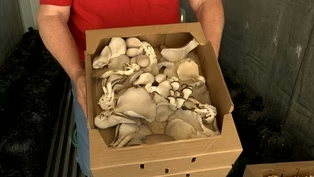
And now we have our growing operation where we grow oysters, shiitakes, and white buttons, portobellos and creminis year round, and we've been selling those at the farmer's markets for about the last five to seven years.
- The mushrooms are grown in shipping containers converted into temperature and moisture-controlled growing houses.
These are shiitakes.
- Shiitakes.
- Some of these are big.
- I know.
They can grow rather large.
Our strain that we use seems to grow quite a few big ones.
- These are good looking mushrooms, aren't they?
- They are, thank you.
And if you cook 'em like a portobella, they're absolutely fantastic.
This one here is actually fantastically perfect.
And actually, you don't cut it.
You just push it off the stem like that.
- Oh, just snap it right off.
- Look at that.
How beautiful.
- Whew.
Look at the underside of that right there.
- Right.
Then, now, sometimes we just pick 'em and take 'em in the warehouse and then we cut 'em.
But in this case, I can cut the stem off right now and show you how we do it, and then we put it in the box.
- And that's going to the farmer's market this weekend?
- That's going to the farmer's market this weekend.
- How much will you get for a mushroom like that?
- Oh, let's see.
- Good size.
- That's about a quarter pound.
That's about a $3 mushroom.
- $3 mushroom right there.
(Don laughs) That's what you like, right?
- That's what I like.
I like $3 mushrooms.
- What is it about the mushroom that, when you describe the taste of a mushroom, what do you tell folks?
- Well, I have to say, sometimes it's a challenge to describe a flavor.
For example, like the shiitake mushrooms, I tell people it has a rich, earthy taste.
And oyster mushrooms have a flavor similar to kind of chicken meat with the same texture.
It's a whole different flavor.
And portobellos and creminis, they have, it's kind of like a more mushroomy flavor than the white buttons.
The white buttons were probably the least flavored.
- Don's mushroom growing began as a hobby.
And 20 years later, it's a full-time farming and business operation.
It also turned Don Simoni into this fungis number one fun guy.
You sort of built a little mushroom empire back here, haven't you?
- I guess you could say that, yeah.
We're mushrooming.
(both laughing) The business is mushrooming.
- Oh, I'm gonna let that one slide, yeah?
- Oh, that's okay, that's fine.
(both laughing) - There's a good chance you've heard of soy candles and soy crayons.
They've been on the market for decades.
But what may surprise you, they got their start here at Purdue University as part of a student competition that's been going on for more than 30 years.
It's called the Student Soybean Innovation Competition.
And the winners not only come away with a cash prize, but often a viable product they can patent and potentially take to market.
- How they come up with it, I have no idea.
But it's impressive to me to see the young minds at work, to see how they develop those products, to be able to produce that in a way that they can use that as a marketable business opportunity.
- Kevin Cox is a soybean farmer and past chairman of the Indiana Soybean Alliance.
The alliance partners with Purdue to support the student competition.
That's because for farmers like Kevin, every new soy-based product opens up new opportunities to enhance the value of their product.
- So as a producer, anytime we can come up with something that uses more of our soybeans, especially for me as an Indiana producer, I want to do all that I can to make sure that, you know, I'm producing a crop in a way that it's gonna be here for future generations.
- Back at Purdue University, students who enter the competition must first overcome a tough hurdle.
Finding a new idea.
- We realize that coming up with a totally novel and new idea is hard.
There will be many failures.
- Professor Nate Mosier remembers a team in 2011 that pitched more than 130 ideas.
They landed on a soy-based denture cream called Dentural.
It went on to win top prize that year.
- We are very intentional that we recruit students at Purdue University from any background, any major.
A common comment I hear from students is, "I've never seen a soybean in my life, but I really don't know anything about them, what they can be used for or anything."
And so we connect the students not only with experts on the faculty here at Purdue, but with companies like Cargill and ADM that process soybeans and make the soybeans into a wide variety of useful products.
- Students in the competition receive this soy sample kit filled with lab equipment, raw soy material like soy protein, flour, and wax.
- So they're using the real products that are available to manufacturers today to make the products that are made from soybeans.
Did it take a lot of different combinations for you to figure out?
- Yeah, so we actually use both of these kind of blend with different ratio.
We test both of them out.
- Kyle Han is a biological engineering student at Purdue.
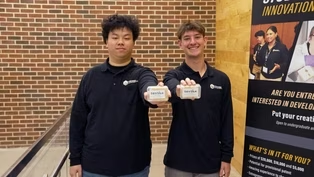
For the 2024 competition, he paired up with business student Ben Gottlieb.
- We knew from day one that we were gonna go out and try and win.
- Kyle and Ben came up with an idea for soy-based baby wipes, traditional baby wipes contained plastic and we're soon to be banned in the United Kingdom.
- And that's how I thought maybe soybean can help.
And then I put my head into it and how, like, we work on it and we created SoySilk.
- I remember the first day we were in there just like with some of our raw materials, just like by hand, stacking them together.
And it gave me just a different perspective on how products really come to market.
- They called their baby wipe SoySilk.
It uses soy fiber for the base sheet and the moisturizing agents are soy-based as well.
- So, basically, the entire product from the start to finish, we have soybean incorporated in it.
- So this is our really first prototype that's handmade here.
We have... It's made out of the soy fiber, and then we have different like wetting agents on it to make it clean.
And I remember the first time Kyle sent me the video of the working prototype.
And being able to see it outcompete the best sustainable baby wipe on the market was shocking.
- The best products, and usually the ones that win, not only work well, they outperform the competition.
So they're renewable, they're biodegradable in many cases, but they work as well or better than their competitors on the market.
- Over $100 million of damage every year to plumbing systems comes from baby wipes and the plastic polymers that aren't able to break down, causing, like, blockages and sewage.
Which is why in the UK, there were proposed laws to ban them.
- Ben and Kyle see SoySilk as a way to fill that void in the market.
But first, the competition.
- We were able to showcase our product, which was super rewarding to see people impressed with what we came up with.
- We performed better than other baby wipes on the market.
- We were not sure if we were gonna win.
We were kind of stressing out a little bit.
- When they announced third place, like, "Okay, that's not my name."
Second place, "That is not my name."
And we're like, "Okay, maybe we we're not winning this year."
And then when they announced, "First place is SoySilk," like I remember me and Ben, we just looked at each other.
We're like, "Is that true?"
- For the grand prize, Team SoySilk.
- It was true.
They won first place and a $20,000 grand prize.
But their journey isn't over.
Like winners before them, they hope to see their product someday be realized.
- We work hard to make sure technologies that can be patented are.
it's very difficult to launch a new product.
The success stories have been ones where things have been developed to a point where a company was interested enough of taking that next step, that next leap to take the product to market.
- My goal is to hopefully partner or license this technology to a bigger company that has more of the backing to put this in stores and get it out to market.
- And every year, soybean farmers like Kevin look forward to seeing what creative new ideas students come up with.
- So, as a soybean producer, big deal.
What do I care?
Once it goes on the truck, it goes to the elevator.
But to be able to see new products being able to be developed each year, it's exciting for me as a producer to be able to know that I've got a hand in some of that.
- That's it for this edition of "America's Heartland."
For more stories, full episodes and recipes, visit americasheartland.org or connect with us on Facebook.
♪ You can see it in the eyes ♪ Of every woman and man ♪ In America's Heartland ♪ Living close to the land ♪ There's a love for the country ♪ ♪ And a pride in the brand ♪ In America's Heartland living close ♪ ♪ Close to the land - "America's Heartland" is made possible by: - [Announcer] Sustainable Agriculture Research & Education.
SARE is a USDA grants program for farmers, researchers, and educators.
Since 1988, SARE grantees have used their own innovative ideas to improve profitability, stewardship, and quality of life on farms and ranches across the US.
More information at sare.org.
U.S.
Soy, powered by the innovation of the American soybean industry and a commitment to the sustainability of the soybeans grown by our farming families who invest through checkoff dollars.
More information at unitedsoybean.org.
 New
NewVideo has Closed Captions
A California farmer shares easy-to-grow mushrooms with giftable box kits. (5m 43s)
 New
NewVideo has Closed Captions
A Minnesota farm family plants a new kind of wheat that restores the soil and saves water. (5m 2s)
 New
NewMontana Grasslands Restoration
Video has Closed Captions
A Montana rancher honors his ancestors, and Mother Earth, by restoring native grasses to his land. (5m 33s)
 New
NewVideo has Closed Captions
See how college students are turning soybeans into new products like baby wipes. (6m 5s)
Providing Support for PBS.org
Learn Moreabout PBS online sponsorship
- Food
Christopher Kimball’s Milk Street Television
Transform home cooking with the editors of Christopher Kimball’s Milk Street Magazine.





Support for PBS provided by:
America's Heartland is presented by your local public television station.
Funding for America’s Heartland is provided by US Soy, Sustainable Agriculture Research and Education, Rural Development Partners, and a Specialty Crop Grant from the California Department of Food and Agriculture.