
The formation of the NAACP and Du Bois’ magazine, “The Crisis”
Clip: 5/19/2026 | 3m 10sVideo has Closed Captions
How Du Bois used "The Crisis" and NAACP efforts to expose racism and celebrate Black achievement.
After violent race riots surged across the United States, the NAACP was formed in 1909. W.E.B. Du Bois became its only Black board member and editor of the organization’s magazine, “The Crisis.” The publication used journalism, art, and data to expose racial violence and highlight Black achievement.
Problems playing video? | Closed Captioning Feedback
Problems playing video? | Closed Captioning Feedback
Support for American Masters is provided by AARP, The Rosalind P. Walter Foundation, Thea Petschek Iervolino Foundation, Burton P. and Judith B. Resnick Foundation, The Philip and Janice Levin Foundation,...
Support provided by:

The formation of the NAACP and Du Bois’ magazine, “The Crisis”
Clip: 5/19/2026 | 3m 10sVideo has Closed Captions
After violent race riots surged across the United States, the NAACP was formed in 1909. W.E.B. Du Bois became its only Black board member and editor of the organization’s magazine, “The Crisis.” The publication used journalism, art, and data to expose racial violence and highlight Black achievement.
Problems playing video? | Closed Captioning Feedback
Where to Watch American Masters
American Masters is available to stream on pbs.org and the PBS app.
Buy Now
A front row seat to the creative process
How do today’s masters create their art? Each episode an artist reveals how they brought their creative work to life. Hear from artists across disciplines, like comedian Chris Fleming, actor Greg Kinnear, sports journalist Taylor Rooks, and more on our video podcast "American Masters: Creative Spark."Providing Support for PBS.org
Learn Moreabout PBS online sponsorship- [Narrator 1] In 1908, two years after the Atlanta Massacre, white mob violence jumped the Mason-Dixon line.
Scrapbooks and postcards cataloging white supremacist cruelty were becoming commonplace.
(glass breaking) - [Narrator 2] In Springfield, Illinois, the home of Abraham Lincoln, a riot breaks out.
Whites are indiscriminately killing Black people, especially those who had any kind of power and resources, such as business people.
- [Narrator 1] They burned homes, looted stores, and shot Black people in the streets.
(gun firing) At least eight Black people were killed, and thousands fled Springfield, Illinois.
- It revealed that white supremacy had defined all of the United States.
- [Narrator 2] White liberals were very disturbed.
They issued a call for Black people and white people to come together and form an organization to deal with it, and that's how the NAACP came about.
- [Speaker 1] Its board is largely comprised of wealthy white people who believe in civil and political rights for African Americans.
Du Bois is the only Black board member.
- [Speaker 2] He serves as Director of Research and Publications, and most prominently, as editor of The Crisis.
(light music) The title was extremely important.
The crisis of the color line was the crisis of America.
- Not only is he going to become a social activist, but he understands the power of the press.
- [Narrator 2] He insisted that "I have all editorial privilege and power.
Nobody will dictate to him what he can say."
(dramatic music) - [Speaker 3] It was like our internet now.
The topics that were covered in The Crisis covered everything.
(dramatic music) - [Speaker 4] Using photography, using art, using poetry, celebrating social accomplishments, the political and economic accomplishments of African Americans.
A brief history of Reconstruction
Video has Closed Captions
Reconstruction saw Black progress, then backlash erased gains after brief equality. (2m 32s)
Du Bois used visualized data to confront racism at the 1900 Paris Exposition
Video has Closed Captions
At the 1900 Paris Expo, Du Bois used data to present a visually captivating case against racism. (2m 25s)
W.E.B. Du Bois' childhood, family and education
Video has Closed Captions
Born in 1868, W.E.B. Du Bois rose from hardship to academic excellence. (3m 43s)
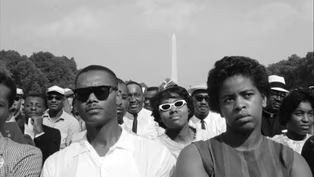
W.E.B. Du Bois passed away on the eve of the 1963 March on Washington
Video has Closed Captions
Du Bois’ death at the 1963 March on Washington marked a passing of the torch in civil rights. (1m 48s)
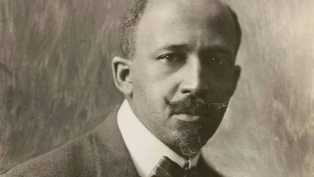
W.E.B. Du Bois: Rebel With a Cause
Video has Closed Captions
Explore the life and legacy of notable Black scholar and civil rights pioneer W.E.B. Du Bois. (2m 29s)
Providing Support for PBS.org
Learn Moreabout PBS online sponsorship










Support for PBS provided by:
Support for American Masters is provided by AARP, The Rosalind P. Walter Foundation, Thea Petschek Iervolino Foundation, Burton P. and Judith B. Resnick Foundation, The Philip and Janice Levin Foundation,...