
Feb. 19, 2026 - Full Show
2/19/2026 | 26m 47sVideo has Closed Captions
Watch the Feb. 19, 2026, full episode of "Chicago Tonight."
A new study examines the Chicago Police Department’s use of force. And lawmakers react to the governor’s budget address.
Problems playing video? | Closed Captioning Feedback
Problems playing video? | Closed Captioning Feedback
Chicago Tonight is a local public television program presented by WTTW
WTTW video streaming support provided by members and sponsors.
Feb. 19, 2026 - Full Show
2/19/2026 | 26m 47sVideo has Closed Captions
A new study examines the Chicago Police Department’s use of force. And lawmakers react to the governor’s budget address.
Problems playing video? | Closed Captioning Feedback
How to Watch Chicago Tonight
Chicago Tonight is available to stream on pbs.org and the free PBS App, available on iPhone, Apple TV, Android TV, Android smartphones, Amazon Fire TV, Amazon Fire Tablet, Roku, Samsung Smart TV, and Vizio.

WTTW News Explains
In this Emmy Award-winning series, WTTW News tackles your questions — big and small — about life in the Chicago area. Our video animations guide you through local government, city history, public utilities and everything in between.Providing Support for PBS.org
Learn Moreabout PBS online sponsorship>> Hello and thanks for joining us on Chicago Brandis Friedman.
Here's what we're looking at.
A first of its kind study finds Chicago police disproportionately use force against black and Latino residents.
>> Him and the return of the money and resources this president has taken from the people of Illinois.
>> Governor Pritzker takes game President Trump as he unveils his budget plan.
>> State lawmakers are here to weigh in.
And disabilities impact more Chicago adults than you might think.
What a new report from the city shows us.
>> First off tonight, federal immigration agents suspected of criminal wrongdoing could face charges from the Cook County State's attorney after she unveiled a policy to prosecute them.
Eileen O'Neill Byrd's office says the changes call for the use of all available prosecutorial tools to support law enforcement investigations into the use of force by federal immigration officers, including those involving a death shooting or act of violence.
The move comes after calls from other elected officials for her office to prosecute federal immigration agents.
Mourners looking to pay their respects to the late Reverend Jesse Jackson will have several opportunities starting next week.
The family says the civil rights leader will lie in state at his rainbow push headquarters next Thursday and Friday, starting at 10:00AM the family will travel to South Carolina and Washington, D.C., the first week of March for services in both cities.
There.
Then on Friday, March 6, the people celebration will be held at House of Hope in the Pullman community.
Finally, a private home going celebration.
What's now private?
But I open homegoing celebration back at Rainbow push.
But with limited seating capacity yesterday, his adult children said some services will be open for all and for more on times and how to register, you can visit our website.
Indiana's plans to lure the Chicago Bears across state lines moved forward today.
That's after a panel of Indiana lawmakers unanimously advanced a bill to create a public stadium authority with the power to finance construct and least stadium in Hammond.
In a statement, the Bears say, quote, the passage of Senate Bill 27 would mark the most meaningful step forward in our stadium, planning efforts to date.
But the team short of giving the plan their full endorsement saying they need to finish their analysis of the site.
Illinois Governor JB Pritzker says while he was surprised to see the bear statements, team officials told his staff today that its quote, not some confirmation that they're moving to Indiana House Committee hearing on an Illinois bill was set for today but was canceled.
Ok, did you wake up wondering yesterday did wake up wondering why your car was caked in mud?
Okay.
We all did.
Chicago residents who park outside saw their vehicles coated in dirt.
Thanks to a perfect storm of events that started with wildfires hundreds of miles away.
National Weather Service says wildfires in Oklahoma and Kansas sent ash into the air.
Then strong winds moved the dirt northeastward and became embedded in raindrops reading to some gusty rain in Chicago.
Some residents took to social media to comment on the humor of the money.
Rain coming Ash Wednesday.
While others bemoaned the mess it made.
See you in line at the carwash.
Either way.
What a study of 8,000 police incidents reveals.
Heather Sharon joins us right after this.
>> Chicago tonight is made possible in part why the Alexander and John Nichols family.
The Pope Brothers Foundation.
And the support of these donors.
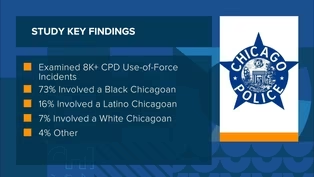
>> Chicago police disproportionately used force against black Chicagoans between 2020 2023.
That's according to a first of its kind study looking at 4 years of data or Heather.
Sharon joins us now with more.
Heather, we have seen studies like this before, including from the city's inspector general.
Why is this one different?
Well, this study authored by independent experts who professors at the University of Texas at San Antonio in the University of Pennsylvania is the first to use scientifically valid statistical tools to assess whether Chicago Police Department officers are more likely to use force against black Chicagoans Latino, Chicagoans or white Chicagoans.
They did that by comparing the race of arrest ease and people suspected of crime against those identified in use-of-force reports.
So what they find?
Well, they found that in 73% of such use of force incidents, the person subjected to that force was black in 16%.
Of instance, that person was Latino.
Just 7% of use-of-force instance.
That person was white.
Now the issue is is that if you're a black person suspected of crime, you face a higher risk.
Nearly 39% being subjected to use of force incident.
you are arrested that risk increases to nearly 60%.
Wow.
How his CPD responded to these findings?
Well, they sent me a statement that said, quote, We know we have more work to do and we will continue to build on the foundation.
We have set.
Cpd has said they've made significant progress in complying with the consent decree.
Of course, that's that federal court order that requires them to stop routinely violating the civil rights of black and Latino Chicagoans.
That court order is about to mark its 7th anniversary, 7th anniversary.
Ok, you also spoke with members of the coalition who've been working for more than a decade to change the way CPD operates.
One of the make of this well, they're deeply frustrated that this disparity exists and they're deeply frustrated that nothing has been done since the study was completed and published in March of 2025, that's nearly a year And they say that it's simply unacceptable for this to be the state of affairs in Chicago, especially considering that we know the number use-of-force incidents increased in 2024 and during the 1st half of 2025, current commissioner around, thanks so much.
Thanks.
Brandis.
And you can read full story on our website.
It's all W T Tw Dot com Slash news.
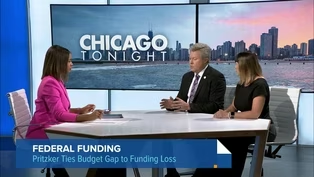
Reaction coming in today to Governor JB Pritzker's annual budget address.
He's proposing a 56 billion dollar spending plan as the state faces >> 2.2 billion dollar budget gap and near weekly threat of losing federal funding we won't let headwinds from Washington stop us from addressing the fact that Illinois like Americans everywhere.
>> Are still paying too much for groceries, too much to live.
Everything is just too expensive.
And that's why now more than ever, we must work together to make life more affordable for Illinois's working families.
I propose an agenda to address the high cost of living that makes life easier for the middle class and those striving to get there.
>> Joining us to discuss the spending plan are state Sen Seth Lewis, a Republican who represents cities, including Carol Stream Bloomingdale and Wheaton and State representative Everdeen until a Democrat whose constituents include West and northwest side neighborhoods in Chicago like Austin Bill.
Mike Regan and Portage Park.
Welcome to both of you.
Thank you for joining us to great to be So before we get into the details, I want to get your sort of general reactions to what we heard from the governor yesterday.
How did you feel about his proposal, senator, also with you.
>> So start with the positive.
I was expecting a very partisan type speech.
I know we just saw in the opening.
But overall for the 45 minutes, it was not as partisan as I expected out, as part says, as I thought speeches were in the past, he did lay out an agenda and that's where let's say our agreements and positive differ a little bit.
This 8 speech, 6 that I've heard.
And, you know, from his perspective, he says he had to turn around, you know, agenda from when he took over.
But now this is this governor's budget and it's his vision for Illinois.
And I don't know how we get from that turnaround to a winning record with this budget or his vision because all noise still below average in almost all categories.
And I didn't hear us getting above average.
And that's what I was looking for.
Representative.
So the governor presented yet another balanced budget.
I think Illinois is moving in the right direction.
We're coming from a time where >> we had to go through a number of years with a budget impasse, right?
And so we're still trying to build our way out of it.
And I think Governor Pritzker did a good job laying out that plan.
And for Illinois Democrats in particular, we know that we have a starting point and we now need to work through a process to make sure that we are putting forth moral document that shows what car priorities and the things that we think we need to do to keep Illinois on a strong will financial footing.
>> Senator Louis.
So the governor's budget staff says that the discretionary spending this year, it's only increasing less than half a percent overall.
Spending over last year is only 1.6% higher.
Your party still argues that the governor is overspending.
What would you say?
Fiscal responsibility looks like this showing those in those priorities.
He wants a tax totaling 728 million dollars and he's leveraging I will not be able to fund education.
>> If I don't get the tax increases.
So as you just mentioned, we have 56 billion dollars and everything else.
front of that is his priority.
Whether it be.
Grants to study New complex you know, the speaker's district for 40 million dollars.
Those are all taking priority over education because we need tax increases to fund education.
I don't think we've actually gone in and looked at the budget and taking out some of the fluff that is in there probably totaling 500 to 600 million dollars.
That he just did.
2 months ago when you said I need every agency to tighten their belt and we put 550 million dollars in reserve.
his executive order.
And now we're left in that executive order.
And we have to have another 728 million dollars and tax increases.
It's the speak out of both sides of his mouth so that the governor repeatedly mention President Trump and his address.
Here's another little bit of that.
>> 8.4 billion dollars.
That is how much the Trump administration has cost the people of Illinois.
>> These are not handouts.
These are dollars that real Illinois.
It's paid in federal taxes and that have been constitutionally approved by our elected Democratic and Republican representatives in Washington.
If you want to talk about our fy 2027 budget, you must first demand the return of the money and resources this president has taken from the people of Illinois.
>> With design how much of the gap is tied to federal instability versus structural issues in Illinois.
I think it's significant when you're looking at near daily tweets that changed what we can possibly be looking at in terms of our day today, spending at the state level.
It's a huge impact.
I think the governor mentioned it.
8 billion dollars is what the Trump administration is costing cause Illinois.
so regardless of weather, you are in the red part of the state or the blue part of the state.
That kind of instability really impacts our ability to be able to just provide a today's services for folks right.
And we're talking about health care.
We're talking SNAP benefits for families that need that extra support to feed their children every day.
So this is not like these are small things.
These are very significant and these are day-to-day affordability issues that we keep talking about.
>> I disagree with that with that approach.
We just saw for Emily Budget here with the Senate Republicans and we're talking 8.4 billion dollars or that is equivalent to about 20% of our current budget.
We're at 56 Billion.
There is nothing in a speech that said he had to cut or make significant changes because we lost 8 8.4 billion dollars.
There was no mention of was a nice talking point to open up this speech with.
But in reality, our budget has not suffered 8.4 billion dollars.
They're there is no proof.
There's no evidence.
It's theoretical.
This may or may not happen, but we have not had to come up with 8.4 billion dollars.
I think the challenge with this administration, right, we don't know what we can bank on.
just dealing with day-to-day reaction.
>> Every time something changes at the federal level and it's it is no way to run government.
And it's certainly not the way that we should be handling the issues that are affecting day today.
But I don't know what account to ask for the money back that he's talking about.
>> So I want to because he he presented revenue ideas, right?
So his proposal outlined a few new revenue streams like a social media feed.
This would charge platforms with 1 million or more users $165,000 per month.
Plus, $0.50 per user over a million.
Now, we should mention they're also lower tiered fees for platforms with fewer users starting at 100,000 up to 1 Million.
The governor says that this tax would bring in an estimated 200 million earmarked for education.
Now, Mair Johnson has also taken aim at social media companies in his budget process very recently.
Is this untapped source of revenue was this is going to be bad for business think is bad for business because >> Illinois is now a leader in another category of figuring out how to tax businesses.
The rhetoric is that we're a great place to move to in.
The magazines are reporting that.
However, when I look at reality, they're not coming so when the businesses do their say you may be a good place, but its tax structure, its regulatory structure, what they actually do and treat businesses, they will find a way 2 taxes out of the state.
And second all, I don't think we really need it.
I don't think we've gone through the budget and actually trimmed where we need to trip.
>> Representative Joe Biden, the senior legal legal challenges over this.
>> I am not sure whether we can expect to get a legal challenge.
What I can say is that when you're talking about companies that are making billions of dollars off of our data, it doesn't hurt to take a look at that transition from it's to the digital world knowing that that's where a lot of the future of our economy is going right.
And so I think it makes sense to take a look at all of these different opportunities.
And again for us, I think this hearing this proposal from the governor's office.
We're going to take a look at it and see if this is the right approach to go on.
that's where we really want to end up.
But I do think that you have to make sure that you're tapping all the sources that you can almost out of time.
The budget also adds 305 million dollars to the evidence base funding model which funds schools.
>> Less than years Republicans are calling for restoring the 350 million dollar increase that was initially intended back when this was have approved.
We've got about 30 seconds worse of the additional money come from?
So I believe there's opportunities within the budget with grants and other things that we give to individual districts.
I believe we can get that 50 million dollars back.
>> And that's for tax property tax abatement.
So that's what we have cut out that we're not even funding property taxes.
Representative >> I think if you're going to talk about adding more dollars to particular programs, you gotta be able to point to where that revenues coming from Republicans come have issues about raising revenues and they're not the ones that are voting on budgets.
Then it's difficult to be able to say, let's increase funding for this, but not going identify with that right?
That's where we'll have to leave it Thanks to you both senators us and say representative everything to do that.
I think thank you.
>> Up next, how disabilities shape the lives of many Chicagoans?
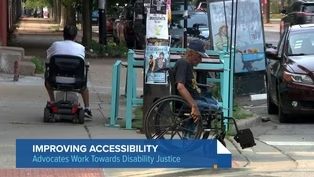
>> One in 4 Chicago adults live with a disability.
That's according to a recent report from the Mayor's Office for People with Disabilities and the Chicago Department of Public Health which found a higher percentage of disabled people living on the south and West sides.
And compared to Chicagoans without a disability.
The report found those with disabilities experience having more environmental concerns, a harder time accessing resources like transit and fresh produce less trust in law enforcement, greater fear of crime less of a sense of belonging.
Joining us now, our Amber Smock, vice president of advocacy at Access living and to both use Gordon Junior, co-founder of Chicago and Disabled people of Color, Coalition and research associate at USC's Institute on Disability and Human Development.
Welcome back.
Welcome.
Thank you for joining Thank Amber, starting with you.
What do you think is at the crux, the court, some of these disparities that we just named?
>> Well, I think both to dream and public be is a mixture different Cup come June definitely public.
And I mean, I think that's fairly obvious answer to anybody looking at different community.
But I think when you mix that in in and also those core out The things that make it more difficult to get by.
fortunately, I think what happens people with disabilities concert, we knew against what you things are going to be cheaper.
I was old we've had some interesting insights about those kinds but concentration yes, well, get.
>> And we'll talk is let's get to you because the most common type of disabilities down in Chicago were mobility and cognitive disabilities.
for those who might not be familiar, what does it mean to have to navigate a cognitive disability?
>> So with having a cognitive disability, also have the process ation, instance, you may need playing when material to understand the gist of what's going on is jargon or 83 research?
E. You may need be-all aids as well to navigate.
You may People.
They help you with paperwork.
So those are examples of accommodations he would conduct a disability or what I like to call knew it.
I get a new diversion people on the autism spectrum.
For example, those.
>> not necessarily always disabilities that people may not quite always recognize.
Amber, you previously spoke with many people with disabilities in Chicago, not living in housing that feels accessible to them.
What is that reality look like for Well, I think reality of ducks you know, >> you just drive down any street and Chicago, you will see just years after stairs after stairs in front of houses.
And so you can see just by them the best.
But that's not welcoming to people with disabilities, House you know, is one of our top can tune into Texas that than one percent.
All the available housing, the city of Chicago is accessible for people with this police.
What looks like on the ground is people getting killed, lead up and up and down the stairs, dragging themselves up and down the studio.
And you have to ask yourself and what you really want for your family everybody should have a state and team on accessible homes, especially when it comes down to push >> What might a more accessible home look like?
Obviously easy getting in and out.
Start so it could look like you couldn't have a new 0 step entrance.
It can look like having a bathroom that is accessible on the first floor.
>> It can look like you certain country DS inside the first foot.
You visible House is not the same thing only accessible house.
Fully accessible means a whole entire thing critical based double means being able to access the first floor.
And you know, the reason that nice she things like no, you want to have to do have fun entrance.
It cost is not just about people might think I'm talking about older folks, but I'm not.
I'm talking about being able to welcome children to home during trick-or-treating time.
You know, so a lot of kids with disabilities don't get the same kind of social opportunities shows trick or treating the same that kids with not without discipline.
So short, all to both the U.S.
But what are the barriers that people disabilities might face living on the south and west sides?
>> It could be maybe fat days.
It could be the fact that >> a lot of the fully accessible housing is actually on the.
North side.
But that's because it's an affordable is festival that to me, if affordable.
Also and to play a lot of the resources says foods.
Or clinics or 80 of pencils.
North side.
Whereas West South sides, mostly food as as you may have to drive by to get the resources that you some like access to grocery stores and healthcare.
>> Yeah, can be more difficult.
Amber, how should the city use the findings in this report?
So these findings, a weak start to talk about other things such as >> You know what?
If you have one map you over.
Another map showed that much of that with a about how many people in different neighborhoods of the Chivas aside.
How many people in different neighborhoods may be impacted by the criminal system.
How many people different neighborhoods all, you know, may have disability categories that not necessarily call food with.
Then the survey itself, what I think the city needs to do and when I say the city, I don't mean just the city of Chicago and Mean City Council used to think about how prioritize, you know, different things right?
But disability and always has to be a priority for everybody making things accessible as a benefit to everybody.
And I think that the mean matches of the conversation that this reporter Scott.
>> To most.
Yes.
What change do you hope to see as a result of this report?
>> Hope to see change in how we accessibility, not only from.
A common people with physical disabilities, but also those with more invisible disabilities, accessible disabilities as well.
As the mayor's they we supposed to be the most accessible city in the world with this report.
It will help us make sure that we reach out to all disability type in all neighborhoods work to be done.
Okay.
Amber Smock to both the school and junior.
Thanks to both.
Appreciate Thank you, sir.
Thank you so much.
>> And that's our show for this Thursday night.
Join us tomorrow night at 5.37, for the week in review.
Now for all of us here Chicago Brandis Friedman, thank you for watching.
Stay healthy and safe and have a good night.
>> Closed captioning is made possible by Robert a cliff.
And Clifford a Chicago from
1 in 4 Chicago Adults Have a Disability: Report
Video has Closed Captions
Clip: 2/19/2026 | 7m 7s | The most common types of disability were cognitive and mobility disabilities, the report found. (7m 7s)
Chicago Police Disproportionately Used Force Against Black Chicagoans: Study
Video has Closed Captions
Clip: 2/19/2026 | 2m 35s | The first-of-its-kind study was commissioned by the Chicago Police Department. (2m 35s)
State Lawmakers Weigh in on Pritzker's Budget Proposal
Video has Closed Captions
Clip: 2/19/2026 | 10m 36s | Pritzker denounced the Trump administration during his annual State of the State speech. (10m 36s)
Providing Support for PBS.org
Learn Moreabout PBS online sponsorship
- News and Public Affairs

Top journalists deliver compelling original analysis of the hour's headlines.

- News and Public Affairs

FRONTLINE is investigative journalism that questions, explains and changes our world.












Support for PBS provided by:
Chicago Tonight is a local public television program presented by WTTW
WTTW video streaming support provided by members and sponsors.