
Feb. 24, 2026 - Full Show
2/24/2026 | 26m 49sVideo has Closed Captions
Watch the Feb. 24, 2026, full episode.
President Donald Trump finds a new way to impose his tariffs. And the EPA rolls back regulations on greenhouse gas emissions.
Problems playing video? | Closed Captioning Feedback
Problems playing video? | Closed Captioning Feedback
Chicago Tonight is a local public television program presented by WTTW
WTTW video streaming support provided by members and sponsors.
Feb. 24, 2026 - Full Show
2/24/2026 | 26m 49sVideo has Closed Captions
President Donald Trump finds a new way to impose his tariffs. And the EPA rolls back regulations on greenhouse gas emissions.
Problems playing video? | Closed Captioning Feedback
How to Watch Chicago Tonight
Chicago Tonight is available to stream on pbs.org and the free PBS App, available on iPhone, Apple TV, Android TV, Android smartphones, Amazon Fire TV, Amazon Fire Tablet, Roku, Samsung Smart TV, and Vizio.

WTTW News Explains
In this Emmy Award-winning series, WTTW News tackles your questions — big and small — about life in the Chicago area. Our video animations guide you through local government, city history, public utilities and everything in between.Providing Support for PBS.org
Learn Moreabout PBS online sponsorship>> Hello and thanks for joining us on Chicago tonight.
I'm Brandis Friedman.
Here's what we're looking at.
>> Other alternatives will now be used replace the ones that the court incorrectly rejected.
>> President Donald Trump announces 15% global tariffs following his Supreme Court last.
And environmental groups sued the EPA after the agency repeals a rule supporting climate protections.
>> First off tonight, Donald Trump, President Donald Trump is set to give his State of the Union address in about 2 and a half hours.
But there will still be some no shows from Illinois's congressional delegation.
Senator Tammy Duckworth and Representatives Delia Ramirez might quickly.
Sean Casten Jan Schakowsky and Erik Sorenson have all said they will not be in attendance.
Ramirez will join a group of Democratic lawmakers at the so-called People's State of the Union as a counterpoint to Trump's address, Congress members who are attending will as is customary, be bringing guests once a Chicagoans may recognize is many Marte Martinez, a U.S.
citizen who was shot 5 times by a Border Patrol agent in Brighton Park.
She is a guest of Congressman R C a to find out who else will be there.
You can visit our Web site W t Tw Dot com Slash news.
The State of the Union address is expected to begin at 08:00PM.
You can watch that right here on W T Tw.
Chicago drivers hit with massive fines and fees for tickets could be getting some of that money back.
>> The ticketing data shows that poor and minority communities were disproportionately targeted with city sticker tickets during this period of time.
And when that happened with increase and the ticket price, is it hard?
Lot of people that were not able to pay these tickets.
They lost their vehicles.
In some cases, they lost their jobs because they were city employees.
and cases like Mr.
Guards are here.
They were unable to drive for Uber left.
>> Last week, a Cook County court agreed that the city was violating state law by assessing fines and penalties greater than $250 for tickets like parking or an expired city sticker attorneys say the city began jacking up those fees back in 2012 through 2022, the total amount to more than a million tickets adding up to more than 163 million dollars in illegal fines and penalties.
Plaintiffs attorneys say this means the city will have to refund those extra fines and fees, although plan to issue those refunds has been made yet local comic crews are heading east to help utility workers there restore service to the hundreds of thousands who've lost power.
>> After the snow storm that meteorologists are calling the strongest in a decade.
That storm dumped more than 2 feet of snow in some parts of the northeast and more than 3 feet in Rhode Island surpassing snow totals from the historic blizzard of 1978 ComEd says 100 crew members and 25 support staff are headed out to help Atlantic City Electric in New Jersey with restoring service do remain there as needed.
How President Trump's latest tariff plan may impact prices, manufacturers and international relations right after this.
>> Chicago tonight is made possible in part why the Alexander and John Nichols family.
The Pope Brothers Foundation.
And the support of these donors.
>> President Donald Trump says the country is facing, quote, fundamental international payment problems.
He made the proclamation while raising a global 15% tariff in the week of a Supreme Court ruling that struck down his previous tariffs imposed under the international emergency Economic Powers Act, AKA EPA in a 63 vote.
joining us now are Benjamin Krause, executive director of the University of Chicago's Becker Friedman Institute for Economics and on Zoom, Harold Krantz, professor of law.
Chicago can't College of Law.
Welcome back.
Thanks to you both for joining us.
Okay.
So let's start with why this is happening in a truth.
Social Post, President Trump wrote, quote, I as president of the United States of America will be effective immediately raising the 10% worldwide tariffs on countries, many of whom many of which have been ripping the U.S.
off for decades without retribution.
Until I came along to be fully allowed and legally tested 15% level.
Ok, Ben Krause, is there any validity to what Trump is saying about the United States ripped off by foreign trade partners?
So unfortunately, the evidence that we've seen we actually do the research took.
Take a look at how the U.S.
has been treated in its various relationships across the globe.
>> Just doesn't stand up to that particular statement.
What we find instead is that the U.S.
is benefiting from the global trade system.
We usually have says a arrangements that are two-thirds are there better than two-thirds of other countries out there in general.
When you think about trade, you should think about negotiations with your friends and neighbors.
When you share, you generally end up getting better results back from those people.
Is it possible to be ripped off like is that nature of of a trade agreements?
>> That one side is benefiting more than the other.
>> So you could imagine a circumstance where under coercion, someone could get the upper hand in.
It's within the models that we have.
We do see that there could be some potential upside of really playing hardball.
However, that assumes that the other side won't reciprocate, won't retaliate.
And in fact, we stand to lose a lot more if other nations start to retaliate.
And we're starting to see early signs that countries are responding in kind to the new way they were behaving on the international field because something that the president has maintained throughout his second term is that we're importing more than we're exporting.
Therefore, this imbalance is hurting us.
One of the things that he talked about especially on Liberation Day was the needed maintain a balance of trade with every single individual country.
And that's just not what we see from the basic foundations of economic science.
It would be as if you would wants to maintain a perfect balance of trade with say your barber.
I don't go to the barber that often as you might imagine.
But if I were to go having a balanced trade would mean that every time I buy a service from him, he buys a service for me.
And that just doesn't make any sense.
What we know from economics instead, as we should all lean into our comparative advantage.
And when we do that, we all end up benefiting.
I mentioned earlier, the potential loss if other countries start retaliating against us, it could be as if each one of our households facing something like one to $2000 hit.
But our annual income, if other countries start responding in the way that we have as late Harold Krantz, as mentioned to the president, he's utilizing a different law this time to justify these new tariffs, the trade act of 1974.
Section one.
22.
>> First, would you would you explain that for us?
What is back?
>> For the train at Rosen time when we read about depreciation of us dollar, the U.S.
dollar was falling as opposed to other currencies around the world.
during the Nixon administration, we, of course we've been hit by the Vietnam try to solidify our position in part by ensuring that there were tools that the president could use case there was a serious imbalance funds international.
So what the president has used isn't this lever that he's used his recently is not about trade imbalance.
It's problem of international balance of payments.
The idea more money is going out from the United States and coming But there's no proof of that.
And so you could, even though there is a more of a statutory folk here for the president, evidence that the president has mustered today to say that there is a serious balance of international payments is simply wanting and you have to aggregate all the payments going in and out.
And the only issue that we had back in the 1974 was that the dog was picked to the gold.
Not that the dollar's no longer pick to the goal.
it's really been relatively stable.
And so there is no perceived needs that we can tell so far this particular tour the question is, will the court look behind the statement by president that he is there is an international.
Fund balance 2 to strike it may be a little closer than the last one, but I think that because of the last case, the court be skeptical look at this more carefully.
That might and go behind the declaration of findings by the president decided he simply isn't.
There's not enough to back it up.
If there is some kind of serious and unbalance.
So it sounds then like, you know, considering his use of EPA, the international emergency Economic Powers Act.
>> It sounds like you question whether this move is legally sound invoking this particular act.
>> Will you to get a slightly different So we If the court look at the presidential findings, not tougher to them and realized that in the context of his retreat from it that the president just what grasping at straws.
So this is set up for another kind core challenge.
It's going to take probably over a to get back to the Supreme Court and we're going to see economic dislocation in the meantime, not to mention the difficulty trying to get all the refunds of billions of dollars on the tears already been collected under up.
>> Been cross the Howell everyday Americans be implemented by the new tariff.
So one of the things that's important to keep in mind is that we hadn't actually seen the full brunt of the costs of >> the previous tariff regime really reach We know from research is it usually takes about a year for that to happen.
Statutory rape.
So statutory rates that the universe that the president had set, there were something in the range of about 27% as of September.
Now he's saying that he's going to be taking things up to 15%.
As you can think of that is basically that the maximum, the ceiling that could potentially be charging.
What we know is that we were only paying about 14% by the time all of this is taking place.
So there's still range for us to continue to increase.
We already when you hear about tariffs should be thinking about a tax on imports.
a rough rule of thumb is that we should be expecting to pay something like 15% more for everything that we're buying it from that, anything that we're buying from any other country.
Okay.
>> Governor JB Pritzker.
He's demanding $1700 tariff refund for every Illinois family totaling nearly 8.7 billion dollars for the state.
Here's what the governor had to say about that earlier today.
>> I'm hoping that the president will refunds to people who have paid these exorbitant tariffs.
average working people are the ones who suffered under the tariffs that have now been stricken by the Supreme Court.
>> Harold Krantz late this afternoon.
Fedex also saying that they plan on suing to get their money back as well or a resident of the state of Illinois.
They owed compensation compensation based on this.
>> I mean, it's a great political move by our governor I wouldn't tell any of your viewers to look at their bank accounts and that any time soon.
It's a long shot is is a legal argument.
But there will be a very complicated process up.
Fedex and other importers well will be lining up to try to get the money back and then we'll have to make a decision as to which companies have already passed on the tariffs to consumers and which happened.
And so it's going to be sort of a long drawn out messy process.
It would be easier just to give money back to Susan to be ongoing elsewhere.
But I doubt that the courts are going to go down that route.
>> Thank Ross.
Same question to you.
Is it likely that anybody gets a refund?
So at the end of the day, we're social scientists were trying to describe what happens in terms of trying to guess about what would play out in the future.
I would certainly yield to my legal calling social scientists predict the future.
generally the kind of work that we do.
We usually take a look at the evidence that we have really start thinking about what's going forward.
What I would highlight for the people watching at home is that we've already been paying these these taxes out of our own pockets.
And we also have evidence to suggest that oftentimes we're not only paying the rate that's charged but potentially even more.
Last time I was on, I talked about how when we're looking at tariffs from the previous Trump administration, we up paying about a $1.60 more on every bottle of 5 buck Chuck, who are picking up as a result of the tariffs.
But the government is only collecting about a $1.20 more, which is to say that even if we were to get these rebates, there's just not going to be the same amount of money out there as we've already paid in prices, OK, that's good to know.
We're going to have to leave it there and see what happens as usual.
Thanks to both Harold current Benjamin Cross for joining us.
Appreciate it.
Thanks so much for having us.
Up next, the EPA rolls back regulations on greenhouse gas emissions.
A look at how some environmental groups are taking action.
>> The EPA is set to start rolling back regulations on greenhouse gas emissions and what President Trump is calling quote to the single largest deregulatory action in American history.
This comes after the agency repealed the 2009 endanger meant finding in which the agency found greenhouse gases that contribute to climate change are a danger to public health and welfare.
Now a coalition of environmental and health groups are suing the EPA over this change.
Here's the announcement from earlier this month.
>> Effective immediately where repealing the ridiculous endangerment finding in terminating all additional green emission standards imposed unnecessarily one vehicle models and engines between 2012 2027 and beyond.
This action will save American consumers.
Trillions of dollars.
And will lower the average cost of a new vehicle by.
Close to $3,000.
>> Joining us to talk about this, our Liz Moyer, a professor of atmospheric science at the University of Chicago.
And Susan, much senior policy advocate at the Environmental Law and Policy Center.
Thanks to both for joining us.
So Susan, let's start with the endangerment finding.
explain briefly for us what it is and how it came about.
under the Clean Air Act, which has been law in this country for over 50 years.
If a pollutant, any pollutant is found to endanger public health.
The EPA is bound to regulate it.
Scientists such as Liz have been finding for decades that.
And greenhouse gas emissions are harming public health.
Therefore the EPA back in 2008 excuse me, 2009 came up with the endangerment, finding another words.
Yes, science is showing that these pollutants caused public health and therefore we're going to regulate them.
So since 2009, a number of regulations that limit air pollution such as on cars, trucks, buses have limited the amount some of the pollutants coming out of tailpipes, I'm Liz briefly remind us just think everybody knows.
how greenhouse gases of their impact on climate change, how they contribute to climate change.
So greenhouse gases are the primary dot the primary factor that controls Earth's climate of the temperature at the surface and Co 2 is really the most important greenhouse gas on the earth.
Adding was here to make harder for the surface.
The shed and so in order to send off the heat to the gets from the sun has to warm up 0.
3rd, a basic stuff.
>> And the basic theory was laid out in 18 96 by a Swedish scientists then spent every day S and I like to tell people we've refined the predictions, but nothing has really changed in that time.
So.
It's very standard.
Pretty basic size.
They were initially predictions and then obviously.
Now we have data technology proving out those predictions that it's happening to the one thing that's changed since 2009 is that we are now seeing the effects.
So I would say we need to refining, went into effect was made in 2009.
It was based on predictions about climate change with do but not realized.
And in the last 17 years since then, there's been pretty severe changes in climate that really are allowing us to test those predictions.
And the answer is basically we were pretty correct.
You know, there's nothing if anything, the case is stronger than it would have been in 2009, the Environmental Law and Policy Center.
Susan, you are suing the EPA over these changes.
What is at stake for the environment if this rollback?
>> endangerment finding.
So the opc along with 17 other health, such as the American nurses for healthy environment, the American Lung Association.
>> 17 other groups are with us on this and what we're doing is seeking a review in the DC Circuit Court of Appeals, which is the second-highest court in this country asking to review Pa's decision.
And the review various legal back and forth.
But the idea is to.
say that pa's flimsy legal argument is not a reason to roll back this finding up in the summer suggested the science wasn't any good.
We're wrong.
And they realized after it was shown by others that they couldn't, they couldn't try to roll back based on science.
Instead, they try legal argument, which we don't have the authority to do this.
So even though that was the Supreme Court upheld Pa's authority and obligation to do this almost 20 years ago.
The EPA is now we really don't have the power to do this.
So you the you when the EPA announced its intent to repeal the finding, it relied heavily on a report from a climate working group that the administration had convened.
>> What do we know about this working group and their findings?
It was a hand-picked cherry pick group of 5 known climates do not deny ERs.
>> And they put together this group and worked in secret without the obligatory public public meetings and came up with a report for the Department of Energy climate science there's really not a problem here.
But that's not true.
As winds and other experts attest, research data.
What what do we know about what the used to to make this argument upon which this rollback of the endangerment finding is based.
>> They said.
They said there's, you know, that this is not a problem.
He said it wasn't causing public health problems.
how do you have think regulatory agency is should be weighing the different cost and benefits winterset in climate policy?
Wilson, one of the interesting things about it in Dayton at finding repeal not based on a cost-benefit analysis.
So they didn't say that Co 2 dozen cars, climate change and they didn't say the cost of mitigating it is too high.
>> They just basically said it would be futile to mitigate it because the U.S.
is only a small part of the global system.
And that's really the only basis.
So there was no direct challenge to the endangerment finding from Mike economic perspective and 11, a challenge for the scientific perspective.
That's a very tentative and weak argument that they ultimately put together.
How much truth to that argument is there that the U.S.
is only a small player, small contributor to the problem.
We are a small player, especially as you know, other countries have become richer and use more energy.
So the United States is not the matter anymore.
China's the leading emitter in the world and this is only about our transportation sector, which is about a 3rd of our missions.
So, you know, it's it's true that it's a modest contribution to a global problem that we spent several decades building economic theories of how to assess the value of contributing extra admissions on top of a system where the people aren't doing anything that's called the social cost of carbon.
And there's, you know, there's arguments about about exactly how this computed, but the the entire methodology for computing.
That was assuming that no one else is doing anything and asking is it still cost effective for us to mitigate extra time?
And the conclusion has been that it is.
He said this finding and this repeal mostly impacts the transportation sector, which is about a 3rd of our contributions.
There's the other two-thirds.
Do you anticipate that the EPA will also take steps on on that?
>> And those other contributions, factories, et cetera.
>> Well, we already have rolled back most of regulations power plant emissions.
Most of plan and some of that as few court cases, can talk about more than where that I 2022.
So this is clearly part of a broader attack.
It is and attempt to undercut the entire legal basis for regulating emissions at all.
And so it's significant in that sense more so than for the immediate actual impact of what they're doing.
You know, the practical emissions of active, what they're doing is less of the key here than the fact that it's trying to set up a legal framework to prevent the EPA from regulating emissions.
>> Susan, the EPA is claiming that the role how rollback of greenhouse gas regulations, it's going to save taxpayers over a trillion dollars.
As we just heard the president say in that sound bite.
What is your response to that claim?
>> The pa's own analysis which came out the same night as their decision, which is called the regulatory impact.
Analysis completely undermines that statement.
In fact, while they say what they say they're going to save money on is reduced vehicle prices.
And slashed electric vehicle prices purchases and lowered spending on the infrastructure for electric vehicles.
That's what they claim is going to be.
1.0, 4 trillion in savings.
But in fact, their own analysis shows that there will be increased fuel purchases because cars that people will be offered to buy in the future will be less energy efficient.
The rolling back those standards vehicle repair and maintenance costs will go up.
Insurance costs will go up.
Traffic congestion will go up, increased refueling time in their own analysis shows that the costs of that or 1.5 trillion.
So the costs to American consumers are higher.
Then the savings that they're projecting and that's before you even count the social and climate costs that was referring to.
It's OK, so we've got about a minute left we just talked about a minute.
Elizabeth.
Susan, how does the rollback of the endangerment finding fit into this broader pattern changes that we've seen?
>> From the EPA last year.
>> Unfortunately, this is one of many things.
But one of key thing that the that the this administration is doing to undermine hate safe safety and health of American residents.
They are attacking one by one with this in danger finding other actions, the things that protect Americans, health.
The EPA has sole job and reason for existence is to protect public health and the environment that supports public health.
But they are seeing with their attacking the standards that regulate water, quality, air quality, all the things that protect us all every day.
We'll have to leave it there.
Thanks to the both of you for joining us here in your information, Susan Mud.
And where we appreciate it.
>> And that's our show for this Tuesday night.
Stay connected with our reporters and what they're working on by following us on Instagram at W T Tw Chicago and join us tomorrow 5, 30 10 now for all of us here at Tonight and Brandis Friedman, thank you for watching.
Stay healthy and safe and have a good thing.
>> Closed captioning is made possible by Robert a and put ball on A Chicago personal injury and wrongful death and sponsor program that offers
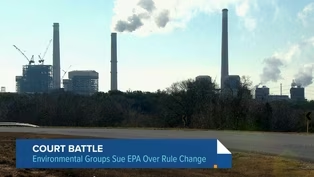
Environmental Groups Sue EPA Over Repeal of Key Climate Change Guardrails
Video has Closed Captions
Clip: 2/24/2026 | 10m 21s | A coalition of environmental organizations is suing the U.S. Environmental Protection Agency. (10m 21s)
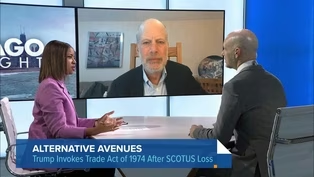
Trump Finds a New Way to Impose His Tariffs
Video has Closed Captions
Clip: 2/24/2026 | 9m 35s | The Supreme Court struck down the president's sweeping use of emergency powers to impose tariffs. (9m 35s)
Providing Support for PBS.org
Learn Moreabout PBS online sponsorship
- News and Public Affairs

Top journalists deliver compelling original analysis of the hour's headlines.

- News and Public Affairs

FRONTLINE is investigative journalism that questions, explains and changes our world.












Support for PBS provided by:
Chicago Tonight is a local public television program presented by WTTW
WTTW video streaming support provided by members and sponsors.