
Ireland Made with Love: Of Sound & Sea
9/9/2026 | 25m 16sVideo has Closed Captions
In Ireland Made with Love: Of Sound & Sea, meet artisans inspired by rhythm and the natural world.
In Ireland Made with Love: Of Sound & Sea, meet artisans inspired by rhythm and the natural world—from harp and basket makers to beeswax candle crafters. Along the coast, oyster harvesters and jewelry makers transform natural elements into works shaped by tradition, skill, and the spirit of Ireland.
Problems playing video? | Closed Captioning Feedback
Problems playing video? | Closed Captioning Feedback
Support provided by:

Ireland Made with Love: Of Sound & Sea
9/9/2026 | 25m 16sVideo has Closed Captions
In Ireland Made with Love: Of Sound & Sea, meet artisans inspired by rhythm and the natural world—from harp and basket makers to beeswax candle crafters. Along the coast, oyster harvesters and jewelry makers transform natural elements into works shaped by tradition, skill, and the spirit of Ireland.
Problems playing video? | Closed Captioning Feedback
Where to Watch Made With Love
Made With Love is available to stream on pbs.org and the PBS app.
Buy Now
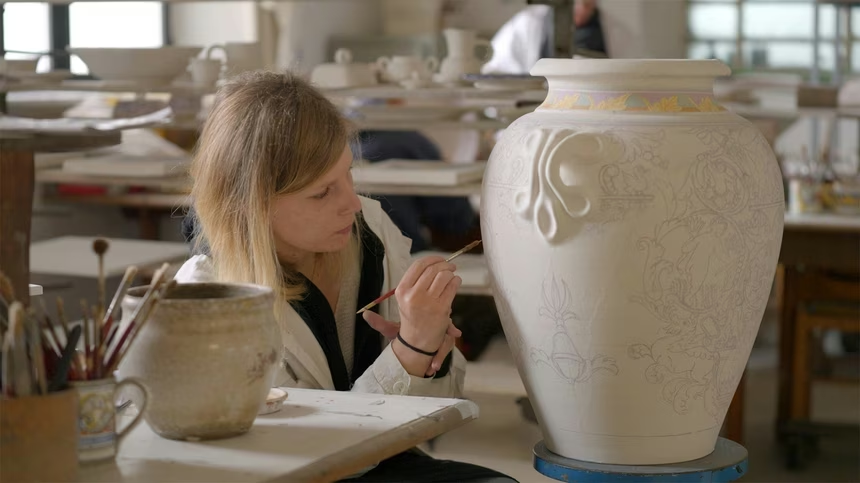
Made With Love
Made with Love celebrates the artisans keeping age-old traditions alive — an intimate journey into their workshops, kitchens, and the passionate hands behind extraordinary craft. Without them, a piece of our shared heritage would be lost.Providing Support for PBS.org
Learn Moreabout PBS online sponsorshipNarrator: Ireland, with its green pastures and sparkling coastlines.
This land nourishes creative souls all across the Emerald Isle.
Woman: There's absolutely no shortage of inspiration.
Narrator: Meet a jewelry craftsman using nature as her muse and a harp maker creating Ireland's national symbol.
Woman: It's a labor of love.
Really, I love my job.
I'm so lucky.
[Exhaling] Narrator: Hear the rhythms of their workshops as each piece takes form.
Inspired by the island's epic landscapes in "Ireland Made with Love."
♪ an enchanting melody that evokes the stunning landscape of this emerald isle.
[Harp playing] The harp is Ireland's national symbol.
You can find its likeness on everything, from Irish currency to an iconic brand of beer.
Here in County Galway, on Ireland's western seaboard, Natalie Surina uses skill, patience, and an artistic eye to recreate traditional Irish harps.
I'm Natalie.
I'm a harp maker from Galway.
Narrator: The earliest Irish harp was made more than 7 centuries ago.
Back then, Irish harps were played all over, but by the 18th century, they had fallen out of favor, and making them was a dying art.
I think there was so much knowledge which is forgotten, and there is so much experience which is forgotten.
Narrator: Natalie fell in love with the classic harp while doing research for her Ph.D.
in Irish studies.
There was just one problem.
Natalie: I couldn't afford it, basically.
[Chuckling] It was so expensive, so I thought I'd make a harp for myself.
Narrator: Since then, she's dedicated her life to making her own harps, copies of those that survive from centuries ago.
Natalie: I like to replicate, 'cause it gives me an idea of how things were done back then.
Narrator: It takes an entire year to make a harp, as Natalie slowly turns huge pieces of local Irish willow into an elegant instrument.
First, she marks the outline for the 3 key pieces of the harp: the soundbox, the pillar, and the harmonic curve, or neck.
It's the same basic blueprint harp makers relied on centuries ago.
Natalie: Very little is known, actually, about these instruments, why things were done that way, so I try to copy the way the old masters were doing it.
This is all the joys of being a female woodworker.
[Electric saw whirring] ♪ Narrator: After the pieces are cut, Natalie hollows out the soundbox, which amplifies the sound made by the strings.
She will often spend several weeks getting it just right.
Natalie: I'm just finishing the sides of the soundbox.
So the idea is to make them completely flat.
When I get to the fine bits, I start using hand tools quite a lot 'cause there's more control.
Narrator: The soundbox needs to be just the right thickness.
Too thick, it produces a dull sound; too thin, the wood will break, and then she'll have to start all over.
Natalie: It's not a kind of a science, you know.
It's just trial and error.
That's it.
[Different tapping sounds] Can you hear it here?
It's much louder and kind of brighter.
This dull section, I need to kind of improve it.
Narrator: Next, Natalie shapes the pillar.
This is the spine of the harp, the piece that helps support it.
[Filing] In this case, she makes the pillar in the shape of the Salmon of Knowledge-- a creature from a beloved Irish legend.
[Continues filing] Here we have a head and the lip and the eyes.
And because it's so smart, instead of the tail, it has the second head.
[Giggling] Narrator: Carving the salmon into the harp's pillar is a nod to Irish history and a practical matter, too.
Natalie: Everyone thinks it's a decorative part, but actually, it has a function.
It prevents the pillar from warping.
Narrator: When all the pieces of the harp are made, Natalie fits them together.
Natalie: No glue at all.
[Tapping] You don't really need any because the joints are so tight.
So, it's like the magic of medieval engineering.
[Laughing] Narrator: Natalie is down to the final steps.
First, she adds designs into the wood, then paints and varnishes it.
Last, Natalie adds the strings.
Some larger harps have as many as 36 of them.
She tunes each string to make sure it has the right amount of tension to help create the harp's lush, lyrical sound.
[Plucking strings] [Playing scale] Natalie: My favorite part is to play its first tune.
So, when you play the first tune when the harp is in tune and you can hear its voice, this is my... Yeah.
Then you feel, yeah.
[Giggles] Narrator: Every time Natalie finishes a new harp, she finds herself falling in love all over again.
You don't want to give it away.
Usually it's for a customer and you're like, "No, I don't want to part with it.
I want to play it."
[Harp music continues] ♪ Narrator: Despite her roots as a historian, Natalie has found her true passion--making harps.
♪ Natalie: It's a labor of love.
I really--I love my job.
So, every time I come here, I just like, "Oh, I'm so lucky."
[Laughing] The person who was going to spend all her life in academia suddenly started doing this and couldn't stop.
[Giggling] 17 years later, I'm still at it.
Narrator: Further north, in a scenic corner of County Galway is Connemara, an area known for its "savage beauty" and not too far from the remains of the 12th-century Castle Kirk.
With its soaring peaks and sprawling bogs, Connemara's rugged landscape has long been a source of inspiration.
My name is Joe Hogan.
I'm a basket maker, and I live in Connemara, Ireland.
Narrator: For Joe and his wife Dolores, it was their love of this land that first drew them here more than 40 years ago.
Well, I think the landscape, for me, speaks for itself.
It's a very beautiful place.
We were both interested in gardening and plants and growing some of our own food.
Narrator: They also grow and harvest the willow Joe needs to create artistic and traditional Irish baskets.
Joe: I was drawn to basket making because of the willow, by a desire to forge a slightly deeper connection with the natural world.
Narrator: Rows of willow line Joe's driveway, where they dry and harden for up to a year.
[Rustling] Today, Joe will use some of his willow to make a traditional basket known as a skib.
Skibs were used in the early 1800s to drain and serve boiled potatoes.
Certainly in the 1800s, potatoes, even though they're not a native plant, they were the main diet of the people.
Narrator: Joe relies on many of the same techniques that basket makers have used for centuries.
He uses the thickest and stiffest pieces of willow to form the grid at the base of his skib.
Joe: So, this is the kind of grid-type opening.
Narrator: Then Joe carefully begins to wrap the base with supple pieces of willow.
Unlike traditional basket makers, he uses different shades of willow to add a splash of color.
Joe: It kind of started by accident 30 years ago, because I used to have a very pliable yellow rod, and I found that people liked it.
It's quite an instinctual process.
I don't draw the basket beforehand or anything like that.
Announcer: Next, Joe adds long rods that will help shape the walls of the skib.
Once he turns the rods upright, a simple hoop will keep them in place.
Joe: this is called a wrapping iron.
It's a basket maker's hammer.
And I now need to use it just to ensure that all my uprights are in tight and close so that there won't be any air holes between the sides and the base.
[Tapping] Narrator: But his greatest tools are his hands.
Making a skib can take up to 3 hours.
Joe also weaves bigger and more complex designs that take days to finish.
He's learned to pace himself.
Joe: There's a proverb in Irish "Suí I gearr ná seasamh fhada."
"It's better to be sitting for a short time than standing for a long time."
Narrator: Over the years, Joe has made thousands of baskets and sculptures.
He also turns to classic Irish designs, like the lobster pot and the donkey creel.
Joe: Some of the weaves are unique to this country, and I find them really useful weaves in the work I do now.
Narrator: At last, the skib is almost done.
One of the final steps is to add a border and the finishing touches.
Joe: Trimming off the end pieces, and hope to use them in another project.
[Cutters snipping] I get very absorbed in the process when I'm making baskets.
So, to say that you don't feel the day going by, it would be an understatement, to be honest.
This is it, the skib, the basket which was used for straining and then serving potatoes.
Narrator: For Joe, his love of nature led him to basket weaving and finding ways of bending nature's raw materials to his artistic vision.
Joe: I just think of it as being absorbed in what I'm doing.
You are going to have to spend long hours at it.
You have to love this kind of work.
Narrator: In the middle of Ireland's heartlands lies one of its oldest counties--Tipperary.
Here, the mighty Rock of Cashel rises above lush green fields... a striking reminder of Ireland's medieval past.
Woman: We are seen as being a traditional part of Ireland.
When you're visiting Tipperary, you feel everything is moving slower because it actually is.
My name is Ailbhe Gerrard.
I'm a beekeeper and a beeswax candle maker in Tipperary, Ireland.
Narrator: Ailbhe grew up in Tipperary, then moved away to college to study sustainability.
She worked in Dublin and abroad until a conference on climate change led her back home.
Ailbhe: I was absolutely astounded by what I learned, and I said to myself, "I need to get into agriculture, "because agriculture is the key to climate change and biodiversity loss."
Narrator: Within a year, she bought a farm next to her parents with the goal of producing organic food and sustainable products.
[Hissing] [Buzzing] Narrator: Before long, she discovered the wonder of bees.
Ailbhe: I started beekeeping because as an organic farmer I was really interested in insects and what they needed, because insects are in many ways the basis of the food chain.
And then realized that wax, beeswax, is an incredible, natural, extraordinary substance.
So I started making things from it.
Narrator: In medieval Ireland, beeswax was considered a luxury item used for candles, seals, and adhesives.
Honey was the only available sweetener, so most families kept their own hives to ensure a steady supply.
Ailbhe has around 15 beehives on her farm.
Once the bees are done with them, she collects the honeycomb frames.
[Scraping] Ailbhe: Once we extract the honey from it, we're left with the empty comb, so we can melt that down, and then you end up with a block of beeswax like this.
It looks almost like cheese.
You can see.
It looks like you want to eat it, doesn't it?
Narrator: The color of the beeswax reflects what the bees have been eating.
Ailbhe: These bees have probably been feasting on summer flowers and multi floral, so this is a particularly bright color, so I like making candles out of this one.
Narrator: Today, Ailbhe's making birthday candles.
She prepares each wick of braided cotton by tying a metal nut to the end to keep it straight as she dips it into the melted beeswax.
[Birds chirping] The key is keeping the liquid wax at just the right temperature, no more than 158 degrees.
Ailbhe: Slowly, slowly, each pair goes in.
We keep on going, section after section, dip, dip, dip.
Making candles is like baking.
If something is off, then you have a disaster.
In the beginning, it feels like you're not getting anywhere, but as time goes on and you do repeated dips, then you start seeing the layers building up.
Narrator: Birthday candles need only 5 or 6 dips.
Dinner candles can take 20 or more.
Ailbhe: The whole process, it takes usually about 8 hours start to finish.
Narrator: The result... beautiful beeswax candles hand-made only steps from the hive.
Ailbhe: Most candles aren't beeswax.
Most candles aren't traditionally hand-dipped.
It's just, like, lovely to see that process through from beginning to end and then have happy customers.
It feels like such a privilege to be working on the land with the help of the bees.
Narrator: And savoring a bit of leftover honey.
Mmm!
That is one of my best honeys.
Thank you, bees.
[Exhaling air] Narrator: Thousands of years ago, people settled in the county of Sligo for its abundance of shellfish.
In Gaelic, Sligo or "Sligeach" means "shelly place."
With its inlets, cold, wet climate, and clean water, Sligo Bay provides a perfect environment for oysters to thrive.
Man: I'm Glenn Hunter.
I'm an oyster farmer from Sligo, Ireland.
Narrator: Glenn Hunter's been farming on Sligo Bay most of his life.
Glenn: Me dad and a few of the guys got together and started clam farming back in the late eighties.
We grew clams for 20 years, and we went over to growing oysters.
Narrator: Glenn's wife Aisling also grew up in Sligo.
She moved away for 15 years, then met Glenn two days after she returned home.
Aisling: He said he was an oyster farmer, and I was like, "Sligo has oysters and farms?"
And then we were dating a few weeks, and then once I seen the farm I was like, "This is incredible."
I fell in love straight away with an oyster farmer and oysters.
Ha ha!
Are we good to go?
Narrator: Each day, Glenn and his team head to the shore when the tide is out to tend to the farm.
[Boat chugging] Growing an oyster is a labor-intensive process that takes about 3 years.
Glenn: I like getting out in the fresh air and the sea breeze and just big open space.
And you never know what you're going to see.
Every day is different down in the oyster farm.
The oysters are grown in oyster bags on top of oyster trestles which keeps the oysters up off the ground.
And it stops the oysters getting suffocated in the sand, keeps them up off the crabs, and it keeps them up where the most food is in the water, which is up higher.
[Oysters rattling] Today, we're down here turning the oyster bags.
Narrator: Oysters grow between March and October.
Glenn's team turns the bags monthly to break off new shell growth, which helps strengthen and shape them.
[Rattling] The goal is a deep, cup-shaped oyster.
The deeper the cup, the better the meat.
Glenn: Here we have the lovely teardrop shape and the deep cup as you can see.
Narrator: Each bag of oysters is brought in once a year and graded according to weight and size.
They haul in up to 600 bags at a time, 50,000 bags in all.
Glenn: Keeps you in shape, all right.
I don't know any better.
Ha ha ha!
Narrator: The largest oysters are shipped to restaurants around the world.
People abroad have been enjoying oysters from Sligo since the 1800s, when the first farm here sent oysters straight to London.
Aisling: So, Harrod's was eating oysters, and all these amazing restaurants were eating Sligo oysters.
So, there was a really strong history.
Narrator: An appreciation developed abroad, but it took a while for oysters to catch on in Ireland.
Definitely a growing trend, I think here.
So, people are eating them more and more.
Once they know about them and hear about how they're farmed and the sustainable practices, they all want to taste them.
Oysters clean your bays.
They're really good for the environment.
They're really good for you.
Narrator: When you're ready to eat, you'll need a sharp eye, a gentle touch, and a good oyster knife.
Glenn: You just go in here on the side of the oyster... and you shake the knife a little bit.
Once you get the knife in, you twist it... [Shell cracks] get the knife, and you slide it on the bottom of the shell.
Just flip it over, take off a bit of the salt, and fire it back.
♪ Aisling: An oyster is like kissing the sea on the lips, so it is like literally tasting the sea.
And they're just so fresh.
There's nothin like tasting fresh oysters from where they're from, you know?
It's really nice.
Narrator: A love of oysters and Sligo they hope to pass on to their daughter Kelly.
Aisling: Kelly loves being out and about with us.
I hope she travels the world and she can tell everyone about how amazing our oysters are and whatever she wants to do.
Glenn: And the world is her oyster.
Aisling: Yeah!
Narrator: Growing up, Irish poet William Butler Yeats spent his summers in Sligo.
Later, he wrote about this coastal county with a boy's sense of wonder.
Woman: "A moon worn as if it had been a shell, "washed by time's waters as they rose and fell about the stars and broke in days and years."
I'm Martina Hamilton.
I'm a jewelry designer from Sligo, Ireland.
Narrator: For local artisan Martina Hamilton, the poetry of Yeats and the Atlantic coastline inspire her jewelry collections.
Martina: I like to think that I engender a sense of place into the jewelry I make.
There's absolutely no shortage of inspiration from finding shells on the beach, and sometimes a simple thing like just looking down at the ground and noticing a shell that's turned a particular way starts the creative process.
And I like to kind of catch that experience if I can in a piece of metal.
Narrator: From her studio in town, Martina and her team of master goldsmiths are crafting a pendant and pearl necklace inspired by the oysters of Sligo.
[Machinery buzzing] She starts by carefully measuring and cutting two circular discs from a thin sheet of sterling silver.
[Sawing] When you're working in silver, of course, you're in a very small world, and once you get into that small world, everything is down to the millimeters.
[Tap] Narrator: Most of the tools used in the workshop have been around for centuries.
[Tapping] A doming punch helps Martina give the discs a gentle curve, then she painstakingly drills a tiny hole for a needle-thin saw.
Martina: A very steady hand is required and patience.
You have to just focus very closely on one thing at a time, which is the beauty of it, really, as well.
When you're concentrating on making something, everything else is gone.
[Flame pops] Narrator: Martina's brother- in-law handles the soldering, applying heat evenly to attach the silver discs.
Martina: Every little detail has to be calculated.
You want something to be light and comfortable to wear, but at the same time, it has to be physically strong.
So, there's a lot of knowing in it.
[Buzzing] And then the outer shape is textured as a shell might be.
[Buzzing] [Filing] Narrator: Once the metal is filed and polished, Martina attaches the pearl.
Martina: I wanted to do something that was a bit asymmetrical, and I wanted to have the feeling of that lovely soft center of the shell on the inside and make a little cozy, safe space for the pearl.
Narrator: From the spark of an idea to a finished piece... inspired by the seas of Sligo.
Martina: The loveliest thing is, we've made something that's classic that lasts a lifetime.
It continues to inspire me.
I hope that I succeed at least sometimes in conjuring up this very special place that is Sligo.
It's home.
Narrator: Across Ireland's green pastures, passion can always be found in its artisans as they draw inspiration from the beauty of the Emerald Isle, and carry on the traditions of past generations.
Joe: I was drawn to basket making because of the willow, by a desire to forge a slightly deeper connection with the natural world.
Narrator: Their work is a living testament to their proud heritage, as they pour love and passion into every creation.
of dedicated artisans from around the world.
[Fire burning] Honoring their work to help preserve these traditions for generations to come.
For more information, visit... [Exhaling]
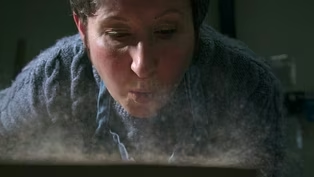
Natalie Surina: Crafting Ireland's Celtic Harps
Video has Closed Captions
An Irish harpmaker handcrafts elegant Celtic harps using centuries-old traditions. (2m 42s)
Providing Support for PBS.org
Learn Moreabout PBS online sponsorship New Season
- Drama

Hugh Bonneville stars in a crime drama inspired by one of the largest robberies in British history.
 New Episode
- News and Public Affairs

Top journalists deliver compelling original analysis of the hour's headlines.
 New Season
 New Episode




 New Episode
Support for PBS provided by: