
June 1, 2026 - PBS News Hour full episode
6/1/2026 | 56m 45sVideo has Closed Captions
June 1, 2026 - PBS News Hour full episode
Monday on the News Hour, the Justice Department hits pause on its plans for a so-called "anti-weaponization" fund for people who claimed they were unfairly targeted by past administrations, Israel launches its deepest incursion into Lebanon in decades amid talks aimed at ending the U.S.-Iran war and a new report examines just how secure the voting process is for the upcoming midterm elections.
Problems playing video? | Closed Captioning Feedback
Problems playing video? | Closed Captioning Feedback
Major corporate funding for the PBS News Hour is provided by BDO, BNSF, Consumer Cellular, American Cruise Lines, and Raymond James. Funding for the PBS NewsHour Weekend is provided by...
June 1, 2026 - PBS News Hour full episode
6/1/2026 | 56m 45sVideo has Closed Captions
Monday on the News Hour, the Justice Department hits pause on its plans for a so-called "anti-weaponization" fund for people who claimed they were unfairly targeted by past administrations, Israel launches its deepest incursion into Lebanon in decades amid talks aimed at ending the U.S.-Iran war and a new report examines just how secure the voting process is for the upcoming midterm elections.
Problems playing video? | Closed Captioning Feedback
Where to Watch PBS News Hour
PBS News Hour is available to stream on pbs.org and the PBS app.
Providing Support for PBS.org
Learn Moreabout PBS online sponsorshipGEOFF BENNETT: Good evening.
I'm Geoff Bennett.
Amna Nawaz is away.
On the "NewsHour" tonight: The Justice Department hits pause on a so-called anti-weaponization fund for people who claimed they were unfairly targeted by past administrations.
Israeli forces launch their deepest incursion into Lebanon in decades, complicating already fragile negotiations aimed at ending the U.S.-Iran war.
And a new report examines just how secure the voting process is for this year's hotly contested midterm elections.
AARON ROSE, Check Point Software Technologies: The real risk that we're facing is misinformation and confusion, which ultimately erode the trust of the American people.
(BREAK) GEOFF BENNETT: Welcome to the "News Hour."
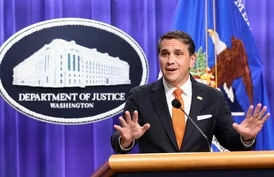
President Trump's nearly $1.8 billion so-called anti-weaponization fund just hit a setback today.
The Justice Department says it will comply with a court order temporarily blocking payments from the program, money that could have gone to January 6's defendants and other Trump supporters.
Beyond that, some Republicans on Capitol Hill expressed concerns about the fund and how the money would be handed out.
Our White House correspondent, Liz Landers, is here to explain what we know.
So, Liz, what exactly has the Trump administration decided to do?
What does this pause effectively mean?
LIZ LANDERS: So there's a lot here that we still don't know.
I will add that.
But, last week, a judge here in Virginia said that there needed to be a pause for about two weeks until June 12 before they could disburse any money from that fund.
In addition to that, another judge in Miami said that they wanted to re-look and reexamine the IRS settlement, which was what precipitated all this when the president settled with the IRS.
The Department of Justice says today that they strongly disagree with that ruling from the judge in Virginia, but they will abide by it.
But that's only for two weeks.
So I asked the White House, is this temporarily paused or is this final and will the fund no longer exist?
They have not responded to that.
GEOFF BENNETT: And as we sit here and speak, the Associated Press, citing a single source familiar with President Trump's thinking says that he is now reconsidering this pause, so certainly more to come.
But the other dimension here, as we mentioned, the Republicans on Capitol Hill who were uneasy about this because they were set to take a vote on this, on this fund.
LIZ LANDERS: Republicans have apparently been outraged about this sort of behind closed doors.
There has been a funding process that they have been hammering out on the Hill to fund ICE and other agencies.
And this was becoming a snag in those negotiations.
Our congressional colleague, Lisa Desjardins, had spoken with one Republican senator who told her that there were only one or two of their Republican colleagues in the Senate that were happy or were comfortable with this fund.
Today, the president met with Speaker Johnson at the White House.
We believe that this came up in conversation.
And then the majority leader, Senate Majority Leader John Thune, told reporters today that he wanted this weaponization fund dropped from that immigration bill.
GEOFF BENNETT: And this fund is part of a larger effort to rewrite what actually happened on January 6.
I know, as part of your reporting, you have been speaking to people on both sides of that debate.
What are they saying?
LIZ LANDERS: I spoke last week with D.C.
Metropolitan Police Officer Dan Hodges.
He was pinned and stuck in the tunnel on January 6 defending the Capitol.
And I asked him about his reaction to the formation of the fund.
DANIEL HODGES, D.C.
Metropolitan Police Department: Why should the government try to pay these people that attacked it?
Why would we try to pay the people who tried to stop the peaceful transfer of power?
If these people were given money, then they -- it would empower them, give them the resources and make them feel like they're untouchable to carry out their threats and any potential further violence.
LIZ LANDERS: I also spoke with Brandon Fellows.
He was convicted for his participation in January 6.
He wants up to $30 million from the federal government, from this fund.
And although he has not been convicted of abusing cops or beating up cops on that day, I asked him, what about the people who did?
Do they deserve to get money from this fund?
He thinks most should.
BRANDON FELLOWS, Pardoned For January 6 Convictions: I think there's a very select few that should not get money.
Now, as far as assaults, you have things ranging from people throwing a water bottle and hitting a shield, and then they ended up pleading to that.
I think they should be rightly compensated.
LIZ LANDERS: Enrique Tarrio, who was considered to be one of the planners of January 6, he was convicted for seditious conspiracy, he told me just this afternoon, he said he doesn't think that this is an abandonment of the fund, adding -- quote -- "I believe even if this fund is killed in courts or at a congressional level, the president will find a way.
There are other options."
They can just settle the tort claims and lawsuits.
That has no judicial review or congressional oversight, and it would mean a lot more money in compensation," Geoff.
GEOFF BENNETT: Liz Landers, our thanks to you, as always.
LIZ LANDERS: Of course.
GEOFF BENNETT: There were conflicting signals today from the U.S.
and Iran over the status of negotiations to extend the cease-fire and begin talks on ending the war.
Meantime, the cease-fire between Israel and Hezbollah has all been but shattered, as Israel presses deep into Lebanon.
That spiraling situation is where Ali Rogin begins our report tonight.
ALI ROGIN: Today in Beirut, another challenge to a brittle truce, chaos and confusion, as thousands flee the capital, displacing again many people who'd already fled their homes.
NAJI MUSULMANI, Displaced Lebanese (through translator): This is the third time we are displaced, moving from a place to another.
Now I'm heading to Tripoli, to the kind people of Tripoli.
ALI ROGIN: They brace for more Israeli bombing after Prime Minister Benjamin Netanyahu ordered more strikes, despite a struggling cease-fire between the two countries.
BENJAMIN NETANYAHU, Israeli Prime Minister (through translator): I have instructed the IDF to strike terrorist targets in Beirut.
There will not be a situation in which Hezbollah attacks our cities and our citizens and its terrorist headquarters in Beirut, in Dahiyeh, remains out of bounds.
ALI ROGIN: Iranian state media released this video claiming to show a ballistic missile launch stamped with a caricature of President Trump targeting a U.S.
military base in Kuwait.
(SIRENS BLARING) ALI ROGIN: In Kuwait City, air raid sirens warned of incoming Iranian drones and missiles, which U.S.
Central Command says were intercepted.
It follows a back-and-forth skirmish over the weekend along the Strait of Hormuz.
The U.S.
says Iran downed an American drone, and CENTCOM responded by targeting air defenses and a ground control facility along the coast.
Such exchanges have become increasingly common, as diplomacy between Tehran and Washington languishes.
But after weeks of attempts to get back to the bargaining table to address the closure of the Strait of Hormuz and Iran's nuclear program, today, the Islamic Republic said it suspended indirect talks between the two countries, tying the war in Iran to Israel's widening invasion of Lebanon, insisting that any peace between the U.S.
and Iran must include Lebanon.
When asked about Iran halting negotiations, President Trump told NBC -- quote -- "I think we have been talking too much, if you want to know the truth.
I think going silent would be very good, and that could be for a long time," then telling CNBC: "I really don't care.
I couldn't care less.
Frankly, I thought they started to get very boring."
But, just hours later, Trump wrote on social media -- quote -- "Talks are continuing at a rapid pace with the Islamic Republic of Iran."
For its part, Iran's Islamic Revolutionary Guard Corps warned the people of Northern Israel, as read by state media.
MAN (through translator): Given the regime's repeated violations of the cease-fire, if this threat is carried out, we warn the residents of the northern areas and military settlements in the occupied territories to leave the area if they do not want to be harmed.
ALI ROGIN: But President Trump today, after speaking with Netanyahu, claimed that "Hezbollah agreed that all shooting will stop, that Israel will not attack them and they will not attack Israel."
The heightened tensions come as Israeli troops pushed past the Litani River last week, the deepest occupation of the territory in over 25 years.
Footage released by the IDF shows infantry seizing Beaufort Castle over the weekend, a 900-year-old crusader fortress, a strategic stronghold Israel fled from in 2000, which Firas Maksad, a Middle East expert at the Eurasia Group, says Israel will not want to give up easily.
FIRAS MAKSAD, Eurasia Group: Beaufort Castle, the Crusader castle, linchpin strategic choke point in Southern Lebanon.
In the past 24 hours, Israel was again able to occupy that strategic hilltop.
ALI ROGIN: The rising violence comes as Lebanon and Israel are scheduled to meet tomorrow in D.C.
for U.S.-brokered peace talks, which Maksad said could be the breakthrough President Trump needs.
FIRAS MAKSAD: It's very clear here that President Trump has an interest in trying to avert the worst in Lebanon.
What's happening in Lebanon is not independent from what is actually happening between the U.S.
and Iran.
Trump very much stepped in, tried to get a cease-fire in Lebanon.
It would be a win for his efforts to try and continue talks with Iran.
It's also a win from Hezbollah that is weakened and very much wants a reprieve from Israeli action.
ALI ROGIN: Until a deal is agreed upon, it's the war-weary Lebanese people who are left hoping talks will bring about a lasting truce.
FIRAS MAKSAD: Even within Hezbollah's own community, much tired and fatigued by war, there is now pressure to bring diplomacy to bear and bring this conflict to a close.
ALI ROGIN: Meanwhile, in Northern Israel, smoke can be seen rising from Lebanon as both sides continue to trade cross-border blows, with a resolution to the war no closer.
For the "PBS News Hour," I'm Ali Rogin.
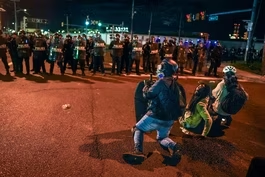
GEOFF BENNETT: In the day's other headlines: New Jersey's attorney general says a group of individuals was arrested last night for breaking a curfew near an ICE detention facility that has seen days of unrest.
Demonstrators clashed with police this past weekend outside the privately run Delaney Hall detention facility in Newark, seen here pushing against barricades.
Federal and state officers used riot shields and tear gas to disperse the crowds.
The protests were sparked by reports of poor conditions inside the 1,000-bed facility, including concerns about food quality.
The wife of one detainee spoke with the "News Hour" earlier today.
Her face is blurred at her request.
GABRIELA FUENTES, Wife of Delaney Hall Detainee: It's not because they don't want to eat it because they don't like it.
It's because it's rotten.
It's because when they go downstairs to lunch, there was an incident about their beans with worms in it.
In the breakfast, their milk is chewy.
So how do they think they're going to be able to eat their cereal?
But when they pour that milk in the cereal, the cereal is expired too.
GEOFF BENNETT: House Minority Leader Hakeem Jeffries and other Democratic lawmakers have called for Delaney Hall's closure over the reported conditions.
In response, Department of Homeland Security posted on social media: "Everyone being held inside Delaney Hall broke the law.
This is a detention center.
We do not provide luxury accommodations."
In Colorado, election denier Tina Peters was released from prison today after serving less than a quarter of her nine-year sentence.
The former elections clerk was convicted in 2024 for her involvement in a plot to show that voting machines in the 2020 election were rigged against Donald Trump.
Joe Biden was the winner of that election.
Last month, Colorado's Democratic Governor Jared Polis commuted her sentence amid pressure from President Trump.
Soon after her release, Peters appeared on right-wing podcaster Steve Bannon's program where she accused Democrats of trying to cheat in this year's midterms.
Colombia's presidential election is set for a run-off later this month, with a pro-Trump candidate enjoying a surge in the polls.
Supporters of Abelardo de la Espriella celebrated his strong showing in Sunday's first round of elections, where he got nearly 44 percent of the vote.
That's thanks largely to his promises to crack down on violent crime.
He beat out progressive opponent Ivan Cepeda, who initially questioned the validity of the results, but then today backed away from such claims.
Since neither candidate won 50 percent of the vote, a run-off election will be held on June 21.
In Kenya, hundreds of young people protested today against plans by the U.S.
government to set up an Ebola quarantine facility for Americans exposed to the virus.
They marched to the gates of the air base where U.S.
officials hoped to establish the center.
On Friday, Kenya's High Court temporarily blocked the plan.
Then, on Monday, Kenya's health minister said the facility would serve everyone and not be reserved exclusively for U.S.
nationals.
But protesters remained unconvinced, arguing that Kenya should not host foreign patients when the country itself is not facing an active outbreak.
SUSAN WANGARI, Protester: We want to tell the president he cannot be making such a decision to people of Kenya without even considering what will be the effect of what they are doing.
We feel that we are being shortchanged, because they didn't even come for public participation.
GEOFF BENNETT: Meantime, in Democratic Republic of the Congo, the outbreak continues to spread across three Eastern provinces with more than 280 confirmed cases so far and at least 1,000 suspected cases.
A.I.
giant Anthropic is moving forward with an initial public offering.
The company behind the Claude chatbot submitted a confidential filing with the Securities and Exchange Commission today.
Anthropic is looking to get out ahead of rival OpenAI, which is preparing its own filing as the companies look to tap investor enthusiasm in artificial intelligence.
Meantime, on Wall Street today, stocks inched higher amid ongoing uncertainty over Iran.
The Dow Jones industrial average added nearly 50 points to start the week.
The Nasdaq gained more than 100 points.
The S&P 500 also ended in positive territory.
And Serena Williams is returning to professional tennis after a four-year absence.
The 44-year-old will play doubles at the Queen's Club Tournament later this month, an event that leads up to Wimbledon.
The 23-time Grand Slam singles champion confirmed the news in a social media video.
Williams bid farewell to the sport after the 2022 U.S.
Open, though she herself never used the word retirement.
Still to come on the "News Hour": a promising new treatment for pancreatic cancer doubles survival rates in trials; the risks A.I.
and misinformation pose in this year's midterm elections; and Tamara Keith and Jasmine Wright break down the latest political headlines.
A medical breakthrough in the fight against pancreatic cancer is showing promising results after decades of research.
The experimental drug taken once a day extends patients' lives by slowing the progression of one of the deadliest cancers.
Stephanie Sy has more.
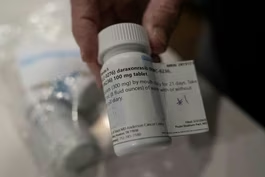
STEPHANIE SY: Geoff, it's called daraxonrasib.
And, put simply, it targets mutations of the KRAS gene, a common driver of pancreatic cancer that chemists viewed for a long time as undruggable.
Pancreatic cancer is expected to kill more than 52,000 Americans this year.
It's often diagnosed after it's already spread, putting the five-year overall survival rate at a meager 13 percent.
For most advanced patients, there's no cure.
And standard treatment has been chemotherapy.
Experts say that could be about to change.
For more on what this means for patients and the future of cancer treatment, I'm joined by Dr.
Rachna Shroff, associate director of clinical investigations at the University of Arizona Comprehensive Cancer Center.
Dr.
Shroff, this is hopeful, to say the least.
And before we get into the details, I imagine you have treated and lost many pancreatic cancer patients over the years.
I lost my own mother to the disease very quickly a few years ago.
What was your reaction when the results were read to the room over the weekend?
DR.
RACHNA SHROFF, Associate Director of Clinical Investigations, University of Arizona Cancer Center: You know, I think, like you said, this was a monumental day in the treatment of pancreatic cancer.
I have been using the word game changer, and that is not a word that we use lightly when it comes to treating this disease.
And the honest truth is, it was tears, tears of joy, 16 years of treating this disease, and, like you said, countless lives lost to this horrible, horrible cancer.
And so to see the results and to be in that room with a number of people who have that same drive to kind of improve cancer outcomes for patients, it was an incredibly emotional moment.
STEPHANIE SY: The studies participants were looking for a Hail Mary.
They'd all undergone at least one round of chemo, from what I understand.
And the results showed those put on this new drug lived an average of 13 months, compared to those who lived only about six months without it.
How significant is that, Dr.
Shroff, in the world of oncology?
DR.
RACHNA SHROFF: You know, I would say that having the ability to have a pill double survival in patients who have already had one prior type of treatment for pancreatic cancer and have stage four disease is so far unprecedented.
We have not ever seen a doubling of survival when it comes to treating this disease.
And that is incredibly impactful, of course, just from a numbers sake, but also is so meaningful to patients who are hopefully going to see more milestones, more important moments in their life.
STEPHANIE SY: This is the same experimental drug that former Senator Ben Sasse has been on since his pancreatic cancer diagnosis.
Here's what he said to "60 Minutes" Scott Pelley in April about why he's still alive.
FMR.
SEN.
BEN SASSE (R-NE): Let's go with providence, prayer and a miracle drug.
In mid-December, I was given a three-to-four-month life expectancy.
I am on extended time already.
I have much, much less pain than I had four months ago when I was diagnosed, and I have a massive 76 percent reduction in tumor volume over the last four months.
STEPHANIE SY: Now, we should also say that Sasse said to a different journalist that the side effects have been pretty nasty, that his skin bleeds and sometimes feels nuclear, were his words, Dr.
Shroff.
But what else should people know about side effects of this drug and who it can and can't help?
DR.
RACHNA SHROFF: Well, so far, from the results that we have seen in terms of who it can and can't help, we think it really is a drug that should be offered to all patients who have had one prior line of chemotherapy.
While we recognize that this drug specifically targets the KRAS mutation -- or the KRAS pathway, rather, over 90 percent of pancreatic cancer patients have KRAS mutations.
And this study included all comers.
It was -- seems to work regardless of KRAS mutation status.
And so it really hopefully will become the standard of care for all patients after one prior line of chemotherapy.
Now, as you mentioned, things to know, yes, with every drug comes side effects and toxicities.
But I will say that there is a learning curve for all of these drugs.
And all of us who -- once we get our hands around it, once we work with some of our multidisciplinary colleagues, for instance, with the rash, working closely with our dermatologists, we're learning.
We're learning how to be preemptive and prophylactic about trying to prevent such severe side effects that the patient's quality of life is affected.
For the rash, avoiding sunlight, using oral antibiotics and topical steroids, I mean, those things seem to be helping, seem to be mitigating the rash.
And I think the other thing I will say is, is that, when you look at the study, only a small percentage of patients actually discontinued taking the drug because of side effects.
And so I think, if we're able to provide clinically meaningful improvements for our patients, as long as we learn how to manage side effects, we can hopefully handle those trade-offs.
STEPHANIE SY: And that KRAS pathway, those mutations, I understand, are also involved in other cancers, including those of the colon and the lung.
So what potential does this drug hold for those patients?
DR.
RACHNA SHROFF: Well, I literally keep saying that the RAS revolution is here.
This has been historically undruggable.
This has been the Holy Grail for cancer, because, like you mentioned, KRAS mutations are ubiquitous.
We see them across all kinds of different tumor types.
And so now, now that we have proof of principle, that we know that targeting this pathway provides meaningful outcomes and improvements in patients with pancreatic cancer, the next obvious question is, is, what can this drug and other RAS inhibitors do?
And we have other KRAS inhibitors that are already available in colon cancer and lung cancer.
So now we're kind of in this next wave, where we're going to see what daraxonrasib can do in colorectal cancer, lung cancer, but a number of other cancers in which KRAS mutations exist.
And this is just the first of many drugs and many more trials that will hopefully answer those questions.
STEPHANIE SY: And we should note the FDA has granted some patients early access to the drug while the company seeks expedited approval from the agency.
That is Dr.
Rachna Shroff with the University of Arizona.
Thank you.
DR.
RACHNA SHROFF: Thank you.
GEOFF BENNETT: The U.S.
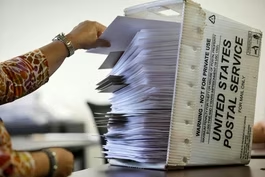
Postal Service has proposed new rules that would require states to hand over data on voters who receive mail-in ballots for federal elections.
It comes after President Trump signed an executive order earlier this year tightening mail-in voting rules with a stated goal of making elections more secure.
But a report out today says the most likely threats to election security this November come from other sources.
Our Liz Landers recently sat down with one of the authors of that report.
LIZ LANDERS: Members of the Trump administration are ramping up warnings about election security as the midterms draw closer, citing conspiracy theories about rigged voting machines, voter fraud, and more.
The president himself repeated those claims from the Oval Office last month, urging Congress to pass legislation he says will secure elections.
DONALD TRUMP, President of the United States: I think the elections are so rigged and we have to do something about it, and we're going to do something about it.
But we cannot continue to have -- and, frankly, the Senate and the House, they ought to get together and they ought to pass the SAVE America Act, so that you have voter I.D.
And it's so important you have proof of citizenship, little thing like proof of citizenship, and also mail-in voting, which is so crooked.
LIZ LANDERS: A new report first shared with PBS News by the cybersecurity company Check Point Software Technologies outlines what should and should not be a concern for voters going into the midterms.
It also analyzes threats from foreign actors, artificial intelligence, vulnerabilities for voting machines, and more.
Joining me now to discuss that report is Aaron Rose, a security expert with Check Point Software.
Aaron, thanks so much for joining us.
AARON ROSE, Check Point Software Technologies: Thanks for having me.
LIZ LANDERS: PBS News had a poll from March that found that 85 percent of registered voters say it's likely that political content generated by A.I.
will spread misinformation related to these upcoming November elections.
How is artificial intelligence accelerating those vulnerabilities and misinformation about our elections here?
AARON ROSE: Now that we're in the age of A.I., it can consume and take so much data and learn so much about us that it can generate things that are believable, not just things that are like a phishing e-mail, but content that's shared on social media or deepfake videos that are getting harder and harder to actually tell what they truly are.
So A.I.
is accelerating, unfortunately, all of this misinformation that we're seeing, especially when it comes to the elections coming up.
LIZ LANDERS: Your report details how foreign adversaries like Iran, Russia and China will likely want to try to influence these midterm elections.
What are they interested in and what are their objectives?
AARON ROSE: Yes, so finding their objectives -- I think the objectives in a lot of way are clear.
They want to either steer it or they want to cause confusion.
So when we're talking about the election, what a lot of people are concerned with when it comes to security is the electronic ballots, right?
They're thinking, OK, somebody's going to hack a voting machine.
Now, I'm not saying that that's implausible.
It is very possible for that to happen.
In fact, it's been proven, but it does require physical access to the machines.
It's very complicated to do that, especially do that at scale.
You start to think about the United States, how many people we have, how many congressional districts, et cetera, that is a lot of machines that they would have to have physical access to actually be able to change the outcome of the election.
However, if you think about it on the flip side of kind of misinformation and confusing people and essentially eroding the trust in the system, that is something that they can do just by spreading misinformation.
So if they can just confuse, I don't know, 10,000 voters maybe in a swing state or area, that alone could shape and change the outcome of the election.
LIZ LANDERS: This administration and the president in particular talk a lot about issues that they perceive with the elections in this country.
Not a lot of what I have heard from the president and what I have heard from the administration overlap with the concerns that are outlined in your report.
Is the administration focused on the right problems?
AARON ROSE: You know, I think there's a lot of issues that we need to address.
There's questions of integrity when it comes to our election systems.
And I'm not going to say either way.
I think that they can be valid in a lot of ways.
But, for us, we're focusing more on the technological, but also the psychological side of things and how they're using technology to do so.
LIZ LANDERS: Are social media companies paying attention and taking responsibility for their role in how misinformation and disinformation in particular can be spread to influence these elections?
AARON ROSE: They're starting to.
I will definitely give some applause or give some positive feedback to them.
I'm starting to see more and more of, like, labels that are being applied to videos and images that may or may not be A.I.-generated.
There's community notes by several of the platforms now, to where people can kind of validate the facts.
So it appears that they are.
They're making an effort.
And it's not an easy problem to solve.
Unfortunately, there isn't a Band-Aid.
There isn't a silver bullet to solve all of this at once.
So I think that every step that we make in that direction is a good step to make.
LIZ LANDERS: What are your recommendations for jurisdictions and for people that implement elections in this country and also for voters to be aware of going into the midterms?
AARON ROSE: So, when you think about, like, individual jurisdictions and kind of, like, smaller counties, municipalities, et cetera, the data that they have or the ability to influence the election is still very high.
And the risk against them is the same as the risk against some of the largest federal agencies that we might have here in the United States.
Unfortunately, there's a disparate -- there's a problem between those two, where one has a much larger budget than the other, right?
So they need to -- unfortunately, they're going to have to do more with less.
They're going to have to pay attention.
They're going to have to implement cybersecurity controls in all areas, physical access controls as well.
Now, when it comes down to the individual voters, this gets a little bit more difficult, because what I would ask everyone is that, when you're seeing information, so if you're seeing a new news story that's shared maybe on Facebook or some other platform, stop for just a moment and really analyze it.
Say, maybe this agrees with everything that I feel politically or not.
Before I repost that, I want to make sure that it's coming from a reputable source.
I want to look and pay attention to that URL and make sure it's something that's legitimate.
LIZ LANDERS: Is the federal government educating the public on this?
And are you working with agencies like CISA, which is the Cybersecurity Agency, that has typically handled the hardening of election infrastructure in this country in the past?
AARON ROSE: Yes, so the federal government has actually done quite a bit.
And I think education is the key.
We have got to educate people to become trained professionals in cybersecurity, but we also need to be able to train consumers and educate them on the risks that are associated.
So I think the federal government is doing quite a bit.
Now, whether or not that's enough, that's a great question, unfortunately.
We will kind of see that after the fact or in the future.
LIZ LANDERS: Do you think that the Trump administration in particular is doing enough to educate the public on these election security concerns?
AARON ROSE: I do believe the current administration, though, has brought up the topic around election security quite a bit.
It's been top of mind for a lot of people.
But the real risk that we're facing is misinformation and confusion, which ultimately erode the trust of the American people.
And I think that area needs a bit more focus at the present time.
LIZ LANDERS: Bottom line here, should Americans have trust in the election system going into November?
AARON ROSE: I'm a very hopeful person, so I'm going to say, yes, I think so.
We haven't seen hard evidence or anything that shows that the back-end systems, that the voting machines, the ballot counting, et cetera, we haven't seen anything like that to say that has definitively been breached or manipulated in any way.
LIZ LANDERS: Aaron Rose, thank you for your time.
AARON ROSE: Thank you.
I appreciate it.
GEOFF BENNETT: Let's delve deeper now into the political headlines shaping this week so far with today's Politics Monday duo.
That's Tamara Keith of NPR and Jasmine Wright, White House correspondent for NOTUS.
Amy Walter is away this evening.
It's good to see you both.
So, Tam, we spent all last week talking about how the latest primaries show President Trump's grip on the GOP.
This latest development where he is now tabling, at least for now, this $1.8 billion compensation fund for his supporters, it really shows the limits of his influence over congressional Republicans in many ways.
TAMARA KEITH, National Public Radio: Well, in some ways, his great victory in defeating Republicans who were not loyal enough now creates a larger what NPR were calling YOLO caucus, you only lose once, and then you are a little bit more free to do whatever you want after that.
But it's not just them.
There's a large number of Republicans.
Ted Cruz on his podcast said something like 20 Republicans in a closed-door meeting with Todd Blanche were pushing back really hard on this so-called anti-weaponization fund.
And the bigger issue is that there are very few Republicans, very few, who want to go out into swing districts and campaign on this or have to answer for it.
And so there is a very big political problem for this fund, which is why you see this quiet backing away, though it's not clear -- until the TRUTH Social post is out and until the president says it with his own mouth, it's not clear really whether they're doing anything more than following what a judge says they need to do for the next two weeks.
GEOFF BENNETT: Right.
What's your latest reporting on this?
JASMINE WRIGHT, NOTUS: Yes, backing away for how long I think is kind of the question that not just we at "News Hour" are asking, but folks on the Hill are starting to ask.
We know, according to my colleagues at NOTUS, that the president met with Speaker Mike Johnson today at the White House.
And an issue like this was raised.
Obviously, I think for a long time Republicans, particularly John Thune, has been saying that they don't have the votes for this.
Mike Johnson expressed that this was in trouble and kind of tried to convince Trump, according to a source -- told NOTUS, to back away from it.
And that factored into this decision which led to that tweet by the Justice Department.
We will see how long that lasts.
But this is something that the president wanted.
This is something that other officials within the administration talked about, but it's not something that necessarily resonates with the base.
They don't -- they are supportive of January 6 folks who believe in the MAGA effort, but do they really need to see folks getting paid?
One source told me, probably not.
And so it's going to -- a question of where it's going to go still remains.
But I think a larger question is, how does this represent the people that President Trump is supposed to be representing going into the midterm elections?
And I think folks have questions on that part too.
GEOFF BENNETT: Well, the president spent part of the weekend Saturday posting on social more than 60 times over a six-hour stretch, Tam, a slew of A.I.
images celebrating himself.
He described himself at one point as being bigger than Elvis.
And this had to do with the unceremonious collapse of this America 250 concert where you saw artist after artist after artist drop out.
The president is now proposing replacing all of it with a political rally.
What's your read on what happened?
TAMARA KEITH: Well, you're just describing an average weekend on President Trump's TRUTH Social feed, which is a lot of stuff.
What happened here is that Freedom 250 is actually a Trump-affiliated organization that was created to plan, among other things, the Great American State Fair on the National Mall, which was supposed to be like a World's Fair, modeled after the Chicago World's Fair, with a giant ferris wheel and some acts that you would see at a state fair or maybe a county fair in the '90s.
And then they announced these acts.
It wasn't a big concert.
It was just like acts scattered over this two-week period.
And all of a sudden, these people who were on the list of artists were both being mocked and being criticized for doing something too closely affiliated with President Trump.
These artists came out and said, we didn't know this was a Trump thing.
And it completely imploded.
I think the bigger issue here is that in this current era of American politics, with a president who's putting his face on money, or wants to, his name on buildings, there is not seemingly a safe space where you can just have the president be the president for all Americans and a patriotic moment for the 250th birthday of America.
Instead, it all comes back to politics and this division that it seems no one really likes and yet everyone continues to feed.
GEOFF BENNETT: Well, on that point, I mean, the 250th birthday is supposed to be a bipartisan celebration of this country and all that it has stood for.
Are we at a point now where you can't really separate a national celebration from partisan politics in this Trump era?
JASMINE WRIGHT: I think that people would hope not.
But, I mean, after the imploding of this Freedom 250 state fair, the question is perhaps.
Obviously, the president has said that he wants it to be the greatest birthday celebration for the country ever.
And that is why Freedom 250 was commissioned by that executive order.
And so you're seeing the president do so much across the city of D.C., fusing about $100 million of taxpayer money to beautify D.C.
ahead of it.
And so I don't think you're going to see the president step back from trying to make sure this is the greatest American birthday, regardless of if people feel that it is becoming politicized with his involvement.
GEOFF BENNETT: Jasmine Wright, Tamara Keith, thank you both.
TAMARA KEITH: You're welcome.
GEOFF BENNETT: There has been a sharp rise in so-called nudification technology.
These A.I.-powered tools can generate realistic fake images and videos that depict people as undressed, often without their knowledge or consent.
William Brangham reports on the growing concern over that technology and efforts to rein it in.
WILLIAM BRANGHAM: As the types and uses of this technology have grown, lawmakers at both the state and federal level have tried to draft laws to curtail it, but that has proven to be very difficult.
So, to help us understand this current landscape, we are joined by Kolina Koltai.
She's an investigative journalist for the news site Bellingcat, and she has been covering this issue closely.
Kolina, thank you so much for being here.
Could you help us just understand at first what these technologies are, what they do, and how they do it?
KOLINA KOLTAI, Bellingcat: Yes.
Thanks for having me here.
It is a little bit of a complicated topic, but essentially there are a range of services, apps, products out there from Web sites to an app you can download on your phone that allow you to essentially take a photo of someone's face and make a pornographic image and a now pornographic video of that person.
So, this might be, say, something as simple, where the term nudify comes from, is just removing the clothing digitally from a photo.
So it takes a real photo, removes the clothes, so the body is completely A.I.-generated, but you might also have technology nowadays that allows you to upload a face of someone from, like, imagine from Facebook or from Instagram, and it creates a whole brand-new image.
So the entire image is A.I.-generated based off that person.
So it makes a fairly convincing image or video that is sexual in nature based on that.
And there's even apps where you can face-swap.
So you might have a video clip and in some cases a pornographic video clip, and they upload of someone's face and it just essentially swaps that person's face onto another actress' body.
So while the face itself and the video itself might be real, they're from two different sources.
And these all kind of fall under the range of sort of what we might call, like, A.I.
nudification, A.I.
deepfake, A.I.-powered nonconsensual intimate imagery.
WILLIAM BRANGHAM: And how widespread are these technologies?
Who's making them and who is using them?
KOLINA KOLTAI: Yes, the technology is unfortunately incredibly widespread.
It's something that is a global issue, not just here in the U.S., but it's something that is definitely plaguing, say, like U.S.
high schools.
There is case after case of this kind of technology being spread about, being used by students.
I think some of the recent surveys have been done is that one -- about, I think, 50 percent of students are familiar with the technology, I have seen someone use the technology, something along those numbers.
And I think it just keeps on rising and rising.
And as far as the prevalence and availability of these kind of apps and technologies, you can find technology that does something similar available on the Google and app Play Store, which people have access to with their cell phones.
But we also then think about really name brand platforms like a Grok on X. So Grok is one of the platforms that is widely available.
Although not billed as a nudification or an aid fake app, it is an app that has been consistently used to generate nonconsensual intimate imagery of both adults and of minors.
But you also will see the prevalence of Web sites.
You might go to a particular Web site.
You don't have to do anything fancy or use a Google search platform or your search platform of choice to be able to put in something like a deepfake generator, a nudify app, something to remove clothes, things of that nature, and you find -- easily access to this.
And, particularly, these are cheap services to use.
I say that, with a dollar and five minutes, you can create, unfortunately, a really convincing nonconsensual intimate imagery of someone.
WILLIAM BRANGHAM: Can you talk a little bit about the efforts that have been made to try to curtail this?
I know there's been federal action, state-level action.
What kind of things have they done and how successful have those been?
KOLINA KOLTAI: Yes, we have seen some really great federal action that's taken place.
So if you're familiar with something that's called the TAKE IT DOWN Act, I believe we have actually seen now three people charged and arrested under that act.
But this is something that has been a big shift, because normally what we have seen is a lot of laws at the state level, so each states having to put in their own laws, either be toward revenge porn or synthetic imagery or nonconsensual imagery.
But the federal act -- or this federal act, the TAKE IT DOWN Act, puts them a little more widespread.
So it involves everything from criminalizing the creation of the images, so you will have actually deepfake laws that now apply across the country.
You will have it applied to platforms.
So platforms have 48 hours to take down the image once they have been notified and a variety of other things.
So you're also being -- penalizing people who are also using it to threaten.
So sometimes people will threaten, I will create this image of you, and that could even be counted under the TAKE IT DOWN Act.
So it is a big change in legislation.
In Minnesota, they recently passed a bill that actually prevents the technology itself.
So one thing that I have often will talk to and tell people is, one of the big gaps we have is that the technology itself didn't seem to be illegal.
So while creating the imagery is now considered, like, universally across the U.S.
against the law, the technology itself is now beginning to -- in August, the law will go into effect banning the technology of nudification apps.
WILLIAM BRANGHAM: Right, because I know a lot of your reporting has been looking at the financial incentives here.
And it seems like, if people are able to make money making these products and selling those products, that's the essential nut to crack here.
KOLINA KOLTAI: Yes, I often like to say I don't think the people who create the technology, make the Web sites, the apps and the services are necessarily always in it for the love of the game.
There are -- it's a little bit of a Whac-A-Mole situation.
In the kind of reporting that we do, we try to identify the people who are behind those Web sites, who are profiting off the Web sites of people paying for those services to get them shut down, because it's still very taboo topic to say that I own one of those Web sites, right?
So our reporting hopefully gets those shut down.
But, ultimately, at the end of the day, if people are no longer able to make money off of these sites, if they're not pulling in the, unfortunately, million -- multimillion-dollar industry that is nonessential deepfakes, I think they go on to something else.
We have seen this time and time again, particularly with a lot of people who are trying to get into the scene.
They're getting into it because they think they can make money from it.
So the harder we're able to crack down or a term I like to say is creating friction, we add friction to the process, the harder we make it for people to be able to access technology, to pay for that technology, for people to profit off that technology, we're going to be able to continue to try to nip this problem in the bud.
WILLIAM BRANGHAM: That is Kolina Koltai of Bellingcat.
Thank you so much for sharing your very troubling journalism with us.
KOLINA KOLTAI: Thank you for having me.
GEOFF BENNETT: We will be back shortly with a Brief But Spectacular take from chef Melissa King.
But, first, take a moment to hear from your local PBS station.
It's a chance to offer your support, which helps to keep programs like the "News Hour" on the air.
For those of you staying with us, returning now to a problem facing coastal areas across the world.
That's rising sea levels.
One of those places is the world's largest city, Jakarta, Indonesia, home to some 42 million people.
As Fred de Sam Lazaro reports for our climate series Tipping Point, the Indonesian capital is rapidly sinking, as climate change and overdevelopment collide.
FRED DE SAM LAZARO: In Jakarta's north, only a seawall stands between this megacity and the Java Sea, holding back the tide, but not always, especially between October and April, as the rainy season and rising seas collide.
Entire neighborhoods are submerged, motorbikes stall in water, and children find new joy in the streets filled with contaminated floodwaters.
For millions like 35-year-old Ratini, who, like many Indonesians, goes by just one name, this flooding is now routine.
RATINI, Jakarta, Indonesia, Resident (through translator): The water can reach thigh high.
Cars and motorcycles can't enter the area.
FRED DE SAM LAZARO: She spent her entire life here and cares for a family of seven.
RATINI (through translator): It's difficult for everyone, because, when there is a flood, it's hard to make a living for me and the children.
FRED DE SAM LAZARO: When we visited, one son was sick, a reminder of the flood season's impact.
RATINI (through translator): We often get sick during floods.
Everything becomes chaotic.
Sometimes, electricity goes out as well.
FRED DE SAM LAZARO: Her husband, like many here, supports the family by collecting scrap, earning roughly $6 a day.
During floods, that slashed in half.
About 40 percent of Jakarta is below sea level, and it's estimated nearly half of the city could be inundated and uninhabitable by 2050.
Water is everywhere in Indonesia, an archipelago of 17,000 islands.
Farmers here depend on the rains to flood rice paddies that help feed the world's fourth most populous country.
But in the densely populated capital, water is no longer a lifeline; it's a threat.
M. ABDUL BAITS, Indonesian Forum for the Environment (through translator): It's reached the second floor.
FRED DE SAM LAZARO: M. Abdul Baits, with one of Indonesia's most prominent environmental groups, showed us the impact years of flooding has had in Ratini's neighborhood.
M. ABDUL BAITS (through translator): This is proof that Jakarta has sunk below sea level here.
This used to be a two-story house.
FRED DE SAM LAZARO: Nearby, this submerged mosque has become a symbol of what's been lost in the world's largest Muslim-majority country, its dome disappearing over recent years.
The capital city has been sinking as much as six inches per year, and, at the same time, sea levels have risen about four inches in the last three decades.
That's led to more severe flooding, in 2020 reaching record levels that killed more than 60 and forced tens of thousands to evacuate.
Decades of growth has depleted groundwater, slowly hollowing out the land and causing it to sink.
M. ABDUL BAITS (through translator): During the 1970s and '80s, there was massive development, especially in industrial and commercial areas.
That level of construction required huge amounts of water.
FRED DE SAM LAZARO: And the glittering high-rises that now stretch out for miles add to the burden.
M. ABDUL BAITS (through translator): Most structures are made of concrete.
The weight of those buildings adds significant pressure to the land.
FRED DE SAM LAZARO: This construction covered wetlands and mangrove swamps.
M. ABDUL BAITS (through translator): It is no longer ecologically functional.
Jakarta is like a sponge.
If the sponge is sealed, it can no longer absorb water, and eventually it collapses.
FRED DE SAM LAZARO: By law, a third of Jakarta is supposed to be green, open space.
In reality, Baits says, it's less than 5 percent, leaving rainwater nowhere to go.
Trash and debris often block existing drainage points.
M. ABDUL BAITS (through translator): Flooding in Jakarta has a huge impact on people, especially those living in slums and densely populated areas.
This is deeply unfair.
They're not the ones causing the flooding, yet they suffer the most.
KARITEM, Jakarta, Indonesia, Resident (through translator): Tidal flooding is the worst.
Luckily, this house is on stilts now.
We couldn't cook at all.
We even had to boil water using candles.
FRED DE SAM LAZARO: Karitem (ph), Ratini's mother, lost her nearby home to flooding and moved in with her daughter.
They feel safe for now a level above the street.
RATINI (through translator): After the embankment was built, we don't get flooded as much.
The water is blocked now, so it feels much safer.
FRED DE SAM LAZARO: The government began building coastal defenses and pumps in the early 2000s.
Today, roughly nine miles of seawall protect parts of the shoreline.
Last year, the government announced plans for a massive 435-mile seawall project.
And, in 2019, Indonesia also announced plans to move its capital, now on the island of Java, to Borneo, a transition scheduled for 2028.
Pitched as a green, futuristic city by former President Joko Widodo, it was meant to ease Jakarta's burdens.
But progress has been slow.
Only parts are built, mainly government offices and housing, with few residents so far.
And environmental and indigenous groups warn, the project could endanger one of the world's largest surviving tropical rain forests.
Baits wants to see existing laws about green space enforced, and local communities consulted to find the solutions, instead of what he calls top-down big infrastructure projects.
M. ABDUL BAITS (through translator): This is not a long-term solution.
Seawater gradually erodes concrete, and, over time, it will weaken and fail.
In fact, it could become a time bomb.
People may feel safe because the wall is there, but it does not eliminate the risk.
If a larger disaster happens, the impact could be far worse.
FRED DE SAM LAZARO: In a city that has adapted to the sea since its very beginning 500 years ago, Baits says that skill will be put to its severest test in generations to come.
For the "PBS News Hour," I'm Fred de Sam Lazaro.
GEOFF BENNETT: From Michelin-starred kitchens to guest-starring on "Sesame Street," chef Melissa King has done it all, including breaking records on "Top Chef."
Tonight, she shares her Brief But Spectacular take on food, identity and the family recipes behind her debut book, "Cook Like a King."
MELISSA KING, Chef: I don't know what mom gives their child a Chinese meat cleaver for their birthday, but my mom gave me one when I was about 10 years old.
I remember doing everything with that knife.
That was what I would slice bok choy with and julienne ginger.
I was like, I am going to be a chef.
I know that I want to cook.
I love food so much.
I had never really seen anyone that looked like me that cooked, other than Julia Child and Martin Yan.
I watched them obsessively on PBS as a kid.
And it was seeing a woman and an Asian man cooking.
That was everything.
By like age 10 or so, I was cooking for the family.
My parents would come home late from work.
I was putting dinner on the table.
I went to a traditional college.
Then I went to culinary school and then moved to San Francisco, built my career in Michelin star kitchens out here, and I never looked back.
I went on a show called "Top Chef."
I competed twice.
After I came out of that experience, so many people reached out and they told me how they were so proud of me and they saw an Asian woman cooking in a kitchen, a queer woman.
They had never seen anyone like me on television.
And so it kind of got me thinking back to and Martin Yan and Julia Child and when I was a kid and seeing the importance of representation.
My cookbook is called "Cook Like a King," and it's embracing Chinese Californian dishes.
A lot of these dishes are things that I made with my grandma.
You know, I would crimp dumplings with her in the kitchen and hang out with my mom and we would steam a Chinese egg custard with clams.
There's a Taiwanese popcorn chicken dish in there, and that's something that I used to eat at boba shops in high school.
I have one of my cookbooks here.
I have wanted a cookbook since I can remember.
I remember receiving it in the mail and I opened it up, and I just, like, started crying.
(LAUGHTER) MELISSA KING: I just cried because it's a journey, first of all, to even make the book, but to be able to tell a little -- little bits of my life, and it's almost like a food memoir.
You see the journey and the life that I have lived through the recipes.
I had these foods in my lunch box as a kid that oftentimes made me a little embarrassed, to bring dumplings to school or my mom's leftover fried rice.
And here I am embracing it and feeling proud and being in a position to be able to share that with other people.
My name is Melissa King, and this is my Brief But Spectacular take on cooking with pride.
GEOFF BENNETT: You can watch more Brief But Spectacular videos online at PBS.org/NewsHour/Brief.
And that's the "News Hour" for tonight.
I'm Geoff Bennett.
For all of us here at the "News Hour," thanks for spending part of your evening with us.

Authorities struggle to stop AI tools generating nude images
Video has Closed Captions
Authorities struggle to stop AI tools generating nude images without consent (6m 57s)

A Brief But Spectacular take on cooking with pride
Video has Closed Captions
A Brief But Spectacular take on cooking with pride (3m 10s)
News Wrap: Arrests rise outside New Jersey ICE facility
Video has Closed Captions
News Wrap: More people arrested for breaking curfew at New Jersey ICE detention facility (5m 14s)
Promising pancreatic cancer treatment doubles survival rates
Video has Closed Captions
Promising new treatment for pancreatic cancer doubles survival rates (7m 3s)
Report shows misinformation a threat to election security
Video has Closed Captions
New report shows misinformation is a threat to election security (7m 42s)

Tamara Keith and Jasmine Wright on limits of Trump's power
Video has Closed Captions
Tamara Keith and Jasmine Wright on the limits of Trump's power (5m 58s)
Trump's 'anti-weaponization' fund paused amid GOP pressure
Video has Closed Captions
Trump's 'anti-weaponization' fund hits setback amid political pressure from Republicans (4m 16s)

U.S. and Iran at impasse as Israel goes deeper into Lebanon
Video has Closed Captions
U.S. and Iran send mixed signals as Israel's invasion extends deeper into Lebanon (5m 4s)
Providing Support for PBS.org
Learn Moreabout PBS online sponsorship New Episode
- News and Public Affairs

Today's top journalists discuss Washington's current political events and public affairs.
 New Episode
- News and Public Affairs

FRONTLINE is investigative journalism that questions, explains and changes our world.
 New Episode
 New Episode
 New Episode
 New Episode
 New Episode
 New Episode
 New Episode
 New Episode
 New Episode
Support for PBS provided by:
Major corporate funding for the PBS News Hour is provided by BDO, BNSF, Consumer Cellular, American Cruise Lines, and Raymond James. Funding for the PBS NewsHour Weekend is provided by...