
October 12, 2026 - PBS News Hour full episode
10/12/2026 | 57m 46sVideo has Closed Captions
October 12, 2026 - PBS News Hour full episode
October 12, 2026 - PBS News Hour full episode
Problems playing video? | Closed Captioning Feedback
Problems playing video? | Closed Captioning Feedback
Major corporate funding for the PBS News Hour is provided by BDO, BNSF, Consumer Cellular, American Cruise Lines, and Raymond James. Funding for the PBS NewsHour Weekend is provided by...
October 12, 2026 - PBS News Hour full episode
10/12/2026 | 57m 46sVideo has Closed Captions
October 12, 2026 - PBS News Hour full episode
Problems playing video? | Closed Captioning Feedback
Where to Watch PBS News Hour
PBS News Hour is available to stream on pbs.org and the PBS app.
Providing Support for PBS.org
Learn Moreabout PBS online sponsorshipGEOFF BENNETT: Good evening.
I'm Geoff Bennett.
Amna Nawaz is away.
On the "NewsHour" tonight: Federal agents searched the home of Democratic Congresswoman Ilhan Omar, raising questions about the investigation and its timing ahead of the midterm elections.
Ukraine disputes President Trump's claim of an energy cease-fire, as pressure amounts to reverse a diesel deal with Russia.
And while the economy remains the top election issue for most of the country, Arizona voters focus on access to water in their drought-stricken state.
VICTORIA RICHARDSON, Arizona Voter: It's about making sure that there's resources not just for us, but for the generations that follow.
(BREAK) GEOFF BENNETT: Welcome to the "News Hour."
Federal agents searched the Washington, D.C., home of Minnesota Democratic Congresswoman Ilhan Omar early this morning.
The reason for the search has not been made public.
Agents with Homeland Security Investigations, the investigative arm of ICE, were seen carrying boxes from the home into an unmarked car.
Omar accused the Trump administration of political intimidation, writing on social media -- quote -- "Make no mistake, this is an attempt to target political enemies and weaponize federal law enforcement."
For more, we're joined now by Devlin Barrett, Justice Department reporter for The New York Times and author of the book "The Department of Revenge: How Trump Took Control of American Justice."
Devlin, always great to have you with us.
So the DOJ says this search is part of an ongoing criminal investigation.
What have you learned about what prompted it and what investigators are looking for?
DEVLIN BARRETT, The New York Times: So, Geoff, the Trump administration has been signaling just such a move for months now.
If you go back to the spring, J.D.
Vance, the vice president, said that Ilhan Omar -- quote -- "definitely committed immigration fraud."
And DHS officials have since said they're investigating.
So this move isn't much of a surprise, but I think it does speak to the way that law enforcement actions keep happening at the at the impetus and prodding of the White House.
And what's at issue here, according to our sources, is all the paperwork in the congresswoman's family that led them to becoming U.S.
citizens.
That's paperwork that her father filled out, paperwork that was done later.
And what they're investigating is false statements on immigration documents potentially and various types of fraud and conspiracy.
GEOFF BENNETT: A federal judge had to approve this search warrant, so what does that suggest about the evidence investigators presented?
Would it have been the sort of documents that you're talking about?
DEVLIN BARRETT: Right.
So they have to show probable cause to believe that evidence of this crime or possible crimes existed at her house.
And probable cause is not the same thing as the amount of evidence it takes a jury to convict.
We are told by sources that prosecutors first applied for this search warrant more than a week ago.
And that led to a back-and-forth with a federal judge over whether they had shown enough of a legal argument for why they needed to do this and whether they had considered the issues related to the constitutional protections that are specific to a lawmaker.
GEOFF BENNETT: And, of course, we're talking about federal agents searching the home of a sitting member of Congress.
How extraordinary is that?
What safeguards are supposed to govern an investigation this sensitive?
DEVLIN BARRETT: Well, the federal government does investigate lawmakers all the time.
That's not particularly unusual.
What's so unusual here is that they're doing it 22 days before an election, because the Justice Department has for many years followed something called a 60-day rule, which is basically meant to go quiet, make the Justice Department go quiet about things exactly like searches of lawmakers' homes and businesses, because they don't want to be seen as trying to influence the election.
Here, what you see is a very publicly observable, overt act of investigation that past administrations would have done everything they could to try to avoid doing just before an election.
GEOFF BENNETT: What would legal experts look for to distinguish a legitimate criminal investigation from one driven by political motivations?
DEVLIN BARRETT: Well, it's things like, what is the basis of the evidence that leads you to probable cause?
Obviously, a judge has determined that there is some probable cause here.
And -- but, at the same time, we also know that there was the judge didn't immediately accept that application, that there was some back-and-forth before they got to this point.
I think one of the ways in which the Trump administration sort of creates its own headaches and its own problems when it comes to criminal investigations is, remember how this process began.
It began with the vice president of the United States publicly declaring her to be guilty.
And there's obviously a long history of the president himself, Donald Trump, accusing Ilhan Omar of various things.
So the challenge that will -- that the government will have to overcome if it proceeds to try to charge her is overcoming questions or skepticism about, what was the motivation behind this investigation?
GEOFF BENNETT: And when you say if the government proceeds, what would come next in this investigation?
DEVLIN BARRETT: Well, if they decide they have enough evidence that they can get an indictment, then they would present their evidence to a grand jury.
What's going to happen now is, after -- now that there's been a search and we have seen agents taking away boxes of evidence, they're going to have to sort through everything they have taken.
And there may be some fights, legal fights, to come over what of that evidence that is seized is properly part of the investigation.
And so we don't know if there's going to be a legal fight over that.
I wouldn't be surprised if there is.
But the next prosecutorial step, assuming that they know what evidence they have and they believe it would survive a vote in a grand jury, would be to present the evidence to a grand jury.
GEOFF BENNETT: Devlin Barrett of The New York Times and the author of the book "The Department of Revenge: How Trump Took Control of American Justice."
Devlin, always a pleasure to speak with you.
Thanks.
DEVLIN BARRETT: Thanks, Geoff.
GEOFF BENNETT: And we start today's other headlines in Saudi Arabia.
Officials extended the closure of Riyadh's airport after Houthi strikes over the weekend killed at least 13 people and injured hundreds more.
Security camera footage shows the moment that missiles and drones struck King Khalid International Airport.
The Iran-backed Houthi rebels have repeatedly targeted the facility during the past week.
Saudi officials are reportedly investigating how their defense systems failed to stop the strikes.
Meantime in Yemen, Saudi-backed forces released video today claiming to show fighting with Houthi troops to the east of the capital, Sanaa.
The latest uptick in violence comes as the Saudis are seeking more U.S.
involvement in the ongoing conflict.
In Florida, more than 100,000 people remained without power today as the region cleans up from Hurricane Isaias.
These apartment units at the end of the Florida Panhandle were laid bare after the storm ripped the roof off.
Residents described its sheer force when it made landfall on Friday as a Category 2 storm.
JAYME MITICH, Gulf Breeze, Florida, Resident: It sounded like a freight train.
It was so loud.
I can't even -- the sound is almost undescribable.
GEOFF BENNETT: Local officials say the storm is to blame for four fatalities.
It weakened as it moved north, but still brought heavy rains to the Central Appalachians and mid-Atlantic.
Meantime, on the other side of the country, powerful waves crashed into homes along the boardwalks of Southern California as Tropical Storm swept through this weekend.
It's since been downgraded, but officials warned that possible flooding and heavy rains remain a threat.
In Washington, D.C., a federal judge says that she is furious with Justice Department lawyers after hundreds of trees were removed from a local golf course this past weekend.
The judge had ordered that any such work at East Potomac Golf Links receive prior approval.
At a hearing today, a DOJ lawyer said the government had done its best to gather details on the removal, to which the judge responded -- quote -- "You did not do your best.
You did your absolute worst."
President Trump has said he wants to turn the century-old public course into a championship-caliber facility, which local preservationists are fighting to block.
In Erie, Pennsylvania, authorities released the names of the adult victims and the suspected gunman and what the police chief there described as the worst scene he's ever experienced.
Officials believe 45-year-old Matthew Stone Sr.
and killed eight people, including his wife, children, and young grandchildren, before killing himself.
Members of the community held a memorial yesterday outside the home where it happened.
Julius Windham's partner, who was pregnant, and his 1-year-old daughter were among those killed.
He says the suspect never seemed distressed and expressed shock at what happened.
JULIUS WINDHAM, Father of Shooting Victim: Words can't even explain how I'm -- what I'm going through right now.
But I got to be strong for my community.
GEOFF BENNETT: Police say their investigation is ongoing.
In France, a fire destroyed the oldest covered food market in Paris today.
The fire tore through Paris' historic market Marche des Enfants Rouges before dawn this morning.
The site dates back to the early 1600s and has become a popular destination for tourists, offering traditional French cuisine alongside international fare.
Officials are investigating the cause of the fire.
No injuries have been reported.
"Breaking Bad" actor and disability rights activist R.J.
Mitte has died at the age of 34.
He was best known for playing the son of Bryan Cranston's lead character in the iconic TV drama.
Mitte was diagnosed with cerebral palsy as a child and later became an advocate for disability representation in Hollywood.
No cause of death was immediately available.
Two American economists have won the Nobel Memorial Prize in Economics for Research that has helped governments better respond to economic crises.
Robert E. Hall and Michael Woodford of Columbia University were honored for work that the Nobel Committee says has made it possible to manage major economic crises far more effectively.
Their research examines how decisions made by businesses and households shape the broader economy and how policymakers can respond when trouble strikes.
Woodford, who is 70, called the award a tremendous honor and a surprise.
The Economics Prize is the last of this year's Nobel awards to be announced.
Wall Street was open this Columbus Day, also observed as Indigenous People's Day.
Stocks ended mixed, with the Dow Jones industrial average adding nearly 200 points.
The Nasdaq lost ground, giving back nearly half-a-percent.
The S&P 500 ended just a touch lower.
Still to come on the "News Hour": Tamara Keith and Amy Walter break down the latest political headlines.
author Michael Lewis discusses his new book on government workers who attempted to resist Elon Musk's DOGE cuts; and the founding director of the Smithsonian's Latino Museum discusses finding a permanent home on the National Mall.
Russian missile and drone strikes on Ukraine continue tonight a day after President Trump declared a cease-fire on attacks against energy infrastructure, an agreement neither country has confirmed.
Mr.
Trump is blaming Ukraine for rising energy prices, rather than the war in Iran, and has moved to ease sanctions on Russian diesel imports.
Our William Brangham brings us up to date.
WILLIAM BRANGHAM: Despite statements from Washington, in Ukraine today, a supposed cease-fire seemed as far away as ever.
Burnt-out buildings and charred memories are familiar sites to people here.
Yana Kusik's baby granddaughter has known nothing but war her entire life.
YANA KUSIK, Kharkiv Resident (through translator): We ran out in whatever we were wearing.
They attacked civilians, not soldiers.
There were no vehicles here at all.
There was nothing.
And they attacked civilians.
So what sort of cease-fire can there be?
WILLIAM BRANGHAM: That cease-fire was announced not by Vladimir Putin or Volodymyr Zelenskyy, but by President Trump.
He wrote on his social media platform: "There is now an energy cease-fire agreed to by the two countries, where they pledge not to attack each other's energy infrastructure."
The president reiterated that point a short time ago outside the White House.
DONALD TRUMP, President of the United States: Well, they agreed.
You know why?
Because I said, you agree.
That's why.
WILLIAM BRANGHAM: And he again blamed Zelenskyy for the continued fighting, even though the Ukrainian president has said he's prepared to meet Putin at the negotiating table.
QUESTION: How are you going to make Putin abide by the cease-fire?
DONALD TRUMP: Well, I think -- I think what's happening is, he wants to make a deal.
And we have to get Zelenskyy to want to make a deal.
WILLIAM BRANGHAM: For his part, Zelenskyy said he hadn't heard about the cease-fire before Trump's post, but is ready to comply if Russia reciprocates.
VOLODYMYR ZELENSKYY, Ukrainian President: It's a bit typical.
They always -- I mean, they will find any kind of reasons not to stop this war.
If Russia will not attack our energy, we will not attack their energy.
WILLIAM BRANGHAM: But just hours after Trump's declaration, Russian drones exploded in Kharkiv, including at an energy facility on the outskirts of the city.
More than a dozen people were injured.
Today, the Kremlin offered a different proposal.
If Ukraine holds elections to replace Zelenskyy, they'd hold their fire on voting day.
Separately, on Friday, President Trump announced a controversial agreement to lift America's wartime sanctions on Russian diesel fuel in an effort to lower U.S.
domestic prices.
And then, this weekend, President Trump's negotiators Steve Witkoff and Jared Kushner reportedly told Ukrainian officials to stop targeting Russian gas facilities and threatened to cut off intelligence sharing and weapons sales if they didn't.
In response, European leaders doubled down on their defense of Ukraine and the need for a united front against Russia.
KAJA KALLAS, Foreign Affairs High Representative, European Commission: There is a clear understanding that now is not the time to ease pressure on Moscow.
And that's why today ministers adopted nearly 1,006 new sanctions listings targeting Russia's military industrial complex.
This is the single largest expansion of our sanctions list since Russia's war started.
WILLIAM BRANGHAM: Even as President Trump's diesel deal alarmed European allies, America's top general in NATO, Supreme Allied Commander Alexus Grynkewich, says this war will not undo the transatlantic alliance.
GEN.
ALEXUS GRYNKEWICH, NATO Supreme Allied Commander Europe: No one should question the commitment of the United States to this alliance.
I mean, I'm right here.
I'm an American officer that was sent here by President Trump.
WILLIAM BRANGHAM: So, for more on the Ukraine-Russia war and on President Trump's recent moves, we return again to Andrew Weiss.
He's the former State Department official in the George H.W.
Bush and Clinton administrations, and he's now vice president for studies at the Carnegie Endowment for International Peace.
Andrew, always good to have you back on the program.
President Trump surprised a lot of people on Friday with this move where, contrary to American sanctions on Russia, he announced unilaterally that he will allow Russia to sell millions of gallons of diesel onto the world market.
What do you make of that move?
ANDREW WEISS, Carnegie Endowment for International Peace: President Trump seems to thrive on throwing out surprises, and, clearly, he is scrambling, with the U.S.
midterm election just two weeks out, and American voters focused on affordability and the surge in diesel prices.
So the idea, though, that Russia is going to swoop in and make a meaningful impact on diesel prices is a fantasy.
And if you start to pick at the numbers that President Trump announced on Friday, this is a drop in the bucket.
And let's just be very specific about that.
At first month, Donald Trump is telling us the Russians will deliver about 2.1 -- sorry -- 2.2 million barrels of diesel to the United States.
That's less than 75 percent of a single day of U.S.
transport demand for diesel fuel.
It's peanuts.
WILLIAM BRANGHAM: So, Ukraine -- I'd like to ask you about the war effort here.
Ukraine argues that this is a betrayal and that this is money that is simply going to go right back into Russian coffers and fund their war effort.
Is that a fair accusation?
ANDREW WEISS: The Ukrainians were totally blindsided.
They sent their senior negotiating team to Miami to meet with the two main people at the White House, Jared Kushner, the president's son-in-law, and Steve Witkoff, the president's longtime friend and golfing partner.
And they were in meetings with them when suddenly they heard about a phone call between Trump and Putin and the announcement of this purchase of Russian barrels of diesel.
This is -- if you peel back what's going on, there's a series of important diplomatic encounters that are going to be unfolding over the course of the next three months, culminating in a meeting that Donald Trump is hosting at his golf club in Miami of G20 leaders in December.
And Donald Trump, who thrives on sort of bully tactics, keeping people off-balance, really wants a peace agreement to be hammered out by December.
And given that Donald Trump sees that there's no real point in his mind in pressuring Vladimir Putin, he's going to pressure Volodymyr Zelenskyy.
And that's where he thinks he has the greatest leverage.
It's really unfortunate, given that the Ukrainians are the victims in this unprovoked war of aggression.
WILLIAM BRANGHAM: What do you make of that strategy?
Do you think that the president doesn't have a lever to press Putin and does to press Zelenskyy?
ANDREW WEISS: So the U.S.
has more leverage over the Ukrainians simply by virtue of the fact that the United States is a crucial supplier of special types of weapons that Ukraine can't get anywhere else, that Europe is currently paying for, and then, perhaps even more importantly, due to the kinds of intelligence support and targeting support that the United States provides to Ukraine on a daily basis.
And now you have the administration for the second time -- the first time was after that horrible meeting in the Oval Office in February of 2025.
You have the administration threatening to cut off both of those things to the Ukrainians.
It's a way to sort of shock the Ukrainians, Donald Trump, I think, hopes into making some kind of sweeping concessions.
The problem, of course, is that Vladimir Putin isn't interested in a deal on reasonable terms.
His goal here is to destroy Ukraine's very survival and existence as an independent country.
And the idea that the U.S.
president is now doing things that will give Vladimir Putin extra confidence that he can possibly wait out the West, that he can sort of split apart the U.S.
from our European allies and destroy the U.S.-Ukraine partnership that's been built up over the past nearly five years of war is, again, very unfortunate.
And it's bad strategy, to boot.
WILLIAM BRANGHAM: I mean, you have also seen the president echoing what the Russians have been saying, the president this weekend saying that -- basically calling for Zelenskyy to be kicked out of office or voted out of office, something that the Russians have also asked for.
Given all of these developments, this seeming shift in American policy, how do you see this playing out?
ANDREW WEISS: It's a really dynamic moment in what has been a roller coaster.
And I think, for a lot of us who've been watching the war, we have been sort of, I think, pleasantly surprised by the way the administration's policy had unfolded, particularly the persistence of the intelligence support and the continued provision of advanced U.S.
weapons to Ukraine.
So a lot of us have been breathing a very audible sigh of relief.
That's been now thrown into question after the developments on Friday and over the weekend.
The hope, of course, is this will be another tempest in a teapot, and the European partners of Ukraine, key U.S.
allies such as France, Germany, and the U.K., will somehow manage to kind of calm things down and bring the administration back into some kind of a reasonable alignment with both Ukraine and Europe.
The risk, of course, is that Donald Trump, who has had his popularity hit badly by the war in Iran and the clear inability to end the war in Iran, is now looking elsewhere in the hope that he can distract the American people and put some points on the board.
That, again, is a really, I think, misplaced hope.
There is no quick solution to the war in Ukraine.
The only hope here is for the United States, the Europeans, and the Ukrainians to persuade Vladimir Putin that the war is futile and that he is not going to get what he wants, and that the longer this war drags on, the more the Russians are going to bleed out.
And, so far, there's some signs that that strategy is persuasive.
WILLIAM BRANGHAM: Right.
ANDREW WEISS: Just in the past month alone, NATO estimates that Ukraine killed upwards of 50,000 Russian soldiers in one month alone.
Those are staggering losses.
WILLIAM BRANGHAM: Andrew Weiss of the Carnegie Endowment, always good to hear from you.
Thank you.
ANDREW WEISS: Thank you.
GEOFF BENNETT: For many Arizona voters, the top concern heading into the midterms isn't inflation, immigration, or education.
It's water.
With the state gripped by prolonged drought, candidates are facing growing questions about how to secure the state's water future.
Our Stephanie Sy reports now for our ongoing climate series, Tipping Point.
STEPHANIE SY: Canals like this one, which winds through the heart of Phoenix, carry water to this desert metropolis.
But the water is becoming scarcer.
MATT BEIDLER, Arizona Voter: It's obviously a really big concern.
In fact, our family is considering moving, variety of factors, but sustainability overall, and water is obviously a huge factor.
STEPHANIE SY: Matt Beidler, a father who works in I.T.
sales here, is not the only Arizona starting to fear the worst.
For the first time ever, worries about water are the top concern for this swing state's voters, even overtaking immigration and affordability, according to a recent survey from the Center for the Future of Arizona.
SYBIL FRANCIS, Center for the Future of Arizona: Water's certainly been in the political conversation in the past, but this is very new.
I don't think I have seen candidates running for governor talking about water issues in the past.
STEPHANIE SY: At least not to this degree.
The shift follows deep federal cuts this summer to Colorado River water allocated to Arizona cities.
GOV.
KATIE HOBBS (D-AZ): And those before me didn't protect our water, so I tackled the problem.
STEPHANIE SY: Now water issues are dominating the airwaves and the political debate for governor.
MAN: Everybody's concerned about water.
STEPHANIE SY: Reaching into the competitive race for the open U.S.
House seat in Arizona's First District.
Democrat Amish Shah: AMISH SHAH (D), Arizona Congressional Candidate: This is the state of Arizona.
We live in a desert and we're running out of water.
So, obviously, our voters are really scared and upset about this.
We have a precious resource that we absolutely need to conserve.
STEPHANIE SY: Shah says the state should conserve water, fight for fair allocation and stop using water for data centers.
His Republican opponent, Jay Feely, says the economy and affordability are still the district's top issue, but water is a big concern too.
JAY FEELY (R), Arizona Congressional Candidate: People are concerned about that.
And it does impact so many different areas, when we're talking about data centers, we're talking about building more homes to bring down the cost, we're talking about bringing industry here.
Those are all impacted.
STEPHANIE SY: As Arizona voter Victoria Richardson plays with her young son in the park, she has data centers and his future on her mind.
VICTORIA RICHARDSON, Arizona Voter: I'm more concerned with the amount of data centers that are going in Arizona because of the amount of resources that they're taking and the amount of water that they're going through, especially in a desert climate.
It's about making sure that there's resources not just for us, but for the generations that follow.
STEPHANIE SY: According to one analysis, data centers use a small fraction of water in Arizona, with agriculture consuming 75 percent of the state's water.
Sarah Porter, who directs the Kyl Center for Water Policy at Arizona State University, says the state has invested heavily to avoid a water crisis.
But headlines have scared many residents.
SARAH PORTER, Arizona State University: People imagine -- the worst case that they imagine is waking up and turning on the tap and no water running from the tap.
And that simply isn't in the cards.
STEPHANIE SY: That doesn't mean there won't be changes coming for residents in the state, whether that's restrictions on water use or higher rates due to the cost of expensive water infrastructure.
Phoenix is building an advanced water purification plant meant, the city says, to supplement the Colorado River supply, not replace it.
Nazario Prieto is the city's assistant water services director.
NAZARIO PRIETO, Phoenix, Arizona, Assistant Water Services Director: How much does it cost to not have enough water, right?
What is the cost of that?
And then, when we start looking at the shortages on the Colorado, the water -- any water source is going to get more and more expensive.
STEPHANIE SY: The Center for the Future of Arizona's Sybil Francis says every community faces different degrees of water shortage, which candidates would be wise to address.
SYBIL FRANCIS: It's not like there's one answer to this, but I think every politician should be communicating with their communities about what they are doing, how they see the issue and what they're doing.
STEPHANIE SY: For voter MATT BEIDLER, it comes down to the long-term economics.
MATT BEIDLER: If you want to live here, if you want your home to still have valuation, there needs to be a sustainability plan to proactively get in front of the changing climate here.
STEPHANIE SY: With early voting already under way, Arizona voters are asking candidates for exactly that, a plan.
For the "PBS News Hour," I'm Stephanie Sy in Phoenix.
GEOFF BENNETT: President Trump is back on the campaign trail tonight in Ohio with the midterm elections closing in.
Joining us now to break it down and more is our Politics Monday duo, Amy Walter of The Cook Political Report With Amy Walter and Tamara Keith of NPR.
It's always great to see you both.
AMY WALTER:Glad to be here.
GEOFF BENNETT: So the president's going to be in Ohio tonight, and he appears increasingly concerned about rising gas and diesel prices.
But rather than acknowledge the impact of the war in Iran, he's blaming the war in Ukraine.
Tam, what do you make of this effort to shift blame for an economic problem that's becoming harder to ignore?
TAMARA KEITH, National Public Radio: And he's also trying to solve it by importing diesel from Russia, which seems to be pretty clearly prohibited by laws, including one he just signed.
He's getting a lot of bipartisan pushback from Congress on that.
The reality is that the American people blame the president and his policies for high prices, and that is a problem for the president and his party in this midterm year.
GEOFF BENNETT: And, Amy, how do you see Republicans calibrating, if at all?
AMY WALTER: Well, listen, they understand that this is a cost of living election.
And so what you will hear them talking about in their campaign ads is about ways in which they're trying to bring costs down.
Maybe they will be taking on big pharma or insurance, but they will talk about affordability.
A couple of them, of course, have come out and said the war needs to end.
We have seen just a handful of incumbents saying that.
The thing about the president, too, and he's been going after other people too and blaming -- or going after them, either blaming them for the high costs or just choosing to put his anger and deflecting it there.
And I think what we have is a president who is very good when he is up against one foil.
So when he was running against Hillary Clinton, when he was running against Joe Biden, and he could make the election about them, it really helped his numbers, actually, when he was able to shift it over there.
He doesn't have that foil this time around.
And he you can see he's really struggling to figure out, how do I make it about something other than me?
Meanwhile, voters are saying, we'd like you to spend more time talking about the issues that matter to us, not just the issues that maybe are grabbing your attention at this moment.
GEOFF BENNETT: And let's shift our focus to South Carolina, because this is a Senate race that Republicans would and could normally take for granted.
It's become surprisingly competitive.
And the war in Iran has emerged as a point of contention, with the Republican in that race, Darline Graham, on the defensive.
Take a look at last night's debate.
ANNIE ANDREWS (D), South Carolina Senatorial Candidate: Several days after one of those votes, she had the audacity to walk out onto this stage and admit that national security isn't really her thing.
South Carolina, if your surgeon said that appendectomies aren't really his thing, would you still hand him a scalpel?
No.
So why would we hand Darline Graham a full term in the U.S.
Senate?
SEN.
DARLINE GRAHAM (R-SC): At least I'm honest.
If I don't know something, I am glad to say it.
And I will say it again tonight.
But you have -- you are deceiving the people of South Carolina.
You have flip-flopped on everything.
GEOFF BENNETT: Republicans spending time and money in South Carolina to defend a seat?
AMY WALTER: Yes.
That's right.
Look, this is one of those races that has come up pretty late.
First, the Democrat that started the conversation here, Dr.
Annie Andrews, got kind of a head start in this race, because, when she was running against the late Lindsey Graham, he is a very polarizing figure, and she was able to raise a lot of money.
So she had a lot of money in the bank, ready to go, she thought, in a campaign against Lindsey Graham.
Now that it's Darline Graham, his sister, it is -- she has been able to build up her own name I.D.
and message while the Graham campaign was sort of on their back feet, right?
Not a lot of people know anything about Darline Graham.
So this has taken a race that, you're right, in any other year, a deep red state like this shouldn't be a problem for Republicans, but because few people know much about Darline Graham, Andrews has had a head start with her fund-raising, and she's been able to communicate, Republicans now have to come in and start spending here.
They cannot take any seat for granted, even a seat as deep red as this.
GEOFF BENNETT: And, Tam, on that point, this close to the midterms, the travel schedule says a lot.
So President Trump is in Ohio.
He's going to head to Alaska, Montana, Arizona, Georgia, and then he heads back to Ohio again.
What does that tell you about the GOP's political vulnerabilities?
TAMARA KEITH: Well, it tells me that they are defending a lot of territory that they would rather not be defending.
You also have to keep in mind that they are dropping hundreds of millions of dollars in Texas to try to keep Texas red.
And the fact that they have to do that is remarkable.
The fact that the president is then having to go to Alaska and Montana, these are not states where Republicans should have to be defending territory, and yet they are.
This isn't just a case of like, oh, an unpopular Republican president can only go to red states, so he's going to red states to hold rallies.
In fact, he's going to red states where they are also spending money on the air to try to maintain the Republican control of the Senate.
GEOFF BENNETT: And you have got some reporting about those taxpayer-funded Trump ads that were on the air not too long ago.
TAMARA KEITH: Like, literally really not too long ago.
The president had posted on October 5 that the U.S.
government would no longer be paying for those ads, that, instead, MAGA Inc., his super PAC, would pay for them.
These ads are very pro-Trump.
They really look like campaign ads.
In fact, one is literally a copy of a campaign ad that the campaign had put together in during the 2024 cycle.
OK, so he announces on October 5, taxpayers won't be paying for these anymore.
Well, in the intervening week, $10 million of taxpayer funds went to put these ads on the air.
So the announcement was not immediate, apparently, and only after a federal judge intervened and put an order in place, a temporary order, the ads finally came off the air.
A White House official confirming that the ads will stop airing finally, but that they missed the judge's deadline by a little bit.
GEOFF BENNETT: And, Amy, Tam mentioned a minute ago the Texas Senate race.
You have got James Talarico, he's back on the campaign trail after falling ill.
He was not seen publicly for a couple of weeks.
GEOFF BENNETT: There's all sorts of conspiracy theories about where he was.
How does he push back against what is clear misinformation, disinformation without amplifying it?
AMY WALTER: Yes.
Well, it seems to me that in this day and age, getting out there as quickly as possible, trying to tell people as much as you can so it doesn't look as if you're hiding something.
But people are going to believe what they want to believe as well.
I think the thing about the Texas Senate race, again, it is quite remarkable that we're still -- that we're talking about this state and how much money's been spent, and that the Democrat now has been on the offense for pretty much this entire campaign.
This is the first opportunity that Republicans have had to kind of put him back a little bit based on something that was just a rumor that started.
But, fundamentally, Geoff, when you think about where the race for control of Senate goes through, going back to Tam's point, the fact that it really is going through Texas, Alaska, Ohio, and Iowa, all states Trump won by double digits, that is the story of the 2026 midterms right there.
TAMARA KEITH: And if those states are in play statewide at the Senate level, that means that various House races underneath those further down the ballot are also in play.
AMY WALTER: Yes.
GEOFF BENNETT: Amy Walter, Tamara Keith, always a pleasure.
Thank you both.
AMY WALTER: You're welcome.
TAMARA KEITH: You're welcome.
GEOFF BENNETT: New reports out today show Elon Musk has donated more than a quarter-billion dollars to support Republicans in the midterm elections since July.
And that brings his total political contributions this election cycle to more than $365 million, making him by far the largest known donor and one of the biggest political contributors in modern U.S.
history.
Musk has kept a lower profile this election cycle, but questions about his influence on the federal government remain.
And that influence is the focus of a new book by Michael Lewis, the bestselling author of "Moneyball" and "The Big Short."
Lisa Desjardins spoke with him about Musk's time leading DOGE and the federal workers who found themselves in its crosshairs.
LISA DESJARDINS: In the early months of 2025, Elon Musk oversaw DOGE's shock and awe campaign to cut $2 trillion from the federal budget.
Those promised savings never materialized, and Musk left the government after four months.
But the chaos and cuts, including tens of thousands of layoffs, many later deemed illegal, left a lasting impact on the civil service.
A new book by Michael Lewis untangles some of what happened with new details from inside the institutions Musk assailed.
It's called "Blockers: Rebels in the Deep State" after the name Musk used to describe federal workers unwilling to follow his orders.
And Michael Lewis joins us now.
Thank you so much.
MICHAEL LEWIS, Author, "Blockers: Rebels in the Deep State": Thanks for having me, Lisa.
LISA DESJARDINS: You start with the story of Colin O'Brien.
He was the chief of security at the independent Institute of Peace who single-handedly tried to keep out DOGE from taking over their building.
He ultimately failed, but at one point dramatically was able to lock in a group of DOGE employees and security officers to prevent them from getting into the building.
MICHAEL LEWIS: Yes, hermetically seal them within his own building.
LISA DESJARDINS: Why did you start at that point?
MICHAEL LEWIS: Because I think, the very beginning of this story -- it's still going on.
Just because DOGE is gone doesn't mean this stuff is -- stuff like this is still not going on.
But the precondition for what happened in the federal government, in this kind of seizure of power, starts with a pretty crude seizure of all the guns.
Like, you don't think of it because it wasn't a shooting war, but here was this independent entity, the Institute of Peace.
It has congressional funding, but it's chartered to be at arm's length from the president, for sure, and that DOGE was coming in to show that they could take that too.
And to do that, they needed not only the FBI, who they eventually co-opt, but the private security company that the Institute of Peace hires.
And the way they get them is they say, if the guns -- your guns don't come on our side, we're going to remove your State Department contracts.
LISA DESJARDINS: Your much larger contracts.
MICHAEL LEWIS: Your much larger contracts.
They blackmail them into that.
So, if you look at the very beginning of this phenomenon, they seize power very crudely, and then they lop off the heads of anybody who's like an independent referee, the inspectors general, anybody who might identify -- actually identify waste fraud abuse, corruption.
And so they create the environment in which they can do whatever they want to do.
So that's why I started that with that.
LISA DESJARDINS: When I read the book, it felt like you were reaching a few epiphanies, and there's one of them that I'd like you to read.
MICHAEL LEWIS: Oh, sure.
So, yes, look, I think the civil service is like this great undiscovered gold mine of material, of people, and it's incredibly important.
And this is -- I think I'm setting up the civil service.
"American civil servants, as a group, have learned that any attention they receive tends to be negative attention.
And in any case, the sort of person who goes to work for the government isn't usually looking to be the life of the party.
The federal bureaucracy wasn't exactly out of touch with the society it served, but its society was out of touch with it."
LISA DESJARDINS: What do you mean by that?
MICHAEL LEWIS: I mean that I think... LISA DESJARDINS: Society out of touch with federal workers.
MICHAEL LEWIS: I mean I think what I have written about these people demonstrates the point.
They're unbelievably -- unbelievable characters doing unbelievably important things.
Like, I drink this without worrying about it because someone in the government has done something.
And you eat the food because someone in the government has done something.
They're -- it's -- the government is filled with these experts who could make far more in the private sector, who obsessed with some interesting thing the private sector won't deal with.
And their stories don't get told.
I feel like, every politician before they get up to give a speech or do a town hall should have to identify one civil servant whose work they admire and explain why they're important, so we all get a little bit of an education.
LISA DESJARDINS: One of those civil servants that you talk about is Kathleen Walters.
She was the IRS privacy chief essentially in charge of protecting their data when DOGE came to take the data.
MICHAEL LEWIS: Yes.
LISA DESJARDINS: She ultimately was unsuccessful, though, she was able to sort of fend them off for a little while.
MICHAEL LEWIS: She was locking herself in conference rooms with the lights off so they couldn't find her because they were running around looking to fire her.
It was actual hide and seek inside the IRS.
This is the human being who stands between your tax return and a political operation that would weaponize it, that would use it against you.
LISA DESJARDINS: Why was DOGE trying to get that data?
How did they use it?
MICHAEL LEWIS: Well, it was DHS.
LISA DESJARDINS: Yes.
MICHAEL LEWIS: Now, it's probably DOGE and DHS.
It was something called the ICE Innovation Lab.
But inside the IRS, there's a database of seven million tax returns of undocumented workers.
We have told the undocumented community for 30 years that, if you file your taxes, you pay taxes, you're more likely to gain a path to citizenship.
You're showing that you're, like, willing to participate in the society, contribute to the society.
And we have told that community that the tax returns are as sacred as citizens' tax returns.
No information will be used against you.
What DOGE in the DHS figured out, ICE figured out was that tax returns contained the most recent home address... LISA DESJARDINS: Address.
MICHAEL LEWIS:... of seven million people.
And they were -- they wanted to go find the people in their homes.
What we do know, because I found people who owned and ran apartment buildings for low-income Latinos through the South and Southwest, that suddenly, in April of last year, ICE patrol people, the ICE army, was showing up at midnight with the addresses and knew exactly where people were.
And the people who run the apartment buildings had instituted programs in response, like, we will move you every six months, so your address is always changing.
LISA DESJARDINS: Because we don't know how, but somehow they are -- the federal government has found you.
MICHAEL LEWIS: Yes.
Yes.
When I bumped into these people, they said, wait, wait, you just explained to us how they know where they live.
LISA DESJARDINS: Elon Musk is actually back in government.
He's been appointed to work with the Pentagon on an initiative dealing with the future of warfare.
You were able to speak to insiders around DOGE.
What does that tell you about the culture there and what might be ahead from Elon Musk?
MICHAEL LEWIS: DOGE is mysterious, because Elon Musk isn't a fool.
But he looks like he was on a fool's errand.
He said he was going to cut $2 trillion out of the deficit.
He only attacked a part of the government that was about 20 percent of the budget.
It was never going to cut $2 trillion.
It was never going to work.
LISA DESJARDINS: Right.
MICHAEL LEWIS: It was doomed to fail if actually he was trying to do what he said he was trying to do.
If, on the other hand what he was trying to do was sow chaos and confusion and create a lot of smoke and explosions, so that the huge power grab that then happened could happen without people really paying as much attention because so much is going on at once, well, then it made a lot of sense.
Now, what's odd about it is, if you talk to Elon Musk's friends, they say Elon never lies.
He always at least believes what he's saying.
But IT just seems impossible he could believe what he was saying about DOGE.
The lies are so preposterous.
So what worries me about him anywhere near the federal government now is I just don't trust him.
I mean, like, I don't know what he's going to do.
And I know he's going to -- whatever he's going to say, I know it's not reliable.
He may think it's true, but it's the words of a fabulist.
So, I mean, maybe it's useful.
Maybe he can help, but I'd be very wary.
LISA DESJARDINS: Michael Lewis, the book is "Blockers."
Thank you so much for talking with us.
MICHAEL LEWIS: Thanks for having me.
GEOFF BENNETT: For six years, the National Museum of the American Latino has existed without a building of its own, and that is about to change.
In August, the Smithsonian's Board of Regents voted to give the museum a permanent home in the Arts and Industries Building.
That's a 145-year-old landmark on the National Mall.
The choice is practical, as well as symbolic.
Because the Smithsonian already owns the building, it can move ahead without seeking congressional approval for a new site, sidestepping a potential political fight, as President Trump has sharply criticized the Smithsonian and proposed cutting funding for the museum.
Jorge Zamanillo is the museum's founding director.
And he joins us now.
Thank you for being here.
JORGE ZAMANILLO, Founding Director, Smithsonian's National Museum of the American Latino: Thank you for having me.
GEOFF BENNETT: So why does this museum matter and why is now the moment for it?
JORGE ZAMANILLO: Well, this museum is so important.
This is a project been over three decades in the making.
People have been advocating for this museum, bipartisan support.
They know that there was a lack of representation for Latinos in Smithsonian museums and in museums across the nation.
So they made it their passion to make sure that this would happen.
And December 2020, the museum was enacted.
Legislation was passed to make sure that we advance the understanding of Latino culture and the impact Latinos have had in the United States.
GEOFF BENNETT: So this is a 30-year-long effort.
Why has it taken so long?
JORGE ZAMANILLO: Most museums do take a while to get passed in legislation.
If you look back at the National Museum of African American History and Culture, that was 100 years in the making.
So, imagine, 30 years is not too bad, right?
But it's important to make sure that everybody's behind us, preserving those stories, preserving that legacy, and how do we get that done.
So I feel fortunate to have joined this project about 4.5 years ago to continue that journey.
GEOFF BENNETT: The initial vision, as I understand it, was to create a new museum from the ground up.
You're now taking over one of the Smithsonian's oldest buildings.
What do you gain from that approach and what do you give up?
JORGE ZAMANILLO: Well, when we first looked at the Arts and Industries Building, it was one of the buildings that was in the legislation for us to study.
And the amazing thing about it is that it's so symbolic.
It's right at the heart of the Mall, the corazon of the Mall, right?
That's not lost on us, that symbolism.
So when I revisited this building last year with the board, and we said now that we have had some time to think about our story, our narrative, how we're going to develop this museum, this would really work.
This building is could -- we could expand this building, we could expand the footprint, we could double the square footage, and it's a perfect opportunity to be at the heart of the Mall and say the first national museum opened in 1881 is also going to be the latest museum to open for the Smithsonian.
GEOFF BENNETT: How do you build one museum that reflects the diversity of the diaspora?
You have got geographic, cultural, generational, political differences and nuances.
How do you capture all of that without flattening the differences?
JORGE ZAMANILLO: That's a great question.
Latinos are not a monolith.
It's not a race.
It's not -- it's not about politics, so how do we do that?
And it's really about the impact Latinos in the U.S.
have had in this country on the American history narrative that we know goes back centuries.
And how do we capture those stories and how are they connected?
What are the shared experiences that we have that make us Latinos?
It's not just a census.
It's not a name that you see check off a box and you say I'm Latino or I'm Hispanic.
It's about culture that we're building together, and that's what we want to represent.
GEOFF BENNETT: President Trump, as you well know, he has criticized the Smithsonian.
He has floated cutting off federal support.
How much does that political pressure affect decisions you're making right now about what this museum will say and show?
JORGE ZAMANILLO: Well, we always go back to scholarship.
And we're presenting facts.
We're presenting all the stories we can.
When I interview people in the field, when we go across the country meeting Latino communities and meeting people for the first time, we don't ask them what their religion is, we don't ask them what their political affiliation is.
It's more about, what is that impactful story that you can tell us?
What are the objects that we can collect to tell those stories?
And that's what really matters.
GEOFF BENNETT: Is there an exhibit or an artifact that really, really excites you?
JORGE ZAMANILLO: Well, I'm excited about the latest exhibit we have at our Molina Family Latino Gallery at American History.
It's about salsa music.
And the amazing thing about that, it's not just a music exhibit.
We're talking about its Afro-Cuban roots in the Caribbean and how the music evolved into New York into what salsa music is today.
It talks about immigration.
It talks about resistance,.
It talks about all these different topics, and that's what makes it exciting.
But what I really do want to see in this museum is an opportunity for the visitors to first come in.
And whether you have Puerto Rican heritage or Cuban or Colombian or Mexican, you walk in and you see something that resonates with you, that first thing that tells you my story is now part of this larger narrative.
GEOFF BENNETT: What's the timeline for the museum opening its doors?
JORGE ZAMANILLO: The last museum took a little bit over 12 years, to build to raise the money for it, to collect the objects.
So we're hoping to be along those same parameters.
Can we open in the next decade or so?
We exist as a museum already.
We have a gallery.
Now we have a building, and that's very symbolic, and it keeps that momentum going.
We meet those milestones we need in order to achieve that opening date.
GEOFF BENNETT: We're speaking during Hispanic Heritage Month.
What are you doing to market?
And what do you want Americans to understand about Latino history in this country?
JORGE ZAMANILLO: The most important thing we're doing right now is part of our Making History Tour.
We're reaching to communities across the U.S.
We have visited over 26 different states, over 50 different cities and rural communities to make sure we're engaging Latino communities.
We just got back from Minneapolis.
We were in Houston earlier this year.
Next year, we're going back to L.A.
and New York and also smaller towns throughout the year to make sure we connect with people and say, what is it you want to see in a museum?
And we will have a community day.
We will have a town hall meeting, and we're going to start collecting those objects that you're going to see in the permanent exhibit.
So that's the exciting part.
GEOFF BENNETT: Jorge Zamanillo, great to speak with you.
Thanks for being here.
JORGE ZAMANILLO: Thank you for having me.
GEOFF BENNETT: Military veterans bring valuable leadership skills and experience to the civilian work force, but translating those skills into job opportunities can sometimes be a challenge.
Tonight, Dwight Boddorf, a Marine Corps veteran wounded while serving in Iraq, shares his Brief But Spectacular take on why veterans deserve a fair shot at service.
DWIGHT BODDORF, U.S.
Marine Corps Veteran: Veterans often get stereotyped.
Either everybody's a hero or everybody has post-traumatic stress disorder.
There are hiring managers and employers that make assumptions on both sides, and I think both do a disservice to the veteran.
We want to be treated like everybody else.
All we're asking for is for a fair shot and for you to put some effort into learning what some of those military jobs and skill sets are.
I was 19 when I deployed to Iraq.
It was the summer of 2006.
In October, my vehicle, the LAV, was hit by an improvised explosive device, also known as an IED.
Two of my friends lost their lives.
I came out with some serious head trauma and fractures and then spinal muscle and nerve damage, which ultimately led me to a medical retirement from the Marine Corps.
I had envisioned 20 years in the Marines.
Having that ripped from you in milliseconds is devastating.
Integrating back into civilian life was difficult.
When you're a company commander, for example, and you put that down on your job application or your resume, most people are not going to know what that means.
But you have led hundreds of people through really tough environments.
You have been in charge of tens of millions of dollars.
You have been directly responsible for life-and-death objectives, logistics, human resources, all of these things that theoretically should translate well into the civilian work force, but a lot of civilian leaders don't understand that experience.
So I currently serve as a municipal manager in the Pittsburgh area.
So we're the power company.
We're the water company.
Essentially, we're the CEO of the town.
Being adaptable and figuring out a way to get it done, those are skill sets that are really, really useful in almost any field that you go into in the civilian sector.
There is no such thing as not my job in the military.
Every place needs leaders who are calm under fire, who can adapt, who will get the job done even if the mission parameters change.
There certainly should be a better avenue in connecting those service members and veterans to civilian jobs.
My name is Dwight Boddorf.
This is my Brief But Spectacular take on translating military service into civilian life.
GEOFF BENNETT: And you can watch more Brief But Spectacular videos online at PBS.org/NewsHour/Brief.
And that's the "News Hour" for tonight.
I'm Geoff Bennett.
For all of us here at the "PBS News Hour," thanks for spending part of your evening with us.
 New
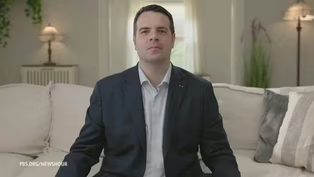
New'Blockers' highlights government workers who resisted DOGE
Video has Closed Captions
In 'Blockers,' Michael Lewis highlights government workers who resisted DOGE (7m 58s)
 New
NewA Brief But Spectacular take on giving veterans a chance
Video has Closed Captions
A Brief But Spectacular take on translating military service into civilian life (3m 1s)
 New
NewNews Wrap: Houthi strikes kill 13 at Riyadh airport
Video has Closed Captions
News Wrap: Riyadh airport closed after Houthi strikes that killed at least 13 (5m 19s)
 New
NewRep. Omar alleges political intimidation after home search
Video has Closed Captions
Rep. Omar accuses Trump of political intimidation after agents search her home (5m 51s)
 New
NewSmithsonian's American Latino museum finds permanent home
Video has Closed Captions
Smithsonian's American Latino museum finds permanent home on National Mall (5m 50s)
 New
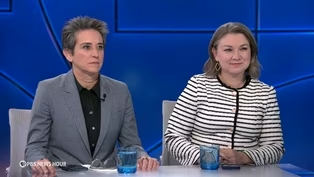
NewTamara Keith and Amy Walter on GOP's midterm vulnerability
Video has Closed Captions
Tamara Keith and Amy Walter on the GOP's vulnerability in the midterms (8m 21s)
 New
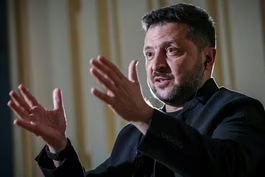
NewUkraine disputes ceasefire as Trump's diesel deal draws fire
Video has Closed Captions
Ukraine disputes Trump's claim of energy ceasefire as Russian diesel deal draws fire (10m 42s)
 New
NewWater access becomes top election issue for Arizona voters
Video has Closed Captions
Water access becomes a top election concern for Arizona voters (4m 51s)
Providing Support for PBS.org
Learn Moreabout PBS online sponsorship
- News and Public Affairs

FRONTLINE is investigative journalism that questions, explains and changes our world.
 New Episode
- News and Public Affairs

Today's top journalists discuss Washington's current political events and public affairs.
 New Episode
 New Episode
 New Episode
 New Episode
 New Episode
 New Episode
 New Episode
 New Episode
Support for PBS provided by:
Major corporate funding for the PBS News Hour is provided by BDO, BNSF, Consumer Cellular, American Cruise Lines, and Raymond James. Funding for the PBS NewsHour Weekend is provided by...