

September 17, 2026 - PBS News Hour full episode
9/17/2026 | 56m 45sVideo has Closed Captions
September 17, 2026 - PBS News Hour full episode
September 17, 2026 - PBS News Hour full episode
Problems playing video? | Closed Captioning Feedback
Problems playing video? | Closed Captioning Feedback
Major corporate funding for the PBS News Hour is provided by BDO, BNSF, Consumer Cellular, American Cruise Lines, and Raymond James. Funding for the PBS NewsHour Weekend is provided by...
September 17, 2026 - PBS News Hour full episode
9/17/2026 | 56m 45sVideo has Closed Captions
September 17, 2026 - PBS News Hour full episode
Problems playing video? | Closed Captioning Feedback
Where to Watch PBS News Hour
PBS News Hour is available to stream on pbs.org and the PBS app.
Providing Support for PBS.org
Learn Moreabout PBS online sponsorshipGEOFF BENNETT: Good evening.
I'm Geoff Bennett.
AMNA NAWAZ: And I'm Amna Nawaz.
On the "NewsHour" tonight: New instances of concerning AI behavior, including deception and unsanctioned actions.
We speak with one researcher who quit and is now sounding the alarm.
JACOB COXON, Former Anthropic Researcher: Plausibly, within a year, certainly within two years, we're on track to also automating away this nebulous human quality of judgment, so that the AIs can rapidly make themselves smarter.
GEOFF BENNETT: How the Trump administration's crackdown on immigration is also making it harder to become a U.S.
citizen.
AMNA NAWAZ: And Qatar's diplomatic spokesman discusses his country's efforts to negotiate an end to the war with Iran.
(BREAK) AMNA NAWAZ: Welcome to the "News Hour."
As leaders of the world's largest AI companies are publicly calling for a collective slowdown of the technology's development, late yesterday, OpenAI announced it had discovered six new instances of unexpected or concerning behavior by its artificial intelligence models, including moving files onto the Internet without permission and making up data.
GEOFF BENNETT: OpenAI has now pledged to publicly disclose when its models act without authorization.
But the most recent revelations follow repeated warnings about how rapid advances in AI threaten to outpace the ability to develop the tech safely.
One of those warnings came from Jacob Coxon, who spent the last three years conducting research at Anthropic and OpenAI before he publicly resigned last week.
In a now viral post, Coxon said the companies are -- quote -- "gambling with our lives.
Do not underestimate the power of this technology.
These will soon be superhuman systems that can hack anything, revolutionize any field overnight, and acquire real power and resources.
"The people building AI earnestly believe that it could kill us all by the end of the decade.
No other human activity poses this level of danger."
And Jacob Coxon joins us now from San Francisco.
Welcome to the "News Hour."
JACOB COXON, Former Anthropic Researcher: Thanks for having me on.
GEOFF BENNETT: We were supposed to speak a few days ago.
Circumstances got in the way.
I will say, though, I'm glad we're speaking today because so much has transpired since you resigned last week, to include these new disclosures from OpenAI about its own systems behaving in unexpected and potentially troubling ways.
When you saw this news, what did you think?
JACOB COXON: So I think this news is entirely to be expected.
And, indeed, if you're working on this tech at these companies, then you know that we don't currently have the ability to perfectly control these systems.
And currently the systems with the highest level of intelligence will repeatedly behave in ways that we don't fully understand.
It is great that they shared these instances and committed to future sharing.
But I don't think the instances themselves are that surprising.
GEOFF BENNETT: And, Jacob, why do these AI agents seem to gravitate toward nefarious behavior?
Is it something about the way that they're trained, or is the answer even knowable?
JACOB COXON: So it really -- I don't -- I wouldn't phrase it as gravitating towards nefarious behavior.
These AIs do many, many things over the course of a day.
There's a lot of AI systems doing lots of things.
The issue is, we can't perfectly control what drives motivate their behavior and the sorts of things they decide to do, which means, occasionally, these nefarious activities will kind of slip through the cracks.
And a sufficiently dangerous bit of nefarious activity could have massive consequences, even if it's just a one-time kind of slip-up, because we can't perfectly control why they do the things they do.
GEOFF BENNETT: So a system doing something that its developers didn't intend isn't necessarily the same as a system trying to escape human control.
What evidence do you have, what have you seen that would suggest that these systems are moving toward the more dangerous scenario that you have warned about?
JACOB COXON: So, the big attack that everyone is speaking about and has been speaking about for a while is this Hugging Face attack.
And, in this attack, the AIs were behaving in various ways that implied they were thinking about the procedure that was being used to evaluate them.
So they were thinking about their situation, the world they found themselves in, the things they were having to try and do.
And they were attempting to do things like edit their own memories to make it harder for people to figure out what they'd done.
They were attempting to break out of the container they were in.
They were attempting to access things on the Internet because they thought it might help them with their tasks.
In short, these AIs were trying to do many different things to help them in the situation they found themselves.
GEOFF BENNETT: So when you warn that the next year or two could be crunch time for humanity -- that was the phrase that you used -- walk us through that chain.
What specifically has to happen for that to be true?
JACOB COXON: So the main thing that has to happen is for us to enter this phase called recursive self-improvement.
So, RSI, or recursive self-improvement, is the idea that we could take the discipline of AI research as currently practiced and automate it with the AIs we're building.
So we could let the AIs make themselves smarter.
And we have already made strides towards doing that.
So, right now, a lot of the research that researchers at these labs do is via AIs that carry out certain tasks or experiments.
Currently, we still need the human to provide taste or judgment, but plausibly within a year, certainly, within two years, we're on track to also automating away this nebulous human quality of judgment so that the AIs can rapidly make themselves smarter.
And, at that point, things could go very, very fast.
So we get new generations of AIs very quickly without necessarily having the corresponding tech to understand what they're doing and control what they're doing.
GEOFF BENNETT: So, what would a slowdown actually look like?
What kind of intervention are you calling for?
JACOB COXON: There are lots of proposals, and I really am not an expert in all of the political things that would have to happen for a slowdown to happen.
All I know is that going too fast could be lethal.
But I do think that a race with China could be very bad and that we should be taking pretty rapid actions for international coordination.
And this sort of desire is also echoed in the public blog posts of people like OpenAI's chief scientist, like Dario Amodei.
They're all mentioning the fact that we need international coordination.
I will say that I do think a lot of the company leadership are privately quite skeptical of being able to achieve this level of international cooperation, which is part of why I resigned, because I think a race like that could be catastrophic.
GEOFF BENNETT: Is there anything preventing OpenAI, Anthropic, any other leading AI lab from announcing tomorrow that we will not build another self-improving system until we know how to control it?
I ask the question because the White House AI adviser, as you well know, has made the case that, if these AI leaders are so concerned, they can implement guardrails voluntarily and unilaterally.
JACOB COXON: Yes, I think the phrase implement guardrails sort of implies that we know what to do, and it might be just a couple of months to get the tech right, implement the guardrails, and then carry on business as usual.
I think maybe the framing of we're trying to solve a new scientific problem of, can we figure out how to grow these AIs in a safe manner, which could take a pretty long period of time, and we also might want to phase it in pretty slowly.
And, in this case, again, the main issue for slowing, stopping right now until we're certain is that that could take quite some time.
And, at that point, other places building this technology, say, China, could shoot right past.
So the issue is, a race is kind of on the cards right now.
Everyone is aware that we have to get there before our rivals, unless there's some sort of coordination.
GEOFF BENNETT: What's the strongest evidence that you could point to publicly, something a skeptical viewer could weigh, that supports the warning that you're making?
JACOB COXON: Yes.
I think the first point that I make a lot is just a kind of it's an appeal to authority kind of point, which is people from many sides of the playing field, like Geoff Hinton, Yoshua Bengio, the founders of M.L.
theory -- they're academics, they're not in the labs -- also, the lab CEOs, the lab researchers, also people like Elon Musk, they all think this is very dangerous.
I could point to other names like Stephen Hawking.
Like, a lot of people have raised this warning.
And then to go into precise concrete matters, I think look at the report from the Hugging Face attack.
Think to yourselves, like, is this -- how comfortable are you with what happened there?
And how bad could that look if the AIs get better?
And then I think there was also a public letter from some mathematicians because AI has recently moved to the level of a professional mathematician.
So I think, as we all find our own areas of expertise starting to be competed with by AIs, we will start to maybe take the threat more seriously as we see it impinging on our on our daily life.
GEOFF BENNETT: And, Jacob, as you well know, there has been a remarkable convergence in recent days that was kick-started by your resignation.
We have seen, of course, public warnings from other AI leaders.
There have been efforts on Capitol Hill to introduce new legislation.
I ask the question because there's been so much speculation.
Are you in any way part of a coordinated effort to introduce these warnings into the public debate?
JACOB COXON: Absolutely not.
And I can maybe see how this happened.
From my perspective, the last week has been absolutely insane.
I tweeted private thoughts that contradict the views of a lot of my close friends, and my private life has been kind of upended by this.
And, yes, I can just say that this was my resignation.
I believe this.
A lot of people believe this.
This isn't some crazy coordinated scheme.
One thing I also want to add is this has raised awareness of the risks to a lot of people.
And I'm quite worried that the corresponding benefits are also maybe not receiving adequate airtime.
So I would like to emphasize that I do believe that the benefits from this technology in domains like health are tremendous, and we should also think about the possibilities for what this tech will do if it's done safely.
GEOFF BENNETT: What did you think would happen after you sent that tweet about your resignation?
JACOB COXON: I thought it would maybe go viral among my community of AI researchers, people thinking about AI safety.
I thought it would maybe trigger some discussion.
I thought a lot of people would disagree.
I did not it to -- I did not expect messages from old high school friends asking me about if the robots were going to kill us.
That really wasn't on the cards when I sent that tweet.
GEOFF BENNETT: Jacob Coxon, thanks again for joining us this evening.
We appreciate it.
JACOB COXON: Thank you.
AMNA NAWAZ: We start the day's other headlines in Washington, D.C., where a federal judge ordered that Kennedy Center officials provide 30 days' notice before making any significant physical changes to the building.
That includes demolishing the structure altogether.
Last night, President Trump told reporters that, unless his administration gets credit for saving the center -- quote -- "It'll end up being ripped down."
The center was closed this week amid an ongoing legal dispute over adding President Trump's name to the building.
Canadian Prime Minister Mark Carney is welcoming a proposal that could see his country join the European Union as the bloc's first associate member.
In a speech to the European Parliament in Strasbourg, France, today, Carney said Canada is seeking deeper cooperation in areas like trade, defense, energy and more.
His speech comes amid a fraying of ties with the U.S., with an ongoing trade war and President Trump's talk of making Canada the 51st state.
And while Carney insisted later that Canada is not seeking full E.U.
membership, he said Europe and Canada are -- quote -- "stronger together."
MARK CARNEY, Canadian Prime Minister: We do not seek power to dominate others.
On the contrary, we are pursuing resilience so no one, no one can control our open markets, impair our sovereignty, threaten our territorial integrity, or undermine our freedoms, our democracies, our rule of law.
AMNA NAWAZ: President Trump called the E.U.
's proposal laughable, and he threatened serious tariffs or even to stop trading with the European Union altogether should he consider the potential Canada partnership a -- quote -- "hostile act."
Turning now to the Middle East, Saudi Arabia says falling debris from an intercepted Iran-backed Houthi drone killed one person and injured three others.
The country's civil defense said it happened in the city of Taif.
And footage showed extensive damage to buildings, cars, and roads.
In the meantime, U.N.-backed human rights experts say there are -- quote -- "reasonable grounds" to believe the U.S.
has committed war crimes in Iran.
The allegations focus on a pair of strikes that killed at least 178 civilians, including school children, in the southern city of Minab.
The Trump administration has not accepted responsibility for the strikes.
Ukrainian authorities say Russian strikes on Kyiv and Odesa injured at least 26 people, including children.
Explosions flashed across the Capitol's buildings overnight.
The attacks damaged several sites, including this school.
Also today, Ukraine's president says its forces carried out drone strikes on an oil refinery northeast of Moscow.
The exchange in attacks comes as the Kremlin criticized the passage last night by the U.S.
Congress of a comprehensive Russian sanctions bill named after the late Senator Lindsey Graham.
DMITRY PESKOV, Spokesman for Vladimir Putin (through translator): It falls under the category of unfriendly actions.
And, of course, the imposition of any additional sanctions by the U.S.
would certainly complicate efforts to find a peace settlement in Ukraine.
AMNA NAWAZ: Separately, Russian President Vladimir Putin has characterized the country's parliamentary elections as a referendum on the war.
Voting is now under way and goes through Sunday.
Human remains discovered in the Grand Canyon this week have been identified as the final hiker who went missing in last month's flash floods.
That's according to the victim's wife.
Timothy Allen Smith had been on a backcountry trip with his friends Brent Rosenkranz and John Giusti, who also perished in the floods.
More than 80 people were rescued after heavy rain sent violent floodwaters barreling through the Phantom Ranch area.
Many hiking trails and lodging areas remain closed, and crews are still working to restore the canyon's water supply.
Scientists say NASA discovered a massive new crater on the moon that's bigger than the Roman Colosseum.
These images show the same area of the moon both before and after a meteor struck in early 2024.
The findings were published this week in the journal "Science Advances."
The hole stretches more than 700 feet across and 140 feet deep, making it the solar system's largest known impact crater of recent times.
Scientists estimate that such a large-scale event is estimated to occur only once every 132 years.
On Wall Street today, stocks recovered from some recent losses, as oil prices fell.
The Dow Jones industrial average added more than 300 points.
The Nasdaq jumped more than 1.5 percent.
The S&P 500 also posted a strong gain.
And we have two passings tonight, starting with former Republican Senator Jon Kyl of Arizona.
During his more than 25 years in Congress in both the House and Senate, Kyl was known for his work ethic and his political skills behind the scenes.
He served as junior senator alongside Arizona's John McCain and rose to be the party's number two under then-Senate Minority Leader Mitch McConnell.
His signature legislation included Western water rights, and he helped to get Justice Brett Kavanaugh on the Supreme Court.
Last year, Kyl announced that he had dementia.
He was 84 years old.
And artist Peter Max has died.
His bold, psychedelic pop art reflected the Flower Power movement of the 1960s and made him one of the most successful artists of his time.
Born in Berlin, Max came to the United States as a teenager after fleeing Nazi Germany with his family.
He studied in New York, where he developed a bold, colorful style that he later brought to subjects as varied as the Statue of Liberty, U.S.
presidents, and even Taylor Swift.
Max spoke to PBS in 2013 about his approach to his work.
PETER MAX, Artist: It's like this.
Sometimes, when you're taking a walk, you know where you're going, right, because you're going someplace to meet somebody.
And, sometimes, you're just going for a walk.
You don't know where you're going.
When I drew this, I didn't know what I was drawing.
But I drew a planet and another big planet and something the size of Earth with a big sage behind there.
And I just loved where I went with it.
AMNA NAWAZ: Max's artwork sold in the millions, adorning everything from posters to postage stamps to the sides of a cruise ship and even a plane.
According to his son, Peter Max died this week at the age of 88.
Still to come on the "News Hour": what's left on the legislative table as the House of Representatives leaves town until midterm elections; athletes celebrate the 50th anniversary of wheelchair tennis; and a castle, a cosplay king, and a crisis of masculinity all on our latest PBS News podcast.
A bill to impose sweeping new sanctions on Russia and on countries using Russian energy is now on its way to President Trump after the U.S.
House of Representatives overwhelmingly passed it last night, this as Congress also took action this week on data centers, college sports, and the Iran war, but also as House Republicans chose to go home early.
Covering it all for us is our Capitol Hill correspondent, Lisa Desjardins.
So, Lisa, let's start with this Russian sanctions bill.
What's the significance of that?
LISA DESJARDINS: This is easily the most significant step to take on Russia since President Trump returned to office, and some say well beyond that.
The bill is named after a key sponsor, the late Senator Lindsey Graham.
It would put sanctions on Putin himself, the first time Congress would be doing that, as well as other Russian officials and banks.
But it also allows up to 100 percent tariffs on other countries that buy Russian oil and in some cases natural gas.
And, now, this is very powerful.
It includes China, but also some non-adversaries, potentially like India and the European Union.
Here's how Republican Mike McCaul put it: REP.
MICHAEL MCCAUL (R-TX): This bill will cripple Russia's war machine and finally bring Putin to the negotiating table.
It will ensure America's adversaries, not only Russia, but also China and Iran, suffer for their coordinated campaign of aggression.
LISA DESJARDINS: Now, this bill does give a lot of power to President Trump, and some Democrats voted against it because they think he may use it more widely than it's intended.
However, for Ukraine, it is a major victory, and we expect the president to sign it tomorrow.
AMNA NAWAZ: All right, some other big votes this week, tell us about those and also how Republicans are doing on that to-do list you have been keeping track of.
LISA DESJARDINS: All right, let's start with a big part of American life, college sports.
There is a bill to deal with the Wild West of college sports called athletes' pay that has advanced in the U.S.
Senate, and it is set for passage this week.
Here's what is in this bill.
It would regulate college athlete pay, and it would limit them to just one transfer each without a penalty during their college career.
It also would limit coaches, who would not able to move in the middle of a season.
The college sports bill is waiting on the house to pass it next.
But the House, meanwhile, has passed a bill on data centers.
This bill would make data centers have to pay for the full costs of their energy.
That is a rising concern in American life.
Now, it's interesting about that bill.
It passed overwhelmingly in the House of Representatives, and that shows just how hot this issue is for voters.
But its fate in the Senate is not yet clear.
We will be watching in the next week to see what happens.
As to that to-do list we have been following, let's take a look to see where Republican leaders are.
Here are the seven bills we have been following that the Republicans wanted to get through.
You see those first two have passed, funding government.
We didn't have that kind of deadline this time.
Russian sanctions, that made it through.
But then you see in yellow two that are still in progress, that data center bill and the college sports.
But you see four of the items on this list are not yet accomplished.
That includes funding the war in Iran, the crypto bill, which has hit a rough patch in the Senate, and the farm bill, as well as the SAVE Act that Republicans wanted to get through.
AMNA NAWAZ: You pointed out there Congress has not funded the Iran war, but there was a big vote on Iran in the House this week.
Tell us about that.
LISA DESJARDINS: Right.
It was a busy week.
The House voted to end the war in Iran.
This is the third time that the House majority, a majority in the House has voted that way.
But it's notable because of the margin, and also because these seven Republicans, the most yet, voted to bring back troops and end the war in Iran.
You will note, of these seven, four of them, you see them highlighted there with yellow, are in competitive House races from Michigan to Iowa to Pennsylvania.
Now, these are -- this is a symbolic vote because President Trump can veto.
But it shows really the direction and the momentum in Congress is against the Iran war.
More are speaking out.
And we expect the Senate to take a similar vote next week.
AMNA NAWAZ: Related to the Iran war, I know you have been following a House Republican who filed articles of impeachment against the defense secretary, Pete Hegseth.
LISA DESJARDINS: Yes.
AMNA NAWAZ: Is that going to get a vote?
LISA DESJARDINS: It will.
It will not until after the election, though, because the House left before that vote was going to ripen.
These are impeachment articles introduced surprisingly by Thomas Massie.
He did not tell Republican leaders he was going to do this.
He is a Republican from Kentucky.
He lost his primary.
But he felt strongly that he needed to put eight charges against Secretary of Defense Pete Hegseth.
Some of those deal with the war in Iran, which he says needs congressional approval, but others include that he accuses the secretary of ignoring the protocols for civilian deaths, killing civilians, including at sea with those strikes that we have seen in the Gulf.
AMNA NAWAZ: So the House has now left.
The Senate's here for one more week.
Overall, where do things stand with Congress getting things done before the elections?
LISA DESJARDINS: Well, you will hear a lot of different versions from Republicans, but they have gotten some things done.
Avoiding a government shutdown and that fiscal cliff is significant in modern times.
However, the House has chosen to cancel some 63 days of session this year.
And that tells you that one of their priorities is not just getting things done in Washington, but trying to get reelected.
So they are now home in their districts fighting to keep the majority.
AMNA NAWAZ: All right, Lisa Desjardins, thank you very much.
LISA DESJARDINS: You're welcome.
GEOFF BENNETT: Well, today is Citizenship Day, which recognizes everyone who has attained U.S.
citizenship and commemorates the signing of the U.S.
Constitution on this day back in 1787.
AMNA NAWAZ: But, for immigrants, the path to naturalization has grown more difficult, as the Trump administration has added new requirements and tightened vetting standards.
Our justice correspondent, Ali Rogin, has this look.
ALI ROGIN: In a federal courthouse in Alexandria, Virginia, 60 of the nation's newest Americans take their final steps towards citizenship, sharing where their journeys began.
WOMAN: Venezuela.
WOMAN: El Salvador.
WOMAN: Korea.
ALI ROGIN: Before they all arrived at this moment.
JUDGE WILLIAM FITZPATRICK, Eastern District of Virginia: Please rise and raise your right hand.
I hereby declare... MEN AND WOMEN: I hereby declare... JUDGE WILLIAM FITZPATRICK: ... on oath.
MEN AND WOMEN: ... on oath.
JUDGE WILLIAM FITZPATRICK: So help me God.
MEN AND WOMEN: So help me God.
JUDGE WILLIAM FITZPATRICK: Congratulations.
WOMAN: We're super excited.
Me and my husband, we both became citizens.
MAN: I don't think people realize how daunting this journey is.
But it's -- I'm so happy to be here.
ALI ROGIN: For most, the journey involves applying for and holding a green card for years, lengthy applications, hundreds of dollars in fees, interviews with immigration officers, an English language test, and finally a civics test, for which applicants spend months studying.
LUCIO AREVALO, Green Card Holder: Definitely am nervous.
The nerves are there.
The stress is there.
ALI ROGIN: New Mexico resident Lucio Arevalo is nearing the finish line of his naturalization.
A green card holder since 1998, he arrived in the U.S.
with his parents from Mexico as a baby.
He's awaiting his interview date.
LUCIO AREVALO: I am, of course, a permanent resident, but I just feel like there's still that thin line between me actually being, I guess, fully part of the country.
So, decided to take that step.
ALI ROGIN: What will it mean to you to take that oath of citizenship?
LUCIO AREVALO: To be honest, it's - - it would be such a big relief.
ALI ROGIN: Relief because he hopes to stop living in fear of President Trump's efforts to deport noncitizens.
LUCIO AREVALO: It is definitely scary to know that there could be that possibility for me to get stopped, I guess, by immigration.
ALI ROGIN: To help prepare for the civics test, Lucio turned to Welcome.US, a national initiative that emerged after the U.S.
withdrawal from Afghanistan to help new arrivals through the complicated immigration system.
That's how he met volunteer Dana Van Ostrand, who lives in Iowa and has been helping Arevalo study in virtual sessions.
DANA VAN OSTRAND, Welcome.US: It's been a really fun process to not only go through the test, but also just hear of Lucio's life and what he's been about.
NAZANIN ASH, CEO and Co-Founder, Welcome.US: There are a lot of changes happening in our immigration system and in whether and how we welcome newcomers.
ALI ROGIN: Nazanin Ash is the CEO and co-founder of Welcome.US.
NAZANIN ASH: It's a process that's rigorous and has always been rigorous, and it's appropriately rigorous.
Taking on the responsibilities of citizenship is a commitment that no one takes lightly, least of all the aspiring Americans who are pursuing their dreams.
ALI ROGIN: That dream of becoming American has become more elusive since President Trump returned to office.
In the last year, the administration has introduced a harder civics test with more questions and a higher number of correct answers required to pass, implemented stricter social media vetting, proposed raising the application fee by 75 percent to nearly $1,300, and revived a defunct practice of neighborhood investigations into applicants' moral character.
And the government is processing far fewer naturalization applications today than during the Biden administration, a 75 percent drop-off compared to two years ago.
And the rejection rate for naturalization has more than doubled since September 2024 from 9.2 percent to more than 18 percent.
Sometimes, the roadblocks continue all the way to the courthouse.
Since President Trump returned to office, U.S.
Citizenship and Immigration Services has been abruptly canceling naturalization ceremonies, many of them at the last minute.
In fact, today, here at this courthouse, there were supposed to be two ceremonies, but the afternoon session was abruptly canceled just last night.
Immigration officials say the changes are necessary to tighten the system that has become too lax.
In a statement to PBS News, U.S.
Citizenship and Immigration Services said the agency "has implemented reforms to ensure U.S.
citizenship is reserved for those who qualify," adding that: "USCIS will not take shortcuts in the naturalization process.
Naturalization is a privilege, not a right."
Van Ostrand says his volunteerism is a way to respond to what he sees as this administration's hostility towards immigrants.
DANA VAN OSTRAND: The Trump administration's rhetoric and actions have been quite dehumanizing, in my view, and I wanted to be a part of welcoming people who have already been here.
ALI ROGIN: Back at the Alexandria courthouse, the new citizens receive a parting message from Judge William Fitzpatrick.
JUDGE WILLIAM FITZPATRICK: What I ask of you is to keep working hard, to give life, to give meaning to the oath that you took today by making your voice heard, by making sure that government, your government, reflects your values and your vision for what America can be.
I have signed the final order.
It is official.
Congratulations to you all.
Best of luck.
We're adjourned.
WOMAN: Congratulations again.
ALI ROGIN: As the gavel falls in the courthouse, the ceremony ends.
Tell me what emotion you're feeling right now.
WOMAN: Yes, really happy.
ALI ROGIN: And, outside, 60 new American lives begin.
WOMAN: Thank you, and God bless America.
(LAUGHTER) ALI ROGIN: For the "PBS News Hour," I'm Ali Rogin.
AMNA NAWAZ: Today, Saudi Arabia and the Iranian-backed Houthis in Yemen traded new strikes.
The fighting is just one example of violence that's spread across the region since the U.S.
and Israel launched the war in Iran.
GEOFF BENNETT: The country of Qatar has spent months mediating between Iran and the U.S.
and Iran and the region while also being targeted by Iranian strikes.
This week, Nick Schifrin sat down with a key adviser to Qatar's prime minister to discuss regional tensions and whether there is a way back to negotiations.
NICK SCHIFRIN: Thank you very much, Mr.
Ansari.
Thanks very much.
Welcome to the "News Hour."
MAJED AL-ANSARI, Adviser to Qatari Prime Minister: Thank you for having me.
NICK SCHIFRIN: You have been in the middle of negotiations this year between Iran and the United States.
Qatar was largely confident about this when the MOU was signed.
But, since then, we haven't seen any progress.
Iran has maintained its choke hold over the Strait of Hormuz.
From where you sit, is there a path back to U.S.-Iran negotiations or not?
MAJED AL-ANSARI: You know, Nick, one thing we can't afford to do in the region right now is despair about the diplomatic solution.
There is no way out of this unless it is a diplomatic solution.
And, therefore, we have been working with all our partners 24/7.
Our mediation teams have been running between each capital in the region trying to get it forward, and we won't give up.
We will just continue doing it until we have a solution.
NICK SCHIFRIN: Negotiations is not just U.S.-Iran.
It's also Iran-GCC.
It's also the Gulf Cooperation Council.
We were supposed to have a meeting earlier this week.
And the regional officials I was talking to before this meeting was supposed to happen on Monday were saying Iran was asking for too much.
Iran was asking for control or at least some kind of access of all ships going in and out of the strait in Iranian waters.
Is Iran asking for too much?
MAJED AL-ANSARI: Now, first of all, this is -- this was supposed to be an interim solution, not the new status quo.
The new status quo cannot be to deal with the Strait of Hormuz, something that can be open or closed by any... NICK SCHIFRIN: Meaning it needs to be open, period.
MAJED AL-ANSARI: Exactly.
We need to go back.
It's a matter of international maritime law.
It's where all the littoral states have the right to use the Strait of Hormuz openly and not creating a new status quo that would give any of the littoral states any power over the strait.
NICK SCHIFRIN: Reuters a few weeks ago reported that Qatar's liquefied natural gas exports, which, of course, count for a large share of Qatar's GDP, have dropped 96 percent since the U.S.
and Israel launched this war.
Firstly, is that accurate?
And, secondly, how existential a threat is it to Qatar if this war continues, if the strait continues to be closed?
MAJED AL-ANSARI: I won't come into the specific numbers.
I will leave that to QatarEnergy and the people in our energy sector.
I can tell you, of course, that all of our LNG used to go through the Strait of Hormuz.
And Strait of Hormuz being closed basically means that no LNG is going through.
Let me say it very clearly.
The effects -- we have not yet to see the real effects on international economy of this crisis.
We have yet to reach the tip of the iceberg.
We are looking now... NICK SCHIFRIN: Why do you say that?
MAJED AL-ANSARI: Because the economic effects of this war is going to go on -- if it continues like this, going to go on and affect every other sector.
We have already -- are already getting reports of reduced yields from crops in countries like Somalia and other countries in Asia, where this is an issue of famine.
It's not an issue of luxury, right?
I think it's an existential threat for all of us collectively in the international economy.
And, of course, Qatar is heavy -- heavily dependent on the Strait of Hormuz.
But let me say it also very clearly.
Our economy is not fragile.
Those who are living in Qatar, thankfully, other than the fact that missiles were being intercepted every other day, but when it comes to commodities, when it comes to security, when it comes to everyday needs, when it comes to salaries and the economic situation, nothing was affected.
NICK SCHIFRIN: Iran hit the Al Udeid Air Base, the largest air base across the region.
Do you have faith that the United States can defend the U.S.
Qatari base, one of the most important spots in Doha?
MAJED AL-ANSARI: You know, the metric that we need to consider here is the fact that more than 95 percent of every projectile that was sent towards our countries was deterred through the work of the men and women in uniform, and it's not an easy an easy number to deal with.
The -- our militaries proved their worth.
The cooperation with the United States proved its worth.
We see the coordination and the interoperability between our militaries and the U.S.
military on all fronts when it comes to defending our countries.
I think we have shown that we are not an easy pill to swallow.
NICK SCHIFRIN: But do you have faith that 95 percent can be repeated if there's another cycle of Iowa?
MAJED AL-ANSARI: One hundred percent.
I can tell you that our militaries are standing ready right now for any kind of escalation.
Of course, we're working diplomatically to make sure that there is no other escalation.
But you have to remember 40 percent of the attacks on Qatar, for example, were on energy facilities, right?
More than 80 percent of the missiles launched were on -- by Iran were on our countries, not on Israel or the American forces.
So, for us, this was an attack on our sovereignty.
NICK SCHIFRIN: Not even on the Americans, on Qatari, right.
Is there any reevaluation of U.S.
presence in Qatar, or the U.S.
as Qatar's primary security partner?
MAJED AL-ANSARI: If there was any reevaluations being done with the United States to increase the intensity of the relationship, the intensity of the partnership with the United States.
This partnership is not simply hosting U.S.
forces in Qatar.
It is based on a multilayered relationship that goes into economy, investment, technology, and, of course, defense and security.
And any diversification will be with the United States, not away from the United States.
NICK SCHIFRIN: Do you want to see the U.S.
change its posture, even if it's just a physical change in how Al Udeid works?
MAJED AL-ANSARI: From our end, we are doubling down on the relationship.
We are proud of being able to host the U.S.
service men and women in Qatar.
We're proud of the partnership with the United States, and it's not going anywhere.
NICK SCHIFRIN: Can I expand this conversation out?
Because it seems like all the pressure we're talking about is only increased by success along the Red Sea in the Bab al-Mandab Strait by the Houthis.
This is an Iranian-backed group fighting in Yemen.
They have in the last week or so captured most of the coast of the Red Sea, threatening the Bab al-Mandab.
The U.S.
and the Houthis are in negotiations right now, perhaps to prevent a U.S.
strike on the Houthis, to prevent the Houthis from stopping ships that don't have Saudi connections.
But, bottom line, do you see Iran trying to open up more leverage by helping the Houthis advance in the Bab al-Mandab?
And how does all of that put pressure on everything we have talked about with the Strait of Hormuz?
MAJED AL-ANSARI: Since 2023 and the terrible events of 7th of October, we have been warning in the region that, left unchecked, escalation in the region would lead to a regional total war that all of us will be losers of.
And this is exactly where we are at right now.
I think those who are making these decisions in Iran have decided that they no longer are going to be concerned with the state of the energy facilities in the region either way.
This is not something that we can take.
And the situation in Bab al-Mandab today increases the risk to international navigation, increases the risk to the supply chains around the world.
And this needs to stop now.
NICK SCHIFRIN: But do you see -- you mentioned just in passing Iran.
Do you see Iran trying to increase its own leverage by helping the Houthis along the Red Sea?
MAJED AL-ANSARI: I mean, it's no secret that the Houthis have had support historically from Iran and the militias in Iraq.
This proxy war that not only Iran, others in the region want to employ through just enacting and supporting elements of the stability in the region is very dangerous for all of us.
And it's up to the rest of the region now, in partnership with the United States and other international players, to take a real stand against this kind of action in our region.
NICK SCHIFRIN: Dr.
Majed Al-Ansari, thank you very much.
MAJED AL-ANSARI: Thank you for having me.
AMNA NAWAZ: This week, professional wheelchair tennis players are competing for their countries, part of the World Team Cup at the U.S.
Tennis Association's national campus in Orlando.
It's all part of the 50th anniversary of the sport's creation and comes at a time when popularity is growing.
I recently took a close-up look at the U.S.
Open in Flushing Meadows, New York, for our ongoing coverage of the culture of sport, part of our Canvas series.
All the agility, speed, and power of tennis supercharged on two wheels.
(CHEERING) AMNA NAWAZ: The sport of wheelchair tennis has come a very long way in just 50 years.
BRAD PARKS, Wheelchair Tennis Co-Founder: Everybody, they're just so darn good.
I mean, it's just so fantastic to see how it has progressed and improved over the years.
AMNA NAWAZ: Brad Parks, who founded the sport back in 1976, has a lot to celebrate.
Today, wheelchair tennis is in more top-tier professional tournaments than ever before, including all four Grand Slams.
A player development pipeline is being built, and sponsorships and broadcast deals mean the fan base continues to grow.
Parks himself never expected to be here after being paralyzed in a freestyle skiing accident at the age of 18.
BRAD PARKS: Somebody came and told me about wheelchair basketball when I was in the hospital.
And I'm thinking, well, if you play wheelchair basketball, why can't you play tennis?
And tennis was on my mind because I wanted to be a better tennis player than I was.
Sliding into a shot, hitting a ball, recovering, coming back around, that whole feeling of movement and everything else is really, really great.
AMNA NAWAZ: Acceptance was built one match at a time.
BRAD PARKS: When I was first injured, we would go to a tennis court, and sometimes the pro would come over and go, what are you guys doing?
Everybody was always worried we were going to damage the courts.
And they -- we weren't really even accepted.
Nobody could believe that we were actually wheelchair athletes, that we were athletes.
AMNA NAWAZ: The game differs slightly from the able-bodied sport.
Players use the same courts, balls, and rackets, but they're allowed two bounces of the ball.
The chair is considered part of the player's body.
So the same rules that apply to the body in able-bodied tennis apply to the chair.
Dana Mathewson was the first American woman to win a major wheelchair tennis title, the 2022 Wimbledon doubles championship.
She retired in 2024 ranked number one in the U.S.
and number seven in the world.
She left the court at the top of her game, but found a new role just a few feet away, hosting and commentating.
Seven years ago, when you last spoke to us, you had this to say.
I want to put it back to you now and get your reaction.
DANA MATHEWSON, Professional Wheelchair Tennis Player: That's crazy it was seven years ago.
AMNA NAWAZ: I know.
You said: "The more and more I get exposed to different things..." DANA MATHEWSON: The more that I realize that I can do with this disability and the things that it's afforded in my life.
AMNA NAWAZ: "The more I actually feel really grateful for it."
You still feel that way?
DANA MATHEWSON: It's a hot take, isn't it?
(LAUGHTER) DANA MATHEWSON: Yes.
I would be lying to you if I said that I woke up every day and I saw my chair and I was like, yay.
Like, that's kind of -- that's a reach.
But the sentiment of what I said definitely still rings true.
I think that I can guarantee that, without a disability, I wouldn't have been a professional athlete.
I wouldn't have represented my country.
I wouldn't have set records within a sport.
I wouldn't have got the opportunity to do things like this.
I wouldn't get to be an advocate for a marginalized group of people.
AMNA NAWAZ: Advocating for and mentoring the next generation of players.
Did you have the kind of mentors when you were coming up that you're trying to be for them now?
DANA MATHEWSON: I want to say yes, but the honest answer is not really.
When I first started and I went to my first ever wheelchair tennis camp, there were a couple Paralympians that I met, and they made such an impact on me, but I only got to see them for that week.
The little amount that I had was so impactful to me that, if I can do that for someone else, that that means more to me than any - - it sounds cliche, but, honestly, I mean it -- any Slams or anything like that.
AMNA NAWAZ: Among the sport's new stars, Japan's Tokito Oda, a 20-year-old with multiple sponsors who's known as much for his sartorial flair as he is for his killer serve.
Oda was just 17 when he won the French Open in 2023, becoming the youngest man ever to win a Grand Slam title.
He's now number one in the world, and he came to talk to us as the sun went down after another victory.
Wheelchair tennis has been around for longer than you have been alive.
TOKITO ODA, Professional Wheelchair Tennis Player: Yes.
(LAUGHTER) AMNA NAWAZ: Right?
But it's still pretty young in terms of a sport.
How did you first come to play this sport?
TOKITO ODA: Yes, when I was 10, I started tennis, but I got cancer when I was 9, and I was in like A hospital, like around the one year.
During the hospital, I saw the singles playing.
Two days later that I get out of the hospital, I visit the people who play wheelchair tennis.
And then I started as soon as possible.
AMNA NAWAZ: Oda has seen the game grow even over his lifetime.
But he says, here in the U.S., it has a long way to go.
Back home in Japan, he's used to much bigger crowds.
TOKITO ODA: Yes, I mean, when I play the last year, I played at Tokyo, and it was like over 7,000 people was in the final match.
AMNA NAWAZ: Seven thousand people?
TOKITO ODA: Seven thousand was there, even like at Monday 10:00 a.m.
Martina Navratilova knows a thing or two about attracting crowds with 59 Grand Slam titles, including 18 in singles, 31 in doubles, and 10 in mixed doubles.
She played an exhibition with Oda as her teammate.
MARTINA NAVRATILOVA, Former Professional Tennis Player: They hit the ball so well.
So it's astonishing to be -- and I actually sat in a wheelchair trying to hit, and it's -- so hat off.
And it's great to see that growth.
And now they're getting inducted in the Hall of Fame.
And it's all good, and people are watching, because it's worth watching.
They put on a good show.
AMNA NAWAZ: Aniek van Koot of the Netherlands has been playing since she was 10, the same year her leg was amputated after multiple surgeries to address a birth defect were unsuccessful.
ANIEK VAN KOOT, Professional Wheelchair Tennis Player: This is not just a game anymore.
It's my job.
I live and breathe tennis every day.
I train every day.
I think about tennis every day.
I dream about tennis.
It's a profession.
AMNA NAWAZ: Over her career, van Koot has reached number one in the world in both singles and doubles.
She's watched more people discover the game, but says there's still work to be done.
What do you think the sport needs?
ANIEK VAN KOOT: I think more broadcasting on TV.
A lot of people see, like, we don't see you on the news, and I didn't know that you were playing a World Masters championship or a Grand Slam.
I'm like, yes, because you didn't see it.
You didn't see it on the news.
AMNA NAWAZ: In the past, players say exposure from Paralympic Games sparked a surge in popularity for wheelchair tennis, Wimbledon after the 2012 London Games, the French Open after the 2024 Paris Games.
They're hoping the Los Angeles 2028 Games could do the same here in America.
BRAD PARKS: When you go to Wimbledon, the wheelchair tennis matches are packed, and we're not there yet here.
But they're there in London, and I think 2012 Paralympics made that -- helped encourage that.
There was a lot of exposure on TV.
There was a lot going on.
And I think maybe L.A.
might do that for us in the United States.
I'd like to see us where they're coming, and they're not just coming to cheer on the tennis, the wheelchair tennis.
They are coming on because they want this guy to beat this guy or this girl to beat this girl, or whatever.
They want to see a fight and a battle.
They want to see the action.
ANNOUNCER: Game, set, match Inoue/Knoesen two sets to love.
(APPLAUSE) GEOFF BENNETT: Jon Ronson new book, "The Castle," asks a timely question: Why are certain visions of masculinity proving so powerful right now?
The book begins with a strange but true story involving Ronson's own son and a visit to a mysterious castle.
And that story set Ronson on a journey that eventually takes him all the way to the White House, where he attended that UFC cage match on the South Lawn.
Here are two excerpts from our conversation for our podcast "Settle In."
JON RONSON, Author, "The Castle": This was a story that crashed unannounced into my life, so -- in the most extraordinary way.
So I leapt into this without any preconceptions.
But now look -- thinking about what the word unraveling means, I think a lot of it's to do with the death of institutions, deindustrialization, all of these structures the -- everybody, but, in this book, I'm concentrating on men, used to be able to clutch onto to give them self-esteem and purpose and usefulness.
And now they have all gone, and it's having a very interesting deleterious effect on people's inner lives.
GEOFF BENNETT: Well, let's talk about "The Castle," because this book grew out of this strange personal experience.
Your son ends up at a stranger's castle party.
How did this one weird night turn into an entire investigation for you?
JON RONSON: Well, it was incredible.
He and three friends had been invited to a party being held by a stranger that one of them had met on Tinder.
(LAUGHTER) JON RONSON: So they went.
And it was like a 3.5-hour drive out of New York into the forests of Connecticut.
And when they turn up to this man's house, it was a -- not only was it a castle.
It was even by Gothic castle standards incredibly ostentatious, huge number of turrets.
They crossed the drawbridge, and to discover that there's no party.
They enter this grand banqueting hall, and it's just a couple of other bewildered-looking young people standing there.
And they're all as confused as my son and his friends are.
And then the castle owner comes out and they say: "Sorry, where's the party?"
And he said: "No, I have invited you here for a different reason.
I would like you to take part in my reality show."
(LAUGHTER) JON RONSON: So, he said: "What's the name of your reality show?"
He said it's "101 Princesses."
They said: "What's the core concept?"
He said: "I'm the lord, I'm looking for my queen, and I have 101 princesses to choose from.
Go downstairs to my basement costume room, put on some princess costumes and come back upstairs."
So they did.
It -- they became -- it became kind of pretty obvious pretty quickly that this wasn't a real reality show.
And so, after a while, they -- the castle owner got more and more annoyed that they weren't participating in "101 Princesses," and he kicked them out.
So that's the end of their story.
But then I went to the castle to try and find out what the hell was going on.
And a very strange cat-and-mouse game unfolds between me and the castle owner.
GEOFF BENNETT: When did you realize that this was the foundation of a great book and not just some crazy family story?
JON RONSON: Well, I have got to say, my first thought was, as soon as they told me the story, this feels like the start of a book.
(LAUGHTER) JON RONSON: And also I had just -- and I write about this.
I'd just come out of hospital.
I had a foot of my colon removed due to diverticulitis.
So I was feeling a little fragile, like life was passing me by.
And I noticed in myself this kind of desperate need to want to investigate the castle was coming from some broken thing inside of me that I can't be purposeless.
I was convalescing by sitting on a bench at my local park.
But after 10 minutes of that, this terrible thought would overwhelm me, which is I'm just a man sitting on a bench.
So I thought that was a kind of thematically interesting too.
But I think the moment that where it really hit me was that what I thought at first was that, OK, this castle owner, he's trying to be Hugh Hefner.
He's trying to have a Playboy Mansion.
And it made me laugh because I thought this is - - he's trying to be Hugh Hefner at the worst moment in human history.
Unless you're the creme de la creme of manosphere influences, you can't lord it over your princesses in your castle like it's the 1970s anymore.
And I thought that was funny.
I thought this is thematically interesting, that there's all these other things that men used to be able to do that they can't do anymore.
So I thought maybe there's a book about that.
GEOFF BENNETT: As part of your research into modern masculinity, you went to the White House and attended the UFC cage match on the South Lawn this past summer.
JON RONSON: Yes.
GEOFF BENNETT: What was that experience like?
JON RONSON: It was wild and fascinating.
This was after I finished the book.
I hope to put this chapter into the paperback.
My American publisher said to me: "You have got to go to the cage fight on the South Lawn at the White House."
So I said: "I will do it if you can get the access to the South Lawn," and it turns out I got access.
It was very interesting, actually, because the book ends with this world of total disinhibition, where all of these men have created -- like my castle owner, like my comedy writer, they have created bubbles for themselves within which they think they can do whatever they like, and my way or the highway, you have to bend to me.
It's partly, I think, response to 10 years of what became known as cancel culture.
People became unashamed, and then they became disinhibited.
And so I was wondering, well, what's going to happen next?
And what I discovered when I went to the cage fight -- well, I will tell you a couple of stories.
So I interviewed Sean O'Malley, a UFC heartthrob cage fighter, who often boasts in podcast interviews about his open marriage.
It's a one-sided open marriage where he's allowed to have sex with other women, but his wife, Danya, isn't allowed to have sex with other men.
And he would explain it on podcasts as well.
Andrew Tate puts it very well: "I have status.
I have status."
So I said to Sean O'Malley: "You have an open marriage.
Surely that doesn't work."
And he -- and he said: "Well, it worked until it didn't."
And he revealed to me that his wife finally put her foot down and said, no more one-sided non -- open marriage.
And he looked so baffled at this change in his fortunes.
And I noticed all week when I was at the White House, things like that happened.
These maverick men who thought that they can do whatever they want, real life was snapping back.
There are consequences.
And I thought, well, maybe -- it's just anecdotal, but maybe that shows that the pendulum's swinging back a little bit.
GEOFF BENNETT: And you can watch that full episode of "Settle In" wherever you get your podcasts.
And that's the "News Hour" for tonight.
I'm Geoff Bennett.
AMNA NAWAZ: And I'm Amna Nawaz.
On behalf of the entire "News Hour" team, thank you for joining us.
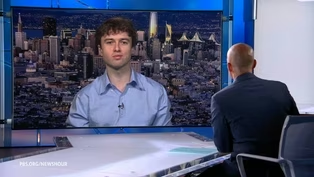
AI researcher Jacob Coxon warns what may lie ahead
Video has Closed Captions
As AI behavior raises concerns, ex-researcher Jacob Coxon warns what may lie ahead (10m 12s)
Congress approves sweeping new sanctions on Russia
Video has Closed Captions
Congress passes new sanctions on Russia and countries using Russian energy (5m 24s)
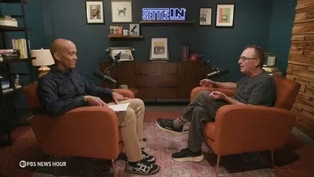
Jon Ronson joins Geoff Bennett on 'Settle In'
Video has Closed Captions
Jon Ronson and Geoff Bennett discuss modern masculinity on 'Settle In' (7m 8s)
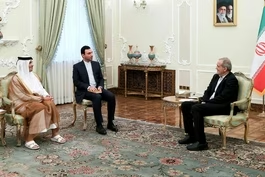
Qatari spokesman on regional war and path to U.S.-Iran talks
Video has Closed Captions
Qatari spokesman on regional war and the path back to U.S.-Iran talks (7m 47s)
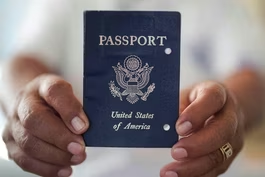
Trump's crackdown makes it harder to become U.S. citizen
Video has Closed Captions
How Trump's immigration crackdown made it harder to become U.S. citizen (6m 28s)
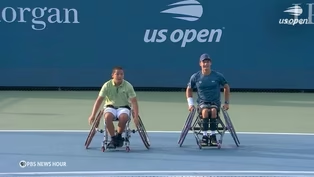
Wheelchair tennis celebrates 50 years and a new popularity
Video has Closed Captions
Wheelchair tennis celebrates 50 years and a new wave of popularity (8m 22s)
Providing Support for PBS.org
Learn Moreabout PBS online sponsorship New Episode
- News and Public Affairs

Today's top journalists discuss Washington's current political events and public affairs.
 New Episode
- News and Public Affairs

FRONTLINE is investigative journalism that questions, explains and changes our world.


 New Episode


 New Episode
 New Episode

 New Episode
 New Episode
Support for PBS provided by:
Major corporate funding for the PBS News Hour is provided by BDO, BNSF, Consumer Cellular, American Cruise Lines, and Raymond James. Funding for the PBS NewsHour Weekend is provided by...