
Why private credit is creating concerns among economists
Clip: 12/11/2025 | 7m 43sVideo has Closed Captions
Why private credit is creating major concerns among economists
Investors and economists are warning about a piece of the financial system that could pose a risk that is potentially similar in ways to the housing crash that preceded the financial crisis in 2008. It’s part of what's been called the shadow banking system: the private credit market, an alternative type of lending to companies that doesn't involve traditional banks. Paul Solman explains.
Problems playing video? | Closed Captioning Feedback
Problems playing video? | Closed Captioning Feedback
Major corporate funding for the PBS News Hour is provided by BDO, BNSF, Consumer Cellular, American Cruise Lines, and Raymond James. Funding for the PBS NewsHour Weekend is provided by...
Why private credit is creating concerns among economists
Clip: 12/11/2025 | 7m 43sVideo has Closed Captions
Investors and economists are warning about a piece of the financial system that could pose a risk that is potentially similar in ways to the housing crash that preceded the financial crisis in 2008. It’s part of what's been called the shadow banking system: the private credit market, an alternative type of lending to companies that doesn't involve traditional banks. Paul Solman explains.
Problems playing video? | Closed Captioning Feedback
How to Watch PBS News Hour
PBS News Hour is available to stream on pbs.org and the free PBS App, available on iPhone, Apple TV, Android TV, Android smartphones, Amazon Fire TV, Amazon Fire Tablet, Roku, Samsung Smart TV, and Vizio.
Providing Support for PBS.org
Learn Moreabout PBS online sponsorshipAMNA NAWAZ: Lately, investors and# economists are warning about a piece## of the financial system that could pose a risk,## potentially similar in ways to the housing crash# that preceded the financial crisis in 2008.
It's part of what's been called the shadow# banking system, the private credit market,## an alternative type of lending to companies# that doesn't involve traditional banks.
We asked economics correspondent Paul Solman# to explain how it works, what's at stake,## and why alarm bells are sounding in some quarters.
PAUL SOLMAN: Bought an aftermarket car part in## recent years?
Good chance# it came from First Brands.
JOHN BASQUILL, Senior Reporter, Global# Trade Review: First Brands was a large## supplier of auto parts, things# like wiper blades, spark plugs.
PAUL SOLMAN: Over a decade the# company borrowed heavily to grow,## gobbling up 20 companies employing# 25,000 people, until this fall, that is.
JOHN BASQUILL: The lenders had become a# bit concerned about some of the financial## goings-on at the company and requested some extra# information which First Brands couldn't provide.
PAUL SOLMAN: What happened?
Went bust.# And who were its lenders?
Many came## from the world of private credit, a# part of the global financial system## that's exploded in recent years and has# some key players in finance rattled.
JAMIE DIMON, Chairman, J.P.
Morgan Chase: I should# probably shouldn't say this, but when you see one## cockroach, there's probably more.
And so we should# -- everyone should be forewarned on this one.
PAUL SOLMAN: One such roach, First Brands.
JEFFREY GUNDLACH, CEO, DoubleLine Capital: I# have been saying this for probably two years now,## that the next big crisis in the financial# markets is going to be private credit.
PAUL SOLMAN: OK, but what# exactly is private credit?
MARK ZANDI, Chief Economist, Moody's Analytics:# Private credit is just lending by nonbanks,## financial institutions like pension funds,# insurance companies, sovereign wealth funds,## but not going through the banking# system, thus the word private.
It's grown very rapidly.
It's now a# sizable player in the financial system.
PAUL SOLMAN: Growing from a $40 billion market# in the year 2000 to nearly $2 trillion today.
NATASHA SARIN, President, Budget Lab at Yale# University: The reason for that growth is that,## after the Great Recession, regulators realized# that large financial institutions had been## really exposed to making relatively# risky bets without having enough of## a backstop internally in the form# of capital that they held that was## available for the bank to draw down on# in case some of those bets went sour.
And so the result of the aftermath# of the crisis and the post-crisis## regulation in Dodd-Frank was to say that,# in order to take those types of risks,## it would be more expensive# for banks going forward.
PAUL SOLMAN: As a result, most banks# pulled back from riskier lending.
NATASHA SARIN: And private credit# stood ready, in some sense, to take## advantage and meet the need of the market# to be able to make those types of loans.
PAUL SOLMAN: For investors, returns on# those loans were, well, mouthwatering,## nearly double the rate of government bonds# or other loans.
So what's the problem?
MARK ZANDI: One of the issues with private credit# is, the lack of transparency is very opaque.
It's## not like the banking system, where it's highly# regulated and exactly what's going on.
Here,## we don't know very much because it is private.
And# so that makes it a little bit more disconcerting.
PAUL SOLMAN: For example, private credit firms can# report the value of their loans according to their## own internal models, rather than the market price,# marking to model instead of marking to market.## Problem is, it's nearly impossible to verify that# the loans are worth what they're claimed to be.
MARK ZANDI: Most times, no big deal.
That's# probably just fine.
But when you get into## kind of a risk-off environment,# when things are moving quickly,## prices are falling rapidly, that's when# mark to model becomes more of an issue.
PAUL SOLMAN: A loan mark to model could# even become a loan marked to zilch.
So how serious is the risk posed by private# credit to the American economy as a whole?
MARK ZANDI: It's consequential, but# it's still on the small side.
And I## don't think it's at a place# yet where it could do us in.
NATASHA SARIN: In some sense, it's a yarn# that you start to pull and you're worried## that it's both potentially unraveling, but# also that it's potentially connected to all## the other parts of the financial system.
And# the system is still very much reliant on all## of these different pieces in a way that# regulators don't yet fully appreciate.## And I worry none of us fully appreciate the# possibility of cascading downturn risk as well.
MARC ROWAN, CEO, Apollo Global# Management: Most of the market## is investment grade.
Credit stats are# actually improvi.. PAUL SOLMAN: Look, says Marc Rowan, CEO of# private credit giant Apollo Global Management: MARC ROWAN: There are good banks# and bad banks and good insurance## companies and bad insurance companies# and good asset managers and bad asset## managers.
But there's nothing# that I see that is systemic.
PAUL SOLMAN: Systemic risk,# that's the danger, which starts## with risk to, well, viewers like you.
TOM GOBER, Insurance Fraud Examiner: A## very large percent of the population is# affected by this higher risk without knowing.
PAUL SOLMAN: Insurance fraud examiner Tom Gober.
TOM GOBER: I look after policyholders and# annuitants.
If you have a life insurance## policy or an annuity, I'm trying to# help that you know you're going to## be safe.
But now there's a lot of# pensioners who are also counting## on the same insurance companies# that are taking all these risks.
PAUL SOLMAN: And suppose insurance policy# and annuity holders get skittish and start## withdrawing their, or, I should say, our money,## the money that backs up the private# credit loans, putting them in jeopardy?
In fact, recent headlines have featured# bankruptcies of firms financed largely by## private credit, Renovo, Tricolor and, where# the story began, First Brands.
A cockroach## operating in the dark accused of engaging# in blatant sleight of hand accounting.
JOHN BASQUILL: The company or group companies# would make a sale, generate an invoice,## and then sell that invoice or the sort of debt# that generates to a third-party investor.
And## there were huge, multibillion-dollar investments# in invoices that First Brands was generating.
PAUL SOLMAN: Those billions came# in large part from private credit,## that is, private loans backed# by invoices.
Unfortunately,## the head of First Brands was allegedly faking# those invoices and selling them more than once.
And, worse still: JOHN BASQUILL: We're talking about a company# that's now being accused.. billions of dollars to fund its founder# and CEO's personal extravagant lifestyle.
PAUL SOLMAN: That's why the new CEO of the# company is suing his predecessor for malfeasance,## while a spokesman for the old CEO says# he -- quote -- "categorically denies## the baseless and speculative allegations# contained in the First Brands complaint."
But the point is, First Brands, financed# in the so-called shadow banking industry,## was operating in the shadows, which leads to# the question of the day regarding the private## credit industry.
Were First Brands and its# fellow private credit failures anomalies or## an early harbinger of risks not unlike those# that triggered the financial crisis of 2008?
For the "PBS News Hour," Paul Solman.
A Brief But Spectacular take on why schools matter
Video has Closed Captions
Clip: 12/11/2025 | 3m 30s | A principal's Brief But Spectacular take on bringing hospitality to education (3m 30s)
How the Tate brothers became connected with the Trump family
Video has Closed Captions
Clip: 12/11/2025 | 7m 43s | Investigation delves into the Tate brothers and their connection to the Trump family (7m 43s)

A look at some of the best video games of 2025
Video has Closed Captions
Clip: 12/11/2025 | 9m 7s | A look at some of the best video games of 2025 (9m 7s)
News Wrap: Indiana GOP rejects redrawing electoral maps
Video has Closed Captions
Clip: 12/11/2025 | 6m 57s | News Wrap: Indiana GOP votes down effort to redraw electoral maps in rare Trump rebuke (6m 57s)
Senate rejects plans to address rising health care premiums
Video has Closed Captions
Clip: 12/11/2025 | 6m 43s | Senate rejects plans to address sharp rise in health care premiums (6m 43s)
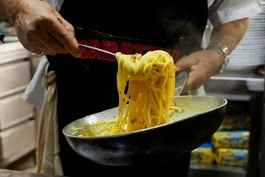
Trump's tariffs could double price of imported Italian pasta
Video has Closed Captions
Clip: 12/11/2025 | 5m 57s | Trump's tariffs raise costs for stores and restaurants that import Italian pasta (5m 57s)

Ukraine pushes for security guarantees as pressure grows
Video has Closed Captions
Clip: 12/11/2025 | 4m 39s | Ukraine pushes for security guarantees against Russia as pressure grows on peace plan (4m 39s)
Providing Support for PBS.org
Learn Moreabout PBS online sponsorship
- News and Public Affairs

FRONTLINE is investigative journalism that questions, explains and changes our world.
- News and Public Affairs

Amanpour and Company features conversations with leaders and decision makers.




Support for PBS provided by:
Major corporate funding for the PBS News Hour is provided by BDO, BNSF, Consumer Cellular, American Cruise Lines, and Raymond James. Funding for the PBS NewsHour Weekend is provided by...